



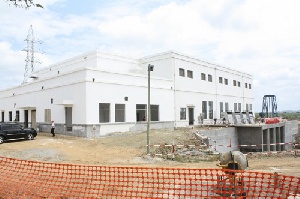
 Teshie-Nungua Desalination Plant
The 25-year Build-Own-Operate-Transfer (BOOT) water deal for the Teshie-Nungua Desalination Plant - in which NDC stalwart Augustus Goosie Tanoh acted as Legal Advisor and Consultant to Spanish firm Befesa and fronted the project at its signing, has now cost Ghana US$235 million in judgement debt.
An International Chamber of Commerce (ICC) tribunal on September 17, 2026, in two final awards, ordered Ghana Water Limited (GWCL) to pay US$235 million to Cox Infrastructure Group, the Spanish group that holds 95% of project company Befesa Desalination Developments Ghana Limited (BDDG).
Cox announced on September 21 that the award, net of taxes, is for termination payments under the Water Purchase Agreement (WPA) under which GWCL was contractually bound to buy treated seawater.
The sum attracts interest from April 1, 2026, until paid.
The tribunal also dismissed substantially all of Ghana Water's counterclaims, including a US$144.5 million claim, and ordered GWCL to reimburse part of Befesa's legal costs. Under the state guarantee attached to the WPA, the Republic of Ghana is jointly liable, though the investor cannot recover twice.
The Goosie Tanoh role
The plant, designed to produce 60,000 cubic metres of water per day to serve Teshie, Nungua, La, Tema and Burma Camp, was announced as a US$110 million project between GWCL and Befesa Agua of Spain.
At the signing in Accra, during the first era of the Mahama Presidency, Mr. Goosie Tanoh was introduced as Legal Advisor and Consultant to Befesa and spoke on behalf of the company, according to the GNA report published by BusinessGhana in 2012.
He explained that Teshie and Nungua were selected because they were at the tail end of the distribution network and suffered perennial shortages, and disclosed that Befesa would invest US$500,000 in a dedicated bulk power line to be owned and maintained by the Electricity Company of Ghana and finance a 1.5km pipeline to link the plant to the GWCL grid, with first water expected by August 2012.
The WPA was signed in December 2012 under President John Mahama, ratified by Parliament, and the cost, which later became US$126 million plant entered commercial operation in February 2015 under the same NDC administration.
Why a $126m plant became a $235m debt
The reverse-osmosis plant quickly became a financial albatross.
Under the take-or-pay terms, GWCL was required to pay a capacity charge of about US$1.4 million per month whether the plant worked or not, plus an average electricity bill of GH¢3 million per month.
The tariff structure collapsed the utility's finances: GWCL bought water at US$1.50 per cubic metre but was permitted by PURC to sell at only about US$0.59 per cubic metre, losing an estimated US$1.42 million every month. Public sector unions described the contract as an albatross around GWCL's neck.
After repeated shutdowns over cost and technical issues, the plant has been idle since October 2025, cutting supply to Teshie, Nungua, Spintex, Sakumono and La and forcing residents onto tankers.
In February 2026, President Mahama directed the Finance Minister, Attorney-General and Ghana Water to negotiate a settlement to resume operations, but talks failed before the ICC issued its final awards.
At US$235 million - nearly twice its construction cost - plus interest and legal costs, the award is now one of the biggest utility-related judgement debts in Ghana's water sector.

Copyright © 1994 - 2026 GhanaWeb. All rights reserved.










