



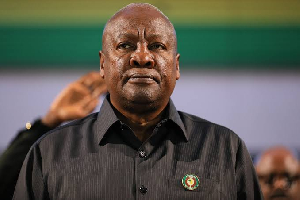
 John Dramani Mahama is the President of Ghana
When President John Dramani Mahama dissolved the governing boards of nine state institutions on September 2, 2026, the decision came suddenly and with immediate effect.
The institutions were not minor agencies. They included the Ghana National Petroleum Corporation (GNPC), Bulk Oil Storage and Transportation Company (BOST), Volta Aluminium Company (VALCO), Consolidated Bank Ghana (CBG), Ghana Post, TDC Ghana, Prestea Sankofa Gold, the Road Maintenance Trust Fund and the National Sports Authority (NSA).
The Presidency directed the relevant sector ministers to take the necessary steps to implement the dissolution and said new boards would be constituted “in due course.”
But there was one obvious omission: no specific reason was publicly given for the decision.
That omission mattered.
These boards oversee institutions operating in some of the most important areas of the national economy — petroleum, fuel storage, banking, aluminium production, sports, real estate, postal services, mining and road infrastructure.
When nine boards are dissolved at once, people will naturally ask what happened.
Was it a performance issue? A governance problem? A disagreement with government policy? Concerns about particular decisions? Or was the administration simply seeking a change in leadership?
At the time, the public was essentially left to wait.
There was also an important institutional background.
When President Mahama assumed office on January 7, 2025, the transition process affected a number of boards appointed by the previous administration under the Presidential (Transition) Act, 2012 (Act 845). The September 2026 decision was different. It was a fresh intervention by an administration already well into its tenure.
That distinction is important.
This was not simply the immediate consequence of a change of government. It was a deliberate decision to remove nine sitting boards more than a year and a half into the Mahama administration.
Then came the question of performance.
The decision was announced at a time when state-owned enterprises were already under scrutiny, including through assessments of their performance by the State Interests and Governance Authority (SIGA).
But the government’s September 2 announcement did not identify a particular performance failure by any of the nine institutions. Nor did it identify any particular board member whose conduct had prompted the decision.
That left a significant gap in the public record.
Government has the authority, subject to the applicable laws, to reorganise public institutions and change governing boards. But the exercise of that authority does not remove the government’s responsibility to explain major public decisions.
Until recently, the reason remained unclear.
Now there is a new piece of information.
Government Communications Minister Felix Kwakye Ofosu, speaking on JoyNews’ PM Express, has said President Mahama dissolved the boards because of “conduct deemed inappropriate.”
That explanation changes the conversation.
If inappropriate conduct was the basis for dissolving nine boards, then the obvious question is: what conduct?
Was it the conduct of individual board members or the collective conduct of particular boards?
Did it involve procurement? Financial decisions? Appointments? Conflicts of interest? Interference in management? Failure to comply with government directives? Or something else?
The phrase “conduct deemed inappropriate” is broad. It tells the public that government considered certain conduct unacceptable, but it does not identify the conduct itself.
That is where the government now owes the public greater clarity.
This is not an argument that every board member who served on those boards did something wrong. A board can be dissolved without every individual member being accused of misconduct. Nor should the dissolution itself be treated as proof of wrongdoing.
But if specific conduct triggered the government’s decision, the public should be told what that conduct was, subject of course to any legitimate legal or investigative restrictions.
There is another development worth watching.
On October 1, Yaw Ampofo Ankrah was relieved of his position as Director-General of the National Sports Authority, almost a month after the NSA governing board had been dissolved. Professor Emmanuel Osei Sarpong was subsequently expected to take up an acting leadership role.
The development raises a broader question: was the September board dissolution the beginning of a wider institutional reset?
If it was, government should explain the policy behind it.
If the administration is reviewing the leadership and governance arrangements of state institutions, that is a legitimate matter of public policy. But the public should be able to distinguish between an administrative decision, a policy disagreement, poor performance and alleged misconduct.
Those are not the same thing.
And that brings us back to the chronology.
January 7, 2025: President Mahama assumed office and the transition process affected boards appointed under the previous administration.
September 2, 2026: President Mahama dissolved the governing boards of nine state institutions, including GNPC, BOST, VALCO, CBG, Ghana Post and the NSA. The Presidency announced the decision without providing specific reasons.
September 2026: The decision triggered questions about the performance and governance of the affected institutions, particularly against the wider scrutiny of state-owned enterprises.
September–October 2026: The institutions continued their operations through their management structures while new governing boards were awaited.
October 1, 2026: NSA Director-General Yaw Ampofo Ankrah was relieved of his position, with Professor Emmanuel Osei Sarpong expected to assume an acting role.
October 2, 2026: Government Communications Minister Felix Kwakye Ofosu provided the clearest explanation yet, saying the boards were dissolved because of “conduct deemed inappropriate.”
That last explanation deserves more than a headline.
It deserves facts.
If there were specific governance failures, identify them. If particular decisions were problematic, explain what they were. If individual conduct was involved, distinguish those individuals from the wider boards. If the decision was part of a broader administrative or policy reform, explain the reform.
That is how public accountability should work.
The issue is not whether a President can change governing boards. The issue is whether citizens should be expected to accept the removal of nine boards from important public institutions without knowing the factual basis for such an extraordinary decision.
The answer should be clear.
A government that demands accountability from public institutions must also be prepared to explain its own decisions affecting those institutions.
Transparency cannot begin and end with the people being supervised. It must apply to the supervisor as well.
So, after the latest explanation from the Communications Minister, the central question remains remarkably simple:
What exactly did they do?

Copyright © 1994 - 2026 GhanaWeb. All rights reserved.










