



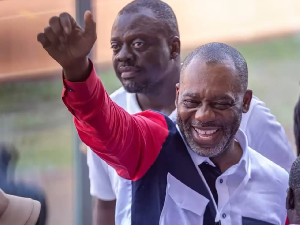
 Dr Mathew Opoku Prempeh is 2024 NPP Running Mate and former Energy Minister
How a bruising 2024 defeat, a united Kumasi conference and one man’s standing ovation are reshaping the NPP’s political conversation
For a party that went through the political equivalent of a heavy knockdown in the 2024 general elections, the atmosphere surrounding the New Patriotic Party’s (NPP) recently concluded National Delegates Conference in Kumasi offered a remarkably different picture.
The smiles were back. The cheers were louder. Delegates appeared more relaxed, and, perhaps most importantly, the party presented an image of relative unity that many observers believe could be the beginning of a difficult but necessary journey back into the political consciousness of Ghanaians.
But amid the speeches, elections, handshakes and celebrations, one name appeared to be repeatedly finding its way into conversations among delegates, political commentators and party sympathisers — Dr Matthew Opoku Prempeh, popularly known as NAPO.
And if the reactions on social media, radio and television call-in programmes are anything to go by, the former Education and Energy Minister may have emerged from the Kumasi conference with something that cannot be won through a ballot box: a renewed reservoir of affection among the party base.
Indeed, one female NPP supporter, decked out in the party’s colours, captured the mood in a passionate video message after the conference.
‘Tell him we love him’
Recounting her experience at the conference, the woman said NAPO’s arrival triggered an immediate and spontaneous reaction from delegates.
“The moment he entered our stance, we all gave him a rousing standing ovation signalling our love for him.”
She went further, insisting that NAPO’s appeal within the party goes beyond the traditional political calculations.
“In fact, the whole youth in our party have fallen flat for him.”
Then came perhaps the most memorable part of her message.
“For those who are close to him, when you meet him, tell him we love him — Bawumia-NAPO, Obiaaa Nsa Womu.”
That declaration, although coming from an individual supporter, appears to capture a wider sentiment that has been gaining traction within sections of the NPP following the Kumasi conference.
It is a sentiment built around loyalty, affection, political influence and, increasingly, the perception that NAPO remains an important bridge between Dr Mahamudu Bawumia and the grassroots of the NPP.
Then came Gideon Annor’s political ‘X-ray’
While the enthusiastic supporter provided the emotional dimension, political commentator Gideon Kwasi Annor provided what could be described as the analytical version of the same argument.
In a Facebook post, Annor offered a striking assessment of NAPO’s role in the internal contest.
“The moment I heard about all that NAPO was doing in the Ashanti Region for John Boadu, I told my people that it was over for Boakye Agyarko,” he wrote.
Annor said he was also aware of NAPO’s influence among some NPP MPs in the Eastern Region and therefore believed Boakye Agyarko would struggle to command the total support of his own home region.
But Annor’s most significant observation was not about a particular candidate.
It was about NAPO himself.
“This election has demonstrated just how influential NAPO is and how deeply loyal he remains to Dr Bawumia’s cause,” Annor stated.
He argued that the Agyarko campaign failed to adequately address what he described as serious gaps and concluded that the former presidential aspirant was ultimately let down by both himself and his team.
But Annor’s strongest conclusion was reserved for NAPO’s influence.
“I am sad about the outcome, but equally pleased to have witnessed, firsthand, the extent of NAPO’s influence and the role he played in shaping this contest.”
And then came the line that has potentially given the entire conversation a new political vocabulary:
“His contribution to the outcome simply cannot be discounted.”
The ‘NAPO Touch’
Annor’s assessment is strikingly similar to another analysis authored by Appiah Brenya Francis, Research Officer at the Bekwai Constituency, who has gone a step further by describing the phenomenon as “The NAPO Touch: The Kingmaker Within the NPP.”
According to Francis, NAPO is increasingly regarded within the NPP as more than merely a political heavyweight.
He describes him as “a trusted voice whose endorsement carries real weight among the grassroots.”
Francis points to NAPO’s support for a number of personalities within the party, including Odeneho Kwaku Appiah (COKA), John Boadu, Justin Frimpong Kodua, Nana B, Kwadwo Bamba, Nana Akomea and Hawa Koomson, arguing that candidates associated with his support have enjoyed strong electoral outcomes.
For Francis, the explanation is relatively straightforward.
“NAPO’s strength lies in his connection with the party base.”
He argues that delegates and supporters perceive NAPO as a leader who understands their concerns and possesses the ability to mobilise and unite the party behind a common cause.
That, he believes, has transformed NAPO’s political endorsement into something considerably more valuable than a mere public declaration of support.
From running mate to grassroots phenomenon?
NAPO’s political relevance is particularly interesting because of the position he occupied on the 2024 presidential ticket.
As Dr Mahamudu Bawumia’s running mate, he became an important component of the campaign that sought to lead the NPP into government.
The ticket, however, suffered the party’s worst presidential defeat in decades.
Yet, barely two years later, the political narrative surrounding NAPO appears to have taken a different turn.
Rather than being defined solely by the 2024 defeat, his name is increasingly being associated with party mobilisation, loyalty to Bawumia and influence over the grassroots.
The Kumasi conference appears to have amplified that perception.
The remarkable Kumasi effect
The significance of the recently held national elections cannot simply be reduced to who won which position.
The bigger political story may be the picture the NPP presented to the country.
After months and years of internal recriminations following the 2024 defeat, the party managed, at least during the conference, to project a more united front.
For a political party seeking to rebuild its electoral fortunes, that matters.
And it may explain why some Ghanaians who watched the proceedings, particularly through television, radio and social media, appeared to react differently to the NPP than they did in the immediate aftermath of the 2024 elections.
The party looked organised.
The delegates looked energised.
And the political temperature appeared significantly calmer.
Within that atmosphere, NAPO’s reception became difficult to miss.
‘The whole youth have fallen flat for him’
Perhaps the most fascinating aspect of the emerging NAPO narrative is not simply that party delegates respect him.
It is the emotional language being used to describe their relationship with him.
“Tell him we love him.”
“The whole youth have fallen flat for him.”
“Obiaaa Nsa Womu.”
These are not the conventional phrases of political endorsement.
They are the language of political affection.
And that distinction may matter enormously in internal party politics, where influence is not always determined by formal position.
A politician may hold office and still struggle to move delegates.
Another may hold no elected national party position and yet possess the ability to make people listen, rally and vote.
This is where the description of NAPO as a “kingmaker” becomes particularly intriguing.
So, is NAPO really a kingmaker?
Of course, political influence is difficult to measure scientifically from applause, social media comments or individual testimonials alone.
But the growing chorus around NAPO suggests that something significant is happening.
Annor says he witnessed the extent of NAPO’s influence firsthand.
Francis describes him as a trusted grassroots voice and brands his political impact the “NAPO Touch.”
And an enthusiastic female delegate is essentially sending a message through the party’s political grapevine:
“Tell him we love him.”
Put together, the three accounts tell a remarkably consistent story.
NAPO appears to have cultivated a political network that cuts across geographical boundaries, party structures and sections of the grassroots.
And his association with Dr Bawumia remains central to that network.
The Bawumia-NAPO equation
There is also a bigger political calculation here.
If NAPO’s influence within the NPP is as substantial as these accounts suggest, then his relationship with Dr Bawumia could become increasingly important as the party navigates its post-2024 reconstruction and looks ahead to the next presidential cycle.
Annor’s description of NAPO as “deeply loyal” to Dr Bawumia’s cause is therefore not an insignificant observation.
It suggests that the NAPO factor could become part of the broader political equation surrounding Bawumia and the NPP’s future.
For now, however, NAPO appears content to occupy the space he has always occupied among the delegates, among the party faithful and, apparently, increasingly in their conversations.
The elephant may have found its ‘touch’
The NPP’s elephant has survived its political bruising and is now attempting to stand on its feet again.
The Kumasi conference may have provided the party with its first major opportunity to show Ghanaians a more united and confident face since the 2024 defeat.
But in the middle of that political reconstruction, another narrative has emerged.
The NAPO Touch.
Whether it is political strategy, personal loyalty, grassroots affection or simply the natural charisma of a politician who knows how to connect with his people, the phenomenon is becoming increasingly difficult to ignore.
And perhaps the most revealing political verdict came not from a strategist or a pollster, but from a woman sitting in an NPP-coloured vehicle, speaking directly to the man himself through the camera:
“For those who are close to him, when you meet him, tell him we love him.”
Then, the punchline:
“Bawumia-NAPO — Obiaaa Nsa Womu!”
For a party rebuilding after a bruising defeat, that may be more than a slogan.
It could be the beginning of a new political story.

Copyright © 1994 - 2026 GhanaWeb. All rights reserved.










