



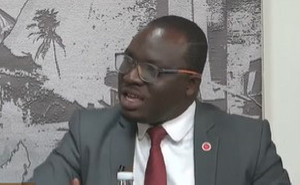
 Dr Elvis Banoemuleng Botah is International Affairs & Security Analyst
Ghana's decision to pursue closer engagement with BRICS presents an opportunity to reconsider our place in the changing global economic and geopolitical order. While expanding our international partnerships is not inherently problematic, we must be careful not to mistake diplomatic expansion for economic transformation.
My fundamental concern is that joining BRICS, whether as a partner country or eventually as a full member, does not, in itself, resolve Ghana's longstanding economic challenges. The structural weaknesses of our economy will remain unless we deliberately address them.
Indeed, joining BRICS at this time adds little to Ghana if we have no clear strategy for leveraging that relationship to transform our productive capacity. We may succeed in diversifying our geopolitical partnerships, but diversification alone does not guarantee industrial development, economic independence or improved living standards.
Understanding the limitations of partner-country status
The distinction between joining BRICS as a partner country and becoming a full member is significant. It concerns the depth of institutional participation and the extent of decision-making authority.
As a partner country, Ghana would have opportunities to participate in selected meetings, consultations and initiatives. However, our participation would be more limited than that of full members, particularly in determining the direction and priorities of the grouping.
We must therefore be realistic about what partner-country status offers. It should not be presented as automatic access to the full range of economic, financial or institutional opportunities associated with BRICS.
The government must clearly explain the specific benefits Ghana intends to pursue under this arrangement and the mechanisms through which those benefits will be realised.
The danger of reproducing unequal economic relationships
The reality is that joining BRICS does not automatically change the existing core-periphery relationships between industrialised economies and countries such as Ghana.
We are entering a grouping involving economies such as China, India, Brazil, Russia and South Africa, which possess considerably stronger industrial and productive capacities.
Ghana, by comparison, continues to depend heavily on the export of primary commodities, including cocoa, gold and other mineral resources, while importing a substantial range of manufactured products.
Without a deliberate industrial strategy, we risk entering this relationship from a structurally disadvantaged position.
We could simply expand our geopolitical partnerships while opening our economy to further exploitation of our primary commodities. Stronger economies could continue processing our resources, producing higher-value goods and selling those products back to our domestic market.
Under such circumstances, Ghana would have gained additional partners without fundamentally changing its position within international production and trade.
This is the danger we must avoid.
We must not become merely another market
An important consideration is the growing capacity of foreign businesses to compete within our domestic market.
For years, many Ghanaian traders travelled to China to purchase goods at competitive prices for resale in Ghana. Today, the increasing presence of Chinese-operated retail outlets illustrates how foreign businesses can also participate directly in the domestic distribution and retail markets previously served by local traders.
This development should prompt a broader examination of how our international economic partnerships affect Ghanaian businesses and their ability to compete.
If we enter BRICS without strengthening local manufacturing, protecting legitimate domestic economic interests and developing our capacity for value addition, we risk becoming primarily a market for products manufactured elsewhere.
Our objective must be to move beyond consuming what others produce and build the capacity to produce competitively ourselves.
Ghana needs a clear industrial and negotiating strategy
The most important question the government must answer is simple: What exactly are we taking to the BRICS negotiating table?
What is our negotiating strategy? What are our major points of negotiation? And what specific economic outcomes do we expect to achieve?
These questions must be answered before we can meaningfully assess the value of Ghana's proposed participation.
Our engagement with BRICS should be anchored in a clear, achievable and measurable industrial development strategy.
We must identify how partnerships with these economies will help us process cocoa, gold and other natural resources domestically, develop manufacturing industries, secure appropriate technology transfer and obtain financing on terms that support our long-term development.
We must also establish specific targets for the next five and ten years.
How many industries do we expect to establish or expand? What level of local processing are we targeting? What technologies do we intend to acquire? How many sustainable jobs should these partnerships create?
Without measurable objectives, we will struggle to determine whether our engagement with BRICS has delivered meaningful benefits to the Ghanaian economy.
Economic transformation must begin at home
Ghana's fundamental challenge is not necessarily the absence of international partnerships. We already maintain extensive relationships with both traditional Western economies and emerging economic powers.
Our challenge has been our limited ability to translate many of these relationships into sustained industrialisation, local value addition and economic transformation.
Joining BRICS will not automatically alter that reality.
We need domestic economic policies that prioritise productive investment, strengthen local industries, develop our technological capabilities and improve the competitiveness of Ghanaian businesses.
We must also ensure that any international financing we pursue supports these objectives rather than merely creating additional financial obligations.
A country that does not adequately define and defend its economic interests risks being disadvantaged irrespective of the international grouping to which it belongs.
Conclusion
I am not opposed to Ghana expanding its international partnerships. There is value in maintaining diverse relationships in an increasingly multipolar world.
My concern is the possibility of pursuing another diplomatic ambition without the necessary economic preparation to make it worthwhile.
BRICS must not become an end in itself. It should be considered a potential instrument for achieving clearly defined national development objectives.
If the government proceeds, it must do so with an industrial strategy, measurable targets, a strong negotiating position and a commitment to ensuring that Ghana obtains tangible benefits from the relationship.
Otherwise, we risk expanding our geopolitical partnerships while remaining trapped in the same unequal economic relationships that have constrained our development for decades.
Ghana does not merely need more economic partners. We need the domestic capacity and strategy to benefit meaningfully from the partnerships we already have and those we intend to pursue.
Dr Elvis Banoemuleng Botah
International Affairs & Security Analyst

Copyright © 1994 - 2026 GhanaWeb. All rights reserved.










