



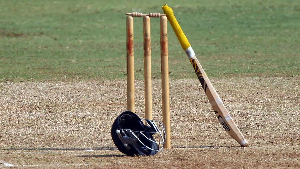
 Ghana's cricket has suffered a decline in the last eight years
A sport at a crossroads
Ghana cricket has known periods of promise, progress and international ambition. From the eras associated with Ras Bhingi and Vanderpuye Orgle to the presidency of Prof William Ampofo, the sport-built foundations that gave players and administrators reason to believe in a stronger future.
Yet, as the Ghana Cricket Association (GCA) approaches its October 24, 2026 election, serious questions remain about whether that progress has been sustained, or allowed to slip away.
Emmanuel Kwame Owusu-Ansah Asare became GCA president in July 2018 after serving as vice-president under Prof. Ampofo. Eight years on, the central question is straightforward: what has the administration delivered, what has it failed to achieve, and what should delegates consider before deciding who leads Ghana cricket next?
This is not merely a contest for positions. It is a decision about the future of national teams, the development of young players, the sustainability of domestic competitions and the credibility of the sport’s governance. The record deserves a clear-eyed assessment, with achievements acknowledged and shortcomings examined against evidence.
When Ghana’s teams offered hope
Under Prof. Ampofo, who led the association from 2010 to 2018, Ghana’s youth teams and regional development programmes offered encouraging signs.
The national Under-19 team advanced through Africa’s Division Two pathway and reached Division One World Cup qualifying level after its performance in Benoni, South Africa, in 2016.
Rexford Bakum was among the players whose individual performances stood out. Ghana did not qualify for the 2018 Under-19 World Cup in New Zealand, but the campaign demonstrated the potential of a structured development pathway.
Development activities were also conducted in cricket-playing regions, including Volta, Eastern, Greater Accra, Ashanti and Central. The question now is whether those foundations have been expanded and sustained.
Ghana’s Under-19 side managed only two wins in the Division Two qualifiers held in Kigali in August, according to the record cited for this article. That result should prompt an honest review of coaching, preparation, player pathways and the quality and frequency of competitive opportunities.
The women’s game tells a similarly troubling story. Ghana assembled a women’s team for the North West African Cricket Council (NWACC) tournament in The Gambia in 2015, finishing third. At the second NWACC women’s tournament, hosted at Achimota Oval in Accra in January 2018, Ghana finished runner-up.
Felicia Serwaa was a standout performer, earning Best Batter, Best Fielder and Most Valuable Player honors after a campaign in which Ghana recorded wins over The Gambia and Sierra Leone but lost to Nigeria.
Ghana returned to regional women’s competition in 2022, when the team, coached by Obed Harvey and assistant coach Williams Kanchoba, defeated The Gambia but lost to Rwanda, Sierra Leone and hosts Nigeria. Serwaa earned a place in the tournament’s Best XI. Ghana then lost all its matches in the 2023 edition.
In the latest tournament referenced by the author, the team faced Nigeria, Rwanda, Zimbabwe Under-19 and South Africa Under-19 and suffered defeats. The account also states that the Nigeria Cricket Federation arranged the team’s flight to Lagos, while the players returned to Ghana by road amid funding difficulties.
Ghana’s Under-19 women also lost all their matches at a tournament hosted by Nigeria’s Under-19 women’s team in September 2024. Domestic league activity has been inconsistent, while one-day Pink Day Bash events have not, on their own, translated into the sustained improvement required at international level.
The article’s source material states that Ghana’s senior women’s team is currently unranked. That position should be a wake-up call: talent cannot develop in isolation, and occasional tournaments cannot replace a consistent programme of coaching, domestic competition and international exposure.
The men’s ranking tells its own story
Ghana’s men once stood considerably higher in the international T20 rankings. When the International Cricket Council (ICC) introduced global T20I rankings for associate members in May 2019, Ghana was ranked 28th in the world and fourth in Africa, according to the figures cited in this article.
In March 2017, captain Peter Ananya led Ghana to gold in Africa Division One, securing qualification for the World Cricket League Division Five tournament.
Simon Ateak led the way in runs, while Frank Baaleri topped the dismissal statistics. Ghana also recorded important victories over hosts Nigeria in the 2018 ICC Men’s T20 World Cup Sub-Regional Qualifier and the ACA T20 Cup.
The current picture is less encouraging. The figures provided for this article place Ghana 70th in the world and 12th in Africa, down from 64th globally and ninth in Africa before the March 2024 African Games.
Eswatini, whom Ghana defeated in the March qualifiers, is listed at 68th in the world and 11th in Africa. Ghana did, however, earn a place in the ICC Men’s T20 World Cup Africa Final Qualifier after beating Malawi on the final ball; a milestone last achieved in 2018 in Lagos.
That qualification is worth recognizing. But one dramatic win cannot, by itself, answer the larger questions raised by the rankings. Ghana needs a sustainable plan that turns isolated successes into consistent progress.
The association should explain how it intends to rebuild performance, retain experienced players, develop emerging talent and make domestic cricket a reliable pipeline to the national team.
Selection, integrity and the need for answers
Questions have also been raised about national-team selection and the use of players based outside Ghana. The author’s material states that six expatriate players were included in a recent national-team squad, including Nitesh Lakhara and Jayant Gautam, who were alleged not to be resident in Ghana.
It further states that several players associated with Alpha Cricket Club, following their Division One league success, were left out. Those selection decisions should be explained transparently, including the eligibility criteria applied and the technical rationale for the final squad.
The article also refers to an ICC investigation involving two Ghana national-team players over alleged spot-fixing during the West Africa Trophy in Nigeria in October 2023. The players’ names have been withheld in the source material.
Such a serious matter must be described with care: an investigation or allegation is not, by itself, proof of wrongdoing. Before publication, the status and outcome of the investigation should be confirmed with the ICC or the relevant governing body, and any individuals criticized should be given a fair opportunity to respond.
The wider point is that the integrity of cricket depends on transparent selection, clear anti-corruption procedures and confidence in the people responsible for the game.
Any suggestion that Ghana was at risk of sanctions, or that selection decisions were improper, requires documentary support and a response from the relevant officials. The GCA should be prepared to answer these questions openly rather than allow uncertainty to undermine trust.
Leadership must be measured by outcomes
The decline in performance has coincided, according to the author’s account, with a reduction in the ICC’s annual development grant—from about US$250,000 in 2018 to US$40,000 in 2026.
The exact figures, the relevant funding periods and the reasons for the reduction should be confirmed against official ICC and GCA records. If accurate, the scale of the change demands a clear explanation of the association’s compliance, development activity and funding strategy.
Players are the first to feel the consequences when programmes become irregular. The source material describes national-team players becoming demotivated, with some stepping away from the game; development officers reportedly missing opportunities to deliver programmes in regional centers; and men’s, women’s and Under-19 league structures failing to operate consistently on an annual basis.
These are not minor administrative details. They determine whether young cricketers receive coaching, whether talented players remain in the sport and whether national teams can compete with confidence.
Funding has repeatedly been cited as a major challenge by the current leadership. Yet a financial constraint should also trigger a clear plan: transparent budgeting, credible fundraising, partnerships, measurable development targets and timely reporting to stakeholders.
The association should publish the steps it has taken to secure funding, meet ICC requirements and ensure that available resources produce visible results on the field and at grassroots level.
The author’s material further alleges that GCA owes salaries to staff, payments to accommodation providers and per diems to players who represented Ghana in international competitions. It also raises concerns about unpaid service providers following the ICC Men’s T20 World Cup Qualifier B hosted in Ghana in March 2026.
These are serious claims that should be tested against contracts, invoices, payment records and audited accounts. The GCA should state what is owed, to whom, why the obligations remain outstanding and when payment is expected.
Nigeria offers a comparison—and a challenge
Ghana’s neighbors provide a useful point of comparison. Nigeria, which Ghana defeated in important competitions in 2018, has since made substantial progress across several levels of the game, according to the record cited here.
Its Under-19 women qualified for the ICC Under-19 Women’s T20 World Cup for a second time after beating Zimbabwe in the qualifiers, and the team finished sixth at the tournament in Malaysia in January 2025, including a victory over New Zealand. Nigeria’s senior women also won bronze at the 2024 African Games in Ghana.
The progress has been associated with sustained grassroots activity, facility development and clearer high-performance pathways. Nigeria Cricket Federation President Dr Uyi Akpata has articulated a vision of elevating cricket into one of Nigeria’s top three sports through grassroots expansion, improved facilities and performance pathways.
Ghana need not copy another country’s model wholesale, but it should be willing to learn from strategies that have delivered results.
Sierra Leone’s recent victories over Ghana, as described in the source material, also underline the danger of standing still. If neighboring associations invest consistently in their players and competitions, Ghana’s historical reputation will not protect it from falling further behind.
Achievements matter—but they do not end scrutiny
A fair assessment must acknowledge that the Asare administration has overseen some notable developments. In 2024, Asare received an ICC plaque in Sri Lanka in recognition of his long service to Ghana cricket.
Ghana also benefited from the installation of turf wickets at Achimota Oval in 2023, alongside upgrades to facilities including dressing rooms, offices, conference rooms, a media area, a scorers’ room and VIP lounges in preparation for the 2024 African Games.
The ICC Men’s T20 World Cup Trophy Tour visited Ghana for three days in 2022, and the country hosted the ICC Men’s T20 World Cup Qualifier B in March 2026. The GCA also hosted umpire-tutor and coaching courses at the University of Ghana.
These are meaningful milestones. However, hosting events, improving facilities and receiving recognition for long service should be part of a wider development strategy—not substitutes for it.
The central test is whether the opportunities created by these achievements have led to more active clubs, stronger regional programmes, reliable leagues, better-supported national teams and improved international results.
The author’s account alleges that preparations for the March 2026 qualifier began too late and that debts to workers and service providers remain unpaid, despite ICC Africa funding for the event.
Those claims require confirmation through financial statements and responses from the association and affected parties. If substantiated, they would raise important questions about planning, procurement, financial controls and accountability.
An election—and questions about governance
The GCA election scheduled for October 24, 2026, is therefore taking place at a consequential moment. The author raises concerns about the timing of the election, the delegates list and the continued use of the association’s 2010 constitution, despite a process reportedly initiated in 2019 to review it.
According to the material supplied, the 2019 Annual General Meeting appointed a group—including lawyer Douglas Djarbeng, vice-president Oscar Provencal, Mahesh Narra, Bruce Okine, Angela Cassandra Allotey and Seth Nti as secretary—to work on constitutional amendments.
The article states that the 2010 constitution remains in use in 2026. The GCA should clarify the status of the review, explain why any proposed amendments were not adopted and make the applicable election rules accessible to all stakeholders.
The article also records changes in the composition of the executive board since Asare took office on July 14, 2018. The then treasurer, Philip Debrah, reportedly resigned in October 2018, and Angella Cassandra Allotey was appointed at the 2019 AGM.
Other board members later resigned, while the 2022 election saw Asare retain the presidency alongside some returning and new members. These details are relevant because continuity in leadership should be accompanied by accountability for the decisions taken over the same period.
More serious are the author’s concerns about the delegates list. These include alleged omissions of contact details for candidates; questions about the eligibility or cricket credentials of certain delegates; the inclusion of a region whose representation is disputed; questions about the existence or status of Obuasi Cricket Club; and concerns about whether clubs and coaches were properly consulted in choosing representatives.
The material also raises a potential conflict of interest involving a board candidate whose club is listed as a voting entity, and alleges that some established clubs were overlooked in favour of other clubs.
These claims should not be treated as proven evidence of an attempt to rig the election without independent verification. They are, however, specific questions that the Election and Vetting Committee should answer publicly.
It should publish the criteria for delegate eligibility, the process used to select representatives, the clubs and regions recognised, and the procedure for lodging and resolving objections.
All candidates should have a fair opportunity to campaign, and all eligible stakeholders should have confidence that votes will be counted under clear, consistently applied rules.
The names and roles identified in the article—including Dennis Amoah Ababio, Williams Kanchoba, Shijo Devasia, Sachin Pandey and Santosh Nair—should be checked carefully with the individuals concerned and against the official delegates register before publication.
Any person whose eligibility or involvement is questioned should be offered a meaningful right of reply. Transparency is not a favor to candidates; it is a basic requirement for a credible election.
Why seek another term?
The question facing delegates is not simply why the current leadership wants to remain in office. It is what a further term would deliver that the previous eight years have not.
If funding remains difficult, national-team performances have declined, domestic competitions are inconsistent and players or service providers are owed money, stakeholders deserve a detailed recovery plan, not assurances alone.
That plan should include annual calendars for men’s, women’s and youth competitions; funded regional development programmes; clear selection and eligibility rules; measurable performance targets; timely payment of players and staff; audited financial reporting; a practical strategy for increasing ICC support; and a constitution and election framework that stakeholders understand and trust.
The suggestion that the administration wishes to retain power in order to correct problems created during its own tenure has circulated as rumour, according to the source material. Rumour should not be presented as fact.
The more useful question is whether the incumbent leadership can show, with evidence and a credible timetable, how it will address the problems now being raised.
The future belongs to the players
The October 24 election will be decided by delegates, but its consequences will be felt most directly by Ghana’s cricketers: the young players who need coaching and regular competition, the women who deserve a functioning pathway to international cricket, and the senior players who represent the country abroad.
Their interests must come before personal ambition or the preservation of office.
The Ghana Olympic Committee, the National Sports Authority and the Ministry of Sports and Recreation also have a role to play in supporting accountable sports governance and ensuring that development extends beyond the country’s most visible teams.
Ghana’s sporting future cannot be measured by the fortunes of the Black Stars alone. Other national teams deserve systems that give athletes a fair chance to grow, compete and succeed.
Ghana cricket has history, facilities, committed players and examples of what can be achieved when development is consistent. The task now is to turn those assets into a credible, long-term programme. Delegates should examine the record, ask difficult questions, demand evidence and judge every candidate by the quality of their plan.
On October 24, the decision will be more than a choice of office-holders. It will be a choice about the standards Ghana cricket expects of its leaders—and the future it is prepared to build for its players.

Copyright © 1994 - 2026 GhanaWeb. All rights reserved.










