


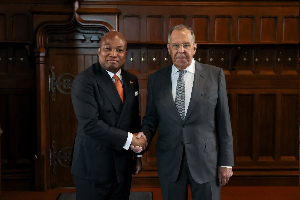
 Foreign Affairs Minister Samuel Okudzeto Ablakwa and Russian counterpart, Sergei Lavrov
As Russia prepares to host the Third Russia-Africa Summit in Moscow on October 28 and 29, 2026, concerns over the recruitment of Ghanaian nationals into its armed forces are emerging as a key issue in Ghana’s diplomatic relations with the country.
The summit, a high-level forum for political, economic and strategic cooperation between Russia and African countries, is expected to bring together representatives from more than 30 countries, according to Russia’s state news agency TASS.
While discussions are expected to focus on trade, investment and security, the gathering could also provide an opportunity for African governments to raise concerns about the recruitment of their citizens to fight in Russia’s war against Ukraine.
For Ghana, the issue has become particularly pressing following reports that dozens of its citizens have been killed or remain missing after joining the Russian military.
Ghana raises alarm over recruitment
Foreign Affairs Minister Samuel Okudzeto Ablakwa has repeatedly raised concerns about what the Ghanaian government describes as deceptive recruitment practices targeting its citizens.
According to research organisation INPACT, 234 Ghanaians were among 1,417 African recruits identified in its 2026 research.
The recruits are reportedly lured by promises of employment or training but subsequently find themselves deployed to the front lines of the war in Ukraine.
During a meeting with his Russian counterpart, Sergei Lavrov, in Moscow in August 2026, Ablakwa disclosed that 62 Ghanaians had been killed while fighting alongside Russian forces, while another 15 remained missing. He also urged Russia to “stop the illegal recruitment of these Ghanaians”.
“As a responsible government, we cannot turn a blind eye to these shocking statistics,” Ablakwa said.
“This is not our war, and we cannot allow our young people to become human shields for others,” he added.
The meeting resulted in an agreement between the two foreign ministers to work towards tackling the illegal recruitment of Ghanaians to fight in Ukraine.
However, Russia has rejected allegations that it is deliberately involved in the unlawful recruitment of African nationals.
In a statement on October 7, 2026, the Russian Embassy in Accra described the allegations as “simply untrue”.
Lavrov acknowledged during the August meeting that some Ghanaian citizens had signed military contracts with Russia’s Ministry of Defence. He attributed their decisions to financial motivations and what he described as solidarity with a country that had helped them fight racism.
Questions over Russia’s partnership with Africa
The summit comes amid broader questions about the outcomes of Russia’s previous engagements with African countries.
Critics argue that several commitments made during the 2023 Russia-Africa Summit remain unfulfilled, particularly in defence, infrastructure and energy. Some have also questioned Russia’s capacity to deliver on major projects amid international sanctions, the cost of the war in Ukraine and domestic economic pressures.
Ghana’s own experience includes longstanding ambitions to establish a nuclear power plant, following agreements on nuclear cooperation with Russia dating back to 2012.
The recruitment issue has also drawn attention to the networks involved in facilitating Russia’s engagement with African countries. A 2025 report by the French Institute of International Relations examined recruitment networks involving Africa Corps personnel, diplomatic representatives and cultural entities such as Russia Houses.
Will Ghana raise the issue at the summit?
With the summit approaching, attention will be on whether Ghana and other African governments intend to use the gathering to press Russia on the recruitment of their citizens.
The event’s Economic and Humanitarian Forum, which provides a platform for discussions on sovereignty, trade, social cooperation and human capital, could offer an avenue for raising the issue. However, it remains unclear whether the matter will feature in formal discussions, private diplomatic engagements or side events.
The Ministry of Foreign Affairs should clarify whether Ghana plans to raise the issue at the summit, what specific measures it expects Russia to take and how the government intends to protect Ghanaians from deceptive recruitment.
The Ministry of Labour, Jobs and Employment and relevant anti-human trafficking authorities could also provide information on measures to identify recruitment networks, investigate suspected cases and support affected families.
As Ghana seeks to strengthen its economic and diplomatic ties with Russia, the summit presents an opportunity to determine whether commitments to address the recruitment of Ghanaian nationals will translate into concrete action.

Copyright © 1994 - 2026 GhanaWeb. All rights reserved.










