


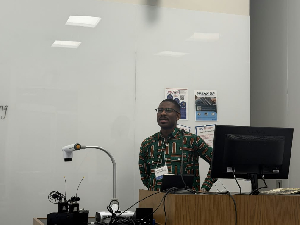
 Crispus Ohene Ankomah is the author of the article
A Ghanaian researcher at Texas Tech University in the United States, Crispus Ohene Ankomah, is examining how media representations of artificial intelligence (AI) shape public understanding of technology, governance and accountability across Africa.
His latest research, titled “Algorithmic Governance in Africa: Media Representations and the Borders of Artificial Intelligence,” was presented at the Engaging Research Across the Humanities (ERAH) Graduate Student Conference, held at Southern Methodist University (SMU) in Dallas, Texas, on October 10 and 11, 2026. Ankomah was also one of two award recipients at the conference.
The study examines how African technology and business magazines portray AI and the broader digital transformation taking place across the continent. Rather than focusing exclusively on the technical capabilities of AI or the policies governing its use, the research investigates how media images, headlines and editorial framing influence the questions that audiences ask about emerging technologies.
Drawing on magazine covers from Synapse Magazine, CIO Africa and Africa Tech Business, the study explores how AI and digital innovation are commonly presented through investment, leadership, business growth and technological readiness. An earlier cover from African Business, published in April 2012, provides a historical comparison with the period when narratives of an “Africa Rising” were prominent in international business coverage.
Ankomah’s analysis identifies an important gap in these representations. While the magazine covers acknowledge issues such as regulation, risk and digital inclusion, these concerns are frequently presented in terms of business performance, the pace of technological development and the ability of institutions to keep up.
Questions about accountability to citizens, individual rights and the ability of people to challenge decisions made by automated systems receive considerably less attention in the covers examined.
The research argues that this selective presentation is significant because media do not simply report technological developments. They also help establish which aspects of those developments receive public attention and which remain at the margins of discussion.
Connecting AI Governance to Movement and Borders
The paper was presented under the conference theme, “Movement and Borderlands,” which provided a framework for examining how technologies, capital and ideas travel across national boundaries.
According to the study, AI systems and the assumptions underlying their design often move across borders into new institutional and regulatory environments. The media narratives accompanying these systems can also travel, influencing how governments, businesses and the public understand technological progress.
The research uses the concept of borders in two related ways. First, it examines the movement of technologies and investment across national boundaries. Second, it considers how media framing creates boundaries around public discussion by determining which governance questions receive prominence.
For example, a narrative that presents AI primarily as an opportunity for investment and economic growth may encourage attention to innovation and competitiveness. However, without equal attention to accountability and public oversight, important questions about who controls these systems, who benefits from their use and how affected individuals can challenge automated decisions may receive less consideration.
The study also examines how AI is sometimes discussed within broader categories such as fintech, cryptocurrency, startups and digital transformation, rather than being identified explicitly. Ankomah argues that this overlap matters because the way a technology is named and presented can influence how people understand its distinctive governance implications.
A Different Approach to Studying Artificial Intelligence
Ankomah’s work brings methods associated with the humanities into contemporary debates about AI. By treating magazine covers as historical and cultural sources, the study examines not only what publications communicate through words but also how images, visual arrangements and omissions contribute to the meaning of technological change.
The paper draws on scholarship on algorithmic governance, media framing and sociotechnical imaginaries to investigate how representations of technology shape expectations about the future.
Its findings do not suggest that African technology media ignore regulation or risk altogether. Instead, the analysis shows that these concerns often appear within a narrative that treats technological growth as a given and regulation as something expected to catch up.
The study is based on a small, purposively selected sample of magazine covers and does not claim to represent all African media. It nevertheless offers a framework for examining how public narratives about AI are constructed and how those narratives might influence broader governance debates.
The implications extend beyond media studies. As governments and institutions across Africa develop AI strategies and expand their use of digital systems, public conversations about these technologies will need to address not only innovation and investment but also transparency, accountability and the rights of those affected by automated decisions.

Copyright © 1994 - 2026 GhanaWeb. All rights reserved.










