


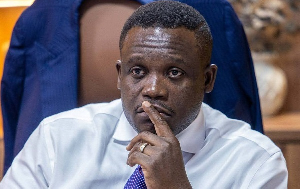
 Minister for Communications, Digital Technology and Innovations, Samuel Nartey George
Samuel Nartey George crossed a line. In his public confrontation with a serving military officer, the Minister for Communications, Digital Technology and Innovations did more than speak up for aggrieved constituents. He diminished the dignity of his office. And the events of the past 48 hours have shown, more clearly than any critic could, that there was a better way all along.
Consider the sequence. In a video filmed at Afienya and shared on Tuesday, November 3, the minister named the officer as Lieutenant Albert Goh. He read out the lieutenant’s Ghana Armed Forces number to the assembled crowd, branded him a disgrace to the uniform, and demanded that the Chief of Defence Staff dismiss him from the Armed Forces. He also warned that any soldier who returned to brutalise residents would “face the law of the streets.”
One day later, the matter was in the hands of the people who should have received it first. The minister met the Defence Minister, the Chief of Defence Staff and the heads of the army, navy and air force on Wednesday, November 4, after the military high command raised concerns about portions of his video. He emerged to report that the Chief of Defence Staff, Lieutenant General William Agyapong, had committed to opening an investigation. He thanked the Defence Minister for his swift intervention and urged his constituents to remain calm, cooperate fully with the investigation, and allow the process to run its course.
That is exactly the right advice. It is also exactly the course the minister should have followed before he took to the microphone.
The most telling detail is that he knew the channel existed. In the very same video in which he exposed the officer to a crowd, he said he would engage the Minister of Defence to ensure that the military authorities investigated the incident and took appropriate disciplinary action. He named the remedy and then reached for the spectacle anyway. The system he bypassed responded within a day. Had he picked up the phone first, the outcome would have been the same: a commitment from the military high command to investigate. What would have been different is everything else. No officer’s identity paraded before an agitated crowd. No talk of street justice. No high command summoning a cabinet minister to account for his words. And no lingering impression that a minister of state holds the country’s armed forces in contempt.
The minister should have known better on legal grounds too. As a long-serving parliamentarian, and as the minister whose portfolio includes oversight of the Data Protection Commission, he should be more familiar than most with the Data Protection Act, 2012 (Act 843) and the obligations it places on anyone handling personal information. Publicly disclosing the name, rank and service number of a serving soldier, before an angry crowd, exposes that individual to hostility and possible harm. A minister charged with safeguarding the data of Ghanaians cannot be seen to treat that principle lightly when it becomes politically convenient.
There is also the matter of fairness. A public verdict was delivered before a single fact had been tested. As of Wednesday evening, Lieutenant Goh’s account of events had not been reported, and no inquiry had yet examined any of the claims. Anyone familiar with military operations knows that soldiers do not deploy, draw weapons or act on their own initiative. They operate within a chain of command, under orders and with authorisation from superiors. If the operation in Ningo-Prampram was unlawful, the investigation will establish who authorised it and who must answer for it. That is precisely why the investigation should have come before the condemnation, not after it.
None of this diminishes the grievances of the people of Ningo-Prampram. Some of the affected drivers say they were assaulted and prevented from working, and if residents were mistreated or their property taken unlawfully, they deserve justice. The minister is right that an MP has a duty to speak up for the people who elected him. But speaking up and inflaming a crowd are not the same thing. The question was never whether he should act. It was how.
I recognise that this confrontational style served Mr George and his party well in opposition. It energised supporters and kept the party in the headlines. But opposition and government are fundamentally different callings. In opposition, the task is to challenge power. In government, the task is to exercise it with restraint and to work through the institutions of the state rather than around them.
This week offered a clear lesson. The proper channels were there; they worked, and they worked quickly. A minister does not need the street to secure accountability. He has the authority of his office and the ear of his cabinet colleagues. That is what the office is for. The office must always be bigger than the politics.

Copyright © 1994 - 2026 GhanaWeb. All rights reserved.










