


 The writer is a third-year Forest Resources Technology student of the KNUST
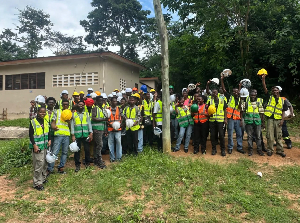
You can read about a buttress root in a textbook. It is another thing to stand in front of one at the Tinte Bepo Forest Reserve and be asked to name the tree. The eight-day field experience at Brosankro in Ahafo South during the last long vacation brought many of our classroom lessons to life.
As students in the four-year Forest Resources Technology programme at the Kwame Nkrumah University of Science and Technology (KNUST), we had the opportunity to put theory into practice, develop essential forestry skills and gain a deeper understanding of Ghana’s forest resources.
I believe every forestry student should spend quality time in the field before graduating, and every institution that trains them should insist on this.
Identification is a habit of patience
Naming a tree is harder than it sounds. We looked at bark texture and colour, root type and leaf shape, and learnt to use the slash method as an additional clue. We were taught never to settle on one feature, because different species can look alike.
Take the Dahoma, Piptadeniastrum africanum, a member of the Fabaceae family. Its buttress roots help you recognise it, but they are only part of the answer. The lesson was to look carefully, check again and record the common, scientific and family names. That is a good habit for any profession.
A forest inventory is a team sport
The stock survey taught me the most. We were split into three groups. Group A, the “Chiefs,” supervised. Groups B and C were the left and right enumerators. The Chiefs called out, and the enumerators answered: a tree was found, with its name, position and diameter, or nothing was found at that point.
If communication broke down, the data would be wrong. Careful demarcation of the area also kept us from missing trees or counting them twice. Forests are managed on the strength of numbers like these, so a careless count is more than a classroom mistake.
Conservation also has to pay
The part of the trip I did not expect to value most was the business side. We studied business planning, and we learnt about beekeeping as a source of income that also supports conservation. Honey and beeswax can be sold. At the apiary near the reserve, some hives held colonies and others were empty. We cleaned the empty ones, removed ants, spiders and geckos, and applied bee attractants.
I came away convinced that conservation works best when it gives communities a reason to protect the forest. A person who earns from bees has a stake in keeping the trees standing. Forestry graduates who can write a business plan will be more useful than those who can only recite regulations.
Tools do not replace judgement
We were introduced to GPS, drones and maps, and also to soil sampling with augers, shovels, sample bags and gloves. The technology is impressive. A drone gives an aerial view, and GPS records a position in seconds. But careless handling spoils a soil sample, and a measurement taken inconsistently is of no use. Technology helps a trained eye. It does not replace one.
What I would tell my country
Ghana’s forests need people who can identify, measure, count and plan. Those skills come from practice, not from lectures alone. The Brosankro trip left me with more interest in the course and a clearer understanding of what it demands. My hope is that the university keeps these field programmes, and that more students get the chance to learn beyond the classroom.
The forest teaches slowly, and it rewards those who pay attention.

Copyright © 1994 - 2026 GhanaWeb. All rights reserved.










