



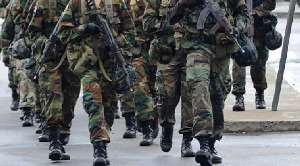
 File photo of soldiers marching
Military professionalism, constitutional distinction and the proper employment of the Armed Forces
1. The question of professional boundaries
There are certain professional boundaries in military service that must remain clearly defined, irrespective of the political circumstances of the day. One such boundary concerns the deployment of military personnel as personal security for politicians and political officeholders.
My position is unequivocal: apart from the distinctive security arrangements associated with the President, other political officeholders should not be assigned military personnel as their personal security detail.
This is not an argument against protecting public officials. Neither is it a question of whether soldiers possess the competence to undertake protective duties. It is fundamentally a question of professional responsibility, institutional purpose and the proper employment of military manpower.
The Armed Forces are established to defend the sovereignty, territorial integrity and constitutional order of the Republic. They are not constituted to serve as a personal security establishment for individuals who occupy political positions.
A soldier's uniform represents the authority of the Republic. It must never become a symbol of personal political privilege.
2. The president's unique constitutional status
The President occupies a unique position in Ghana's constitutional arrangement as Head of State, Head of Government and Commander-in-Chief of the Ghana Armed Forces.
That position carries responsibilities and national significance that distinguish the Presidency from every other political appointment. Consequently, the security arrangements surrounding the President have a special constitutional and national-security character.
However, this distinction must not be diluted.
The fact that the President occupies a constitutionally distinctive office does not establish a precedent for extending military personal-security arrangements to ministers, deputy ministers, Members of Parliament, political appointees or other civilian officeholders.
No political appointment, by virtue of its rank, influence, seniority or proximity to the Presidency, should automatically confer an entitlement to military protection.
The distinction is important. The President's unique constitutional status is not a licence for the wider militarisation of political personal-security arrangements.
The security arrangements of the Presidency must remain exceptional, not become a template for political officeholders.
3. The proper institutional responsibility
The Police Service has the primary responsibility for internal security, law enforcement, public order and the protection of individuals within the civilian environment.
It is therefore within the established professional sphere of the police and designated civilian security institutions to provide personal protection for ministers, legislators and other political officeholders, according to assessed security requirements.
The Ghana Armed Forces, on the other hand, have a distinct military mandate. Their organisation, training, equipment and operational readiness are directed towards responsibilities associated with national defence and the protection of the State.
These institutional distinctions are not artificial administrative divisions. They are important safeguards in the organisation of a professional security system.
When soldiers are routinely assigned to protect civilian political personalities, the distinction between military responsibility and civilian security provision begins to lose its clarity.
The issue is not whether military personnel can perform such duties. It is whether their routine employment in that capacity is professionally appropriate.
Capability does not automatically establish institutional responsibility.
4. The Danger of Personalising Military Service
One of the more serious implications of assigning soldiers to political officeholders is the potential confusion between institutional loyalty and personal allegiance.
A soldier serves the Republic under constitutional authority. His professional obligations are not attached to the personality, political affiliation or temporary influence of an individual officeholder.
Governments change. Ministers are appointed and relieved of their responsibilities. Parliamentary terms expire. Political fortunes rise and fall.
The Armed Forces, however, must remain a permanent national institution, professionally detached from those political transitions.
When soldiers become visibly associated with the personal protection of individual politicians, the public may begin to perceive the military as an extension of political authority rather than an institution serving the Republic.
Such perceptions can undermine confidence in the political neutrality of the Armed Forces.
The danger is not necessarily that individual soldiers will abandon their professional discipline. It is that institutional identity may gradually become blurred through inappropriate patterns of employment.
The military must never create the impression that political influence comes with a personal military security entitlement.
5. The question of military manpower and professional priorities
Military manpower is a national resource maintained at considerable public expense.
Personnel undergo years of professional training, military instruction and operational preparation. Their skills are developed to meet the demands of military service and national defence.
The routine diversion of such personnel into personal-security assignments for civilian political officeholders therefore deserves serious professional scrutiny.
It raises questions about operational priorities, manpower utilisation and the proper distribution of responsibilities among the country's security institutions.
If the Police Service is the appropriate institution for providing personal security to political officeholders, why should the Armed Forces become an alternative arrangement merely because soldiers are available or considered desirable?
Political prominence should not determine the professional employment of military personnel.
Nor should the presence of a military escort become a visible demonstration of an officeholder's status or influence.
A professional military must be guided by institutional necessity, not political convenience.
6. Constitutional authority is not personal privilege
Ghana's constitutional democracy recognises civilian authority over the Armed Forces. The military operates within the constitutional framework and remains subject to lawful civilian control.
That principle is fundamental.
However, civilian control of the military must not be interpreted as an unrestricted personal claim over military personnel by individual political officeholders.
There is a distinction between the lawful authority to direct the Armed Forces through established constitutional and command arrangements and the personal security preferences of politicians.
The military is an institution of the State, not a pool of personnel from which political officeholders may routinely draw personal protection.
A minister's authority within a ministry does not make that individual a military commander. Parliamentary status does not confer military command authority. Political appointment does not create an independent entitlement to military personnel.
These distinctions must be respected if professional military standards are to be preserved.
7. Exceptional circumstances must not become routine practice
There may be extraordinary circumstances in which the security of a public official presents a demonstrable national-security concern requiring military assistance.
Such circumstances must be considered on their particular merits, under lawful authority and through appropriate institutional procedures.
But exceptional necessity must not be used to legitimise routine practice.
There is a fundamental difference between deploying military personnel in response to an exceptional national-security requirement and assigning soldiers permanently to individual politicians as personal security.
The former may be justified by the circumstances. The latter raises questions about institutional propriety and the proper employment of the Armed Forces.
A professional institution must guard against the gradual normalisation of practices that depart from its primary responsibilities.
What begins as an exception must not quietly become an entitlement.
8. Preserving the integrity of the uniform
The military uniform carries an identity that transcends political office, partisan affiliation and individual influence.
It represents discipline, service, sacrifice and allegiance to the Republic.
The soldier must therefore remain conscious of the institutional significance of the uniform he wears. Its authority should not be reduced to an accessory of political prominence or personal security.
The issue is larger than the individual soldier assigned to a particular politician. It concerns the public character of the Armed Forces and the confidence citizens must have in their political neutrality.
The military must be seen as serving the nation through its constitutional mandate, not as providing visible symbols of privilege to selected political personalities.
This is not an argument against the importance of political officeholders. It is an argument for respecting the boundaries between political administration, civilian security and military service.
Conclusion: The soldier serves the republic
The President's unique constitutional position provides a distinct context for presidential security arrangements. That distinction should remain precisely that: unique.
It should not be extended to ministers, legislators, political appointees or other civilian officeholders simply because they occupy positions of political authority.
Their personal security is ordinarily a responsibility for the Police Service and designated civilian security institutions.
The Ghana Armed Forces must retain their professional identity, operational priorities and institutional neutrality. Their personnel should not become a routine extension of the personal security arrangements of political officeholders.
This position is not founded on a lack of confidence in the soldier's ability to protect. It is founded on an understanding that professional competence must be exercised within appropriate institutional boundaries.
There is dignity in knowing one's professional responsibilities. There is also discipline in recognising where those responsibilities should end.
As a retired Regimental Sergeant Major, I regard this distinction as an important matter of military professionalism. The Armed Forces must be protected from the gradual expansion of duties that risk confusing national service with personal political privilege.
Governments are temporary. Political appointments are temporary. The Republic and its institutions must endure.
The soldier is not a politician's bodyguard. He is a servant of the Republic. His uniform belongs to the nation, and his professional loyalty must remain above individual political interests.

Copyright © 1994 - 2026 GhanaWeb. All rights reserved.










