


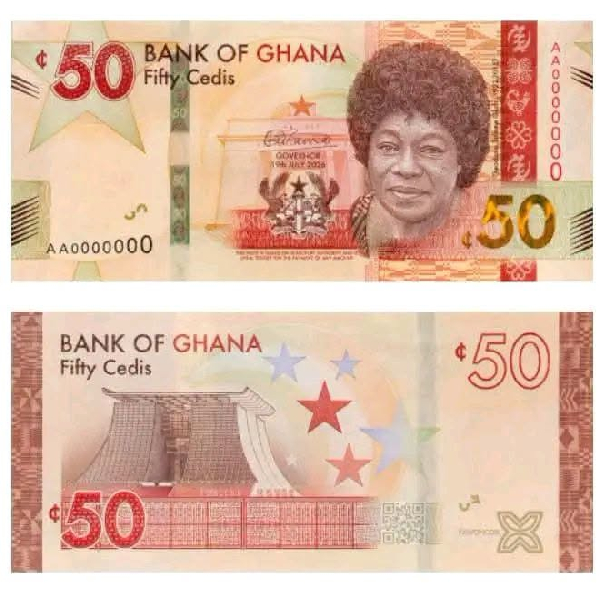
 The controversial image yet to be clarified
Ghana’s new GH¢50 Heritage Series banknote has found itself at the centre of an unusual identity controversy, with questions being raised over whether the woman whose portrait appears on the note is actually the celebrated designer of the national flag, Theodosia Salome Okoh, or her sister, Dr Leticia Obeng.
The controversy has put the Bank of Ghana under pressure to explain how the portrait was selected and whether the image accurately represents the historical figure it is intended to honour.
At the heart of the dispute is a claim by Dr Eddie Obeng, son of Dr Leticia Obeng, that the portrait on the new banknote bears the likeness of his mother rather than that of his aunt, Theodosia Okoh.
If the claim is established, it would raise an uncomfortable question about how a banknote intended to celebrate Ghana's heritage could carry the image of a different person from the one officially named.
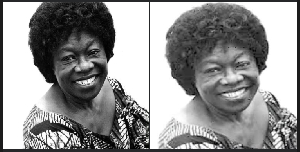
The two women behind the controversy
The debate is particularly striking because the two women were sisters, both of whom made remarkable contributions to Ghanaian society. Their family connection may explain why the resemblance has become a central part of the discussion, but it has also made the alleged mix-up more sensitive.
Theodosia Salome Okoh, born on June 13, 1922, was an artist, teacher and sports administrator whose name became permanently associated with Ghana's national identity after her flag design was adopted at independence on March 6, 1957.
Her contribution, however, extended beyond designing the red, gold and green flag with the Black Star. She played an important role in the development of hockey in Ghana, becoming the first woman to chair the Ghana Hockey Association.
She also served as president of the Ghana Hockey Federation and helped advance the country's participation in international hockey competitions. She died on April 19, 2015, aged 92.
Her sister, Dr Letitia Eva Takyibea Obeng, was equally accomplished, although her achievements were in science rather than art and sports.
Dr Obeng was a pioneering Ghanaian zoologist and freshwater scientist. She became the first Ghanaian woman to earn a Bachelor of Science degree in Zoology and Botany from the University of Birmingham in 1952. She subsequently obtained a master's degree in Parasitology in 1962 and a PhD in Tropical Medicine from the Liverpool School of Tropical Medicine in 1964.
Her research focused, among other things, on the black fly responsible for transmitting river blindness in West Africa. She later became the first female scientist at the Kwame Nkrumah University of Science and Technology (KNUST) and held several important positions, including serving as director of the Institute of Aquatic Biology and working with the United Nations Environment Programme.
She died on March 23, 2023, aged 98.
The two women therefore represent different but equally important chapters in Ghana's history: one through the national symbol that unites the country, and the other through scientific research that contributed to knowledge and public health.
Bank of Ghana responds to portrait concerns
Following the concerns, the Bank of Ghana has offered an explanation of how the portrait was developed.
In a clarification published on November 12, 2026, Bank of Ghana board member Beatrice Annan said the institution used three authentic photographs of Theodosia Okoh to develop the image on the GH¢50 note.
According to her, two of the photographs were taken during Mrs Okoh's younger years, while the third was from a later period in her life.
She explained that the images were combined to produce a portrait depicting Mrs Okoh as a mature woman while retaining what the Bank considered to be her family resemblance.
She further explained that banknote portraits are not ordinary photographic reproductions but engraved artistic representations that must satisfy specific technical requirements.
The process, she said, requires images with adequate lighting, sharpness and fine detail to allow for engraving, raised printing and the incorporation of security features.
The Bank also adjusted the hairstyle to reflect the family's preferred style and provide a clear outline suitable for reproduction on the currency.
"The aim throughout was to produce a bold, clear and dignified image worthy of her place in our history," Mrs Annan stated.
She added that the Bank was engaging members of the Okoh family to explain the work involved in developing the portrait and address the concerns surrounding it.
That explanation, however, does not automatically settle the question being raised by the family member. If the concern is that the source photographs themselves depict Dr Letitia Obeng, the Bank's account of the engraving process would need to be supported by evidence identifying the original photographs.
A question of identity, not just resemblance
The central issue is therefore not whether the Bank of Ghana can artistically transform a photograph to meet the requirements of currency production. It is whether the photographs used in the first place were correctly identified.
There is an important distinction between an artistic interpretation of a person's photograph and using an image of another individual to represent that person.
Even if the two sisters shared similar facial features, that should not remove the need for the institution to establish beyond doubt that the portrait belongs to the individual being honoured.
The Bank's explanation that it worked with three photographs of Mrs Okoh is a useful starting point. However, the public deserves more than an assurance that the final portrait was developed with care. The original photographs and the process through which they were authenticated should be explained, particularly in light of the objection from Dr Obeng's son.
The Bank should also clarify whether members of the family were consulted during the selection and verification of the photographs, and whether they approved the final artistic representation.
This is particularly important because the new currency is not simply a redesign of the Ghana cedi. It is being presented as a representation of the country's history, achievements and national identity.
More than a banknote controversy
President John Dramani Mahama officially launched the new Ghana Cedi Heritage Series on November 12, 2026, at the Bank Square in Accra. The new notes are scheduled to enter circulation on December 1, 2026, and will circulate alongside the existing banknotes, which remain legal tender.
The series celebrates several notable Ghanaian personalities, with different denominations dedicated to individuals whose contributions shaped the country's political, educational, cultural and diplomatic history.
The GH¢50 note is dedicated to Theodosia Okoh, while other denominations feature personalities including Dr Ephraim Amu, Justice Annie Jiagge, Kofi Annan and Dr Kwame Nkrumah.
That makes the portrait controversy particularly significant.
A national currency is one of the most widely circulated representations of a country's identity. Unlike a commemorative publication or an exhibition, banknotes pass through the hands of millions of people, including generations who may never have the opportunity to read extensively about the personalities depicted on them.
For many, the image on the GH¢50 note will become a visual representation of Theodosia Okoh and her contribution to Ghana's independence story.
If the identity of the woman in the portrait is disputed, the matter deserves serious attention before the new notes enter general circulation.
There is also an opportunity here to recognise both sisters properly. Dr Letitia Obeng's contribution to Ghanaian science should not be overshadowed by the controversy, just as Theodosia Okoh's legacy as the designer of the national flag must be protected.
The Bank of Ghana has an opportunity to resolve the matter transparently by presenting the original photographs, explaining how they were verified and addressing the family's concerns.
Ultimately, the question is simple: If the GH¢50 note is intended to honour Theodosia Okoh, can the Bank of Ghana demonstrate that the face on the note is indeed hers?
Ghanaians deserve a clear answer.

Copyright © 1994 - 2026 GhanaWeb. All rights reserved.










