


 Margaret Coomson is the author of this article
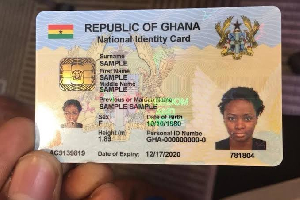
With news of a total of 5,486 businesses across the country now offering customers credit on the basis of their Ghana Card alone, the Ghana Card is indeed no longer just an identity card to millions of Ghanaians, it has now become a key national asset with a massive impact.
The 5,486 businesses across the country are now offering customers credit through their Ghana Card as security, in a move that is opening up formal credit to people who were previously shut out of the system.
The businesses cut across some of the most essential sectors of the economy, including the Electricity Company of Ghana, several insurance companies, retailers, universities, hospitals and hotels.
Under the arrangement, a customer can present a Ghana Card at checkout, have their identity verified instantly, and walk away with goods or services on credit. Payment is then spread over an agreed period, instead of demanding the full amount upfront.
For a family struggling to pay an electricity bill, a student facing school fees, or a patient in need of hospital care, that shift from cash-and-carry to pay-over-time is life-changing.
For decades, access to credit in Ghana was limited to a small group of people who could produce payslips, bank statements and guarantors, while traders, farmers, artisans, drivers and many informal workers who keep the economy running were largely excluded, even though they earn and spend every day.
The Ghana Card is changing that calculation. Because the card is biometric and linked to the National Identification System, businesses can now verify who a customer is within seconds and tie that verified identity to a credit record
While this is good news to individuals and households, it is also positive for businesses as it removes the biggest barrier to sales, which is cash at hand.
The credit rollout is the latest in how impactful the Ghana Card is beyond its traditional purpose purpose as a national ID.
The card has become Ghana's single trusted identity, sits at the centre of almost every part of national life.
It is required to open a bank account, where banks use it for customer verification and to reduce fraud. Its number also serves as the Tax Identification Number, and the Ghana Revenue Authority, banks, telcos and immigration all identify a person by the same number.
The card is also linked to the National Health Insurance Scheme and can be used to access healthcare services, while SSNIT contributions have been merged with the card so that a person's pension follows their identity.
The card is required for passport applications and has been recognised as an e-passport travel document within ECOWAS and for travel to Ghana from any part of the world.
It is also required for new driver's licences and vehicle registration at the DVLA.
What is emerging is a shift from a system where Ghanaians carried a different card for every institution to a system built around one card, one identity and one record. The Ghanacard has clearly emerged as the key pillar for the emergence of a credit economy in Ghana.

Copyright © 1994 - 2026 GhanaWeb. All rights reserved.










