



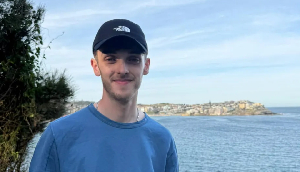
 Kian Bentley said he thought the gunshots were fireworks while working at an open-air cinema
A Scottish musician living in Australia has told how people "stampeded" out of an open-air cinema after hearing gunshots from the attack on a Hannukah event.
Kian Bentley, 22, said everything "became slow motion" following the shooting at Bondi Beach in Sydney which killed 15 people on Sunday.
Mr Bentley, from Stirling, said he opened a gate at the back of the cinema where he was working to allow people to run for safety at a nearby police station.
Jewish leaders in Scotland said there was "increased fear and tension" following the attack.
The gunmen behind the shooting have been named by local media as Sajid Akram, 50, and his son Naveed Akram, 24.
The older man was shot dead by police, while the younger one is in a critical condition in hospital.
Footage verified by the BBC shows a bystander, Ahmed al Ahmed, disarming one of the gunmen and forcing him to retreat.
Mr Bentley, who moved to Sydney to pursue a music career, said he was texting friends while working at the cinema just before 19:00 local time.
He said he could hear the "bangs echo around" the area after the first shots were fired, but did not initially realise they had come from a gun.
"I just heard two or three bangs go off, but I thought it was fireworks," he told BBC Newsbeat.
"But then you heard screams in the distance and everyone in front of me in the cinema just got up and started running. It became a panic quite instantly.
"I quickly opened the fence for the back gate and everyone stampeded out. Hundreds of people just panicked. As soon as I saw everyone panicking, I knew it was serious."
A 10-year-old girl was among those killed in the shooting – the deadliest in Australia in 30 years.
An event to mark the first day of the Hannukah festival, named Chanuka by the Sea, was taking place on Bondi Beach at the time of the attack.
Australia's Prime Minister Anthony Albanese has vowed to strengthen the country's gun laws, which were severely tightened following the 1996 Port Arthur massacre in Tasmania.
'Do Jews have a future in Scotland?'
Two people died in an attack on the Manchester Synagogue on 2 October during Yom Kippur, the holiest day in the Jewish religious calendar.
Sammy Stein, chairman of Glasgow Friends of Israel, said the Jewish community was "afraid" a similar incident could happen in Scotland.
He told BBC Radio Scotland Breakfast extra security had been introduced outside synagogues in the wake of the attack in Manchester.
Mr Stein said there had been a rise in "hate" towards the Jewish community since the escalation in fighting in the Israel-Gaza war two years ago.
"This kind of event does not just happen in a vacuum," he said.
"We need to have guards outside our synagogues. We need to have guards outside our primary schools. Of course people are afraid, they are terrified, because the calls for hate and intimidation have been allowed to grow without being checked.
"People have to be stopped when they are standing in the street calling for hate to fester against Jewish people."
Calderwood Lodge Primary School in Newton Mearns, East Renfewshire - Scotland's only Jewish school - already had a guard on site, but it has not increased security in the wake of the attack.
A spokesman for East Renfrewshire Council said it would work with "the school, local police and our Jewish community" to provide support and "keep the need for any additional measures under review".
Mr Stein said he had heard of one woman, from Edinburgh, who had moved to Israel with her son due to concerns over his safety after he was targeted at school.
'Institutionalised anti-Israel feeling'
Mark Gardner, of the Community Security Trust, a charity set up to provide safety to the Jewish community in the UK, said others were considering their future in Scotland.
"The amount of security we already have in place at synagogues, at Jewish schools, at Jewish community centres is extraordinary," he said.
"We can't just keep building higher and higher walls to hide behind, to live behind. We want to be normal members of society and if that isn't possible, Jews will leave.
"Everyone is talking about whether they have a future in Scotland and that is not because there has been a terrorist attack, it's because of the general mood that people perceive and the isolation they feel."
Scotland's senior Rabbi, Rabbi Moshe Rubin, said some people chose not to attend Hannukah celebrations on Sunday evening.
He said there was an "institutionalised anti-Israel feeling" in some Scottish public bodies, adding that there had been a "definite" rise in antisemitism over the past two years.
"There is a definitely a fear, there's a sense of not feeling welcomed any more in Scotland," he said.
"There is an institutionalised anti-Israel rhetoric at the heart of various different bodies looking after our country, that is where a lot of this rhetoric is coming from.
"That feeds into people who are looking for something to use against Jewish people."
The Scottish government has been contacted for comment.



Copyright © 1994 - 2025 GhanaWeb. All rights reserved.










