



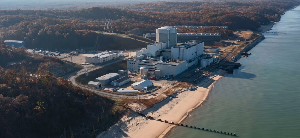
 The Palisades nuclear power plant in Covert Township, Michigan
On the sandy shores of Lake Michigan, set against a backdrop of thick forest, a sharp-angled grey concrete building could be the face of an American nuclear renaissance.
The Palisades nuclear plant, about a two-hour drive from Chicago, was decommissioned in 2022, judged to be uneconomical in a world of cheap American gas. But Florida-headquartered company Holtec is reviving it. It will mark not only the first ever restart of a shuttered US nuclear plant, but, if all goes to plan, Palisades will also be the birthplace of a nuclear breakthrough: America’s first commercial “small modular reactors.”
These advanced nuclear reactors, known as SMRs, are like mini nuclear power plants but touted as cheaper, safer, faster to build and easier to finance than their conventional counterparts — and hype around them is rising fast.
Their appeal is clear: the prospect of abundant, clean power that can run 24/7. They’re catnip for tech companies seeking reliable energy sources to slake the incredible thirst of their data centers, expected to increase exponentially as AI grows. Money is pouring in from Big Tech and the Trump administration.
SMRs are in a sweet spot right now, said Michael Craig, an associate professor of energy systems and climate at the University of Michigan. “They’re in this perfect ground where there’s lots of great ideas … and they have a lot of promise and potential,” he told CNN.
The reality, as ever, is likely to be messier and experts are sounding notes of caution. The total cost of SMRs may be lower than conventional plants, but they are still very expensive, meaning the price of electricity they produce will be far higher than wind, solar or gas, experts warn.
They also take a long time to get up and running. There are only three operational SMRs in the entire world, and none is in the US. One is on a Russian barge off the Siberian coast and the other two in China.
Whether the SMR hype is warranted will only start to become clear once they are built — and the race is on to do so.
Advanced nuclear is “a ‘Back to the Future’-type story,” Touran said. In the 1950s and ’60s, the US had dozens of small reactors, “and they all operated uneconomically,” he told CNN. So, seeking economies of scale to reduce costs and the price of electricity, the industry went big.
Nuclear, however, is an inherently complex technology and building bespoke mega-projects has proved hard. Timelines were delayed, costs spiraled and nuclear stagnated in the US, unable to compete with cheap fracked gas.
Now, small is in again. Companies are saying “we have new technology, we have new materials, and this time it will be cheaper,” Touran said, although “that is definitely yet to be seen,” he added.
The enduring appeal of SMRs is found in their name. First, it’s about size. Large conventional nuclear reactors are incredibly expensive, sometimes stretching to tens of billions of dollars. Smaller reactors simply cost less to build. They are “a technological solution to a financial problem,” Touran said. “No venture capitalists can say, like, ‘oh, sure, we’ll build a $30 billion plant.’ But, if you’re down into hundreds of millions, maybe they can do it.”
It’s also about modularity. The idea is these small reactors will be mass produced in centralized factories and delivered to sites, making them cheaper and more flexible than huge nuclear plants.
Holtec wants to prove the concept at Palisades in Covert Township, Michigan. Alongside firing up the 800-megawatt conventional reactor, the company plans to install two 300-megawatt SMRs to be built in its Camden, New Jersey, factory.
The company kicked off the formal licensing process with the Nuclear Regulatory Commission last month and hopes to have everything approved by 2029, with the SMRs coming online by 2031, a Holtec spokesperson said.
Its long-term aim, with partner company Hyundai Engineering & Construction, is to build a fleet of SMRs in North America in the 2030s.
Some experts question the ambitious timelines, especially for a company that has never operated a nuclear plant before — Holtec started out in the nuclear waste business before buying up and decommissioning closed nuclear plants. But Holtec said its staff has hundreds of years of collective operational nuclear experience, and its technology is proven, based on conventional water-cooled nuclear power plants.
Using this technology is “a very sensible approach” because it should ease the licensing and supply chain process, said Brendan Kochunas, an associate professor at University of Michigan Nuclear Engineering and Radiological Sciences.
But in the race to bring America’s first SMR online, Holtec has competition.
In 2024, California-based Kairos Power broke ground in Oak Ridge, Tennessee, on the construction of a demonstration reactor, aiming to start operations in 2028. The next step will be a commercial-scale reactor which the company says will produce electricity on the grid by 2030. It’s opted for a different technology to Holtec, using molten fluoride salt as a coolant instead of water.
Kairos is interesting because it’s one of the few companies in the US that’s actually building right now, said Allison Macfarlane, director of the School of Public Policy and Global Affairs at the University of British Columbia, and a former chair of the Nuclear Regulatory Commission.
Its process of building, testing, learning and building again may take longer than companies that just design and build one final reactor, but it can provide invaluable learning. “You have to demonstrate the technology before you can sell it to anyone,” Macfarlane told CNN. “Whether it will be successful is another story.”
Big tech companies are betting it will be. In 2024, Kairos signed a deal with Google to deploy a fleet of reactors totaling 500 megawatts — enough to power around 300,000 homes — with the first slated to start operations in 2030. Kairos wouldn’t confirm the value of the deal but said it will help it build out factory production lines and “accelerate the learning curve, making each unit cheaper and faster to deploy.”
Other tech companies are also pouring money into the field. Amazon invested in Maryland-headquartered X-Energy, which uses a gas-cooled design and is planning up to 12 SMRs at a new facility in Washington state.
Earlier this month, Meta announced a deal with SMR startup Oklo to prepay for power and to help build a campus in Pike County, Ohio, to support Meta’s data centers in the region. Oklo did not disclose the value of the deal but a spokesperson told CNN, “the full project build-out would be a multi-billion dollar infrastructure project.”
There’s plenty of public money, too. In December, the Department of Energy approved $800 million toward developing SMRs, with $4 million to Holtec, and more is on the horizon.
“The deployment of advanced reactors is a priority for the Trump administration,” said Rian Bahran, deputy assistant secretary for nuclear reactors. “Additional funds will be invested in the research, development, and deployment of these technologies.”
As the hype increases, some experts are sounding warning bells.
All the arguments in favor of SMRs overlook a fundamental issue, said Edwin Lyman, director of nuclear power safety at the Union of Concerned Scientists: They are too expensive.
Despite all the money swilling around the sector, “it’s still not enough,” he told CNN. Nuclear power cannot compete on cost with alternatives, both fossil fuels and increasingly renewable energy, he said. “An SMR is still a luxury, and it may be more affordable in terms of its initial price tag, but that doesn’t mean it’s producing less expensive electricity.”
So far, the NRC has approved only one SMR design, by the company NuScale Power, but a project to build them in Idaho was canceled in 2023 as costs soared and not enough utilities signed on to buy electricity.
Neither Kairos nor Holtec would confirm how much their SMRs will cost, citing commercial sensitivity.
Some SMRs also have an issue with fuel. The more unconventional designs, those cooled by salt or gas, often require a special type of fuel called high-assay low-enriched uranium, known as HALEU (pronounced hay-loo). The amounts available are limited and the supply chain has been dominated by Russia, despite efforts to build up a domestic supply.
It’s a major risk, said Touran. The biggest challenge nuclear has is competing with natural gas, he said, a “luxury, super expensive fuel may not be the best way.”
There is still stigma around nuclear waste, too. SMR companies say smaller reactors mean less nuclear waste, but 2022 research from Stanford University suggested some SMRs could actually generate more waste, in part because they are less fuel efficient.
Amid the push to accelerate SMRs, some experts say the biggest concern is safety. The Trump administration has focused on speeding up licensing processes and loosening regulatory requirements, which Lyman fears will not give enough time to evaluate safety and security. “It’s really the Wild West,” he said.
Other experts are more optimistic. “Just eliminating regulations without much thought is dangerous,” Michigan’s Kochunas said. But done properly “I don’t think there’s any inherent concerns to safety by prioritizing and fast tracking SMRs,” he told CNN.
The Department of Energy rejected claims safety would be compromised. “DOE upholds the highest standards of safety in our work with the nuclear industry,” Bahran said.
As companies race to prove SMRs can meet the hype, experts appear to be divided in their thinking.
For some, SMRs are an expensive — and potentially dangerous — distraction, with timelines that stretch so far into the future they cannot be a genuine answer to soaring needs for clean power right now. They may not be ready for decades, Macfarlane said. “Will these companies wait until then? Will AI be relevant then?” she asked.
Lyman believes a driving force behind the push to get SMRs online is fear that time is running out to compete with wind, solar and batteries. “If they don’t prove what they’re claiming about how nuclear power is going to save the world, then it’s going to become obsolete,” he said.
Others, however, point out that all technology is expensive to start with, and costs tend to come down as it advances. SMRs could mean data centers don’t strain the grid and push up people’s electricity bills, they could be used in remote areas instead of diesel generators or even in industrial factories to provide heat, they argue.
Investing in SMRs now will prove, one way or another, if they can be an option to complement wind or solar, Touran said, “progress requires people to do stuff.”
“Let’s build the reactor. Let’s turn it on, and let’s see if it actually runs well,” he said. “The big debate, the big race is who can run one economically.”



Copyright © 1994 - 2026 GhanaWeb. All rights reserved.










