



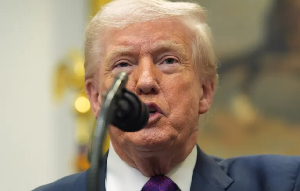
 Trump says he's ashamed of Supreme Court judges over tariffs ruling
The US Supreme Court has ruled that President Donald Trump overstepped his powers when he imposed sweeping global tariffs last year.
In its 6-3 decision, the court ruled that Trump could not use a 1977 law - the International Emergency Economic Powers Act (IEEPA) - to levy taxes on imports from nearly every country in the world.
The ruling left open the possibility of consumers and businesses being given refunds for the estimated $130bn generated by the tariffs - a prospect that the high court did not weigh in on but is likely to end up in another court battle.
Hours after the decision was released, Trump signed a proclamation using an alternative law, Section 122 of 1974's Trade Act, that would let him put a new 10% temporary tariff on goods from all countries.
Here's what to know about what comes next on tariffs and what questions still remain.
What tariffs were found unlawful and why?
The Supreme Court decision released on 20 February relates only to tariffs that Trump had enacted under the IEEPA, which gives a president the power to regulate trade in response to an emergency.
Trump first invoked it in February 2025 to tax goods from China, Mexico and Canada, saying fentanyl trafficking from those countries constituted an emergency.
A few months later, on what Trump called "Liberation Day", he took a much bigger step, imposing levies between 10% to 50% on goods from almost every country in the world.
In this case, the US trade deficit – where the US imports more than it exports – posed an "extraordinary and unusual threat", according to Trump.
The court said the US Congress, and not the president, has the power to create new taxes, and that regulation under the IEEPA did not involve raising revenue.
Still, a number of tariffs Trump has imposed over the last year were not part of the emergencies he declared under IEEPA and can remain regardless of the Supreme Court ruling.
That includes industry-specific tariffs on steel, aluminium, lumber and automotives, which Trump put in place under a different US law, section 232 of the Trade Expansion Act of 1962, citing national-security concerns.
Trump imposes new temporary tariffs under different law
In the aftermath of the Supreme Court ruling, Trump issued a proclamation to impose a 10% global tariff on almost all imports to the US under a never-used law known as Section 122.
The section gives him the power to put in place tariffs up to 15% for 150 days, at which point Congress must step in, which means this solution is temporary.
However, there is a possibility Trump could work around lawmakers. Section 122 does not expressly prohibit the president from allowing the tariffs to lapse after 150 days and then declaring a new emergency to bring them back, according to the Cato Institute, a right-leaning think tank.
Trump is using Section 122 "to address fundamental international payments problems" and rebalance American trade, according to the White House, while also investigating whether he can impose tariffs under Section 301 of the Trade Act of 1974.
That law allows the US Trade Representative - a position currently held by Jamieson Greer - to investigate countries' trade practices. The USTR can then impose tariffs when it finds practices are "discriminatory" or "unfair".
The administration can continue to impose tariffs under Section 232 of the Trade Expansion Act of 1962, which Trump used heavily in his first term, as well.
This allows the administration to levy taxes on imports that threaten national security, but only after an investigation, which means they take time to impose.
An economist, though, told the BBC that the requirements for investigations and findings can also make levies harder to challenge - and have lifted- once they are in place.
US Treasury Secretary Scott Bessent has said that combining Section 122 tariffs with enhanced Section 232 and Section 301 tariffs "will result in virtually unchanged tariff revenue in 2026", essentially making up for the loss of the IEEPA tariffs.
Will consumers and businesses be refunded from the unlawful tariffs?
One of the reasons Trump has given for imposing tariffs is that the money they bring in goes to the US Treasury, helping boost the country's economy.
The US government has collected tens of billions of dollars from companies bringing in the foreign products, by many reports. Estimates say the number is around $130bn (£96bn).
While the Supreme Court's ruling determined that Trump's IEEPA tariffs were not legal, it did not offer guidance on returning the money to those who had paid the taxes.
Trump told reporters that he expected any potential refunds to be locked up in litigation for years.
After the decision was released, Treasury Secretary Bessent also said the issue of refunds could drag on for years.
Speaking at an event in Dallas, Bessent said revenues already brought in through the IEEPA tariffs were "in dispute" since the Supreme Court did not provide any instructions on refunds.
The issue is expected to be decided by the US international trade court. Most likely, any refunds would go to larger companies, experts say, as smaller businesses would lack the resources to go through the many steps of applying for the money.
Alex Jacquez, chief of policy and advocacy at the liberal think tank Groundwork Collective, told the BBC's media partner CBS that more than 1,000 businesses had already asked for tariff refunds before the ruling.
That number, he said, is likely to grow.
Democratic Illinois Gov JB Pritzker also demanded that the White House issue a $1,700 refund check to each American household over the unlawful tariffs.
On multiple occasions, Trump had publicly teased the idea of issuing a tariffs rebate check to Americans.
What tariffs are in effect now?
Starting at 24 February at 12:01 EST (05:01GMT), the new 10% tariffs will be imposed on almost all imports to the US, regardless of where they come from, according to the White House.
A White House official told the BBC that countries that struck trade deals with the US, including the UK, India and the EU, will also face the global 10% tariff under Section 122 rather than the tariff rate they had previously negotiated.
The Trump administration expects those countries to keep abiding by the concessions they had agreed under the trade deals, the official added.
Some goods will be exempt from the tax "because of the needs of the U.S. economy" or in order to better target the duty.
These fall into major categories so that some critical minerals, metals, energy products, natural resources, food crops, pharmaceuticals, electronics, cars and trucks, and aerospace products will be exempted.
Also, "informational materials (e.g., books), donations, and accompanied baggage" will not be taxed, according to a White House fact sheet.
For many of the categories of exempt goods, the proclamation is broad and does not specifically say what items might be exempt.
Another important exemption is goods that are part of the USMCA - the trade agreement between the US, Mexico and Canada.
Those goods were also exempt from the IEEPA tariffs and Prime Minister Mark Carney has often said Canada is among the countries in the world with the lowest tariff rate due to the USMCA exemption.
Similarly, textiles and apparel from Costa Rica, the Dominican Republic, El Salvador, Guatemala, Honduras, and Nicaragua will remain duty-free under the Dominican Republic-Central America Free Trade Agreement.
At the same time, Trump said he is keeping up tariffs on low-cost goods.
Last year, he ended what was known as the de minimis exemption, which had allowed goods valued at $800 or less to enter the US without paying any tariffs.



Copyright © 1994 - 2026 GhanaWeb. All rights reserved.










