



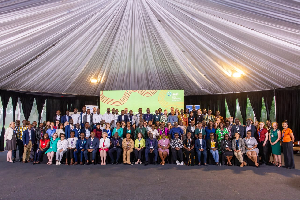
 Some of the stakeholders during the programme
On Tuesday, Accra hosted the ISEAL Global Sustainability Symposium 2026, a gathering of producers, businesses, policymakers and sustainability leaders from across the world. If that description does not immediately explain why it matters for Ghana, here is a clearer picture.
Ghana is deeply embedded in global supply chains. The country exports minerals, metals, timber and cocoa that end up in products consumed by people all over the world.
The rules governing how those products are traded, what standards they must meet, who verifies them and who is held accountable when they fall short, are the subject of ongoing debates in international policy.
Those debates directly affect the livelihoods of Ghanaians who grow, process and sell the commodities at the heart of those supply chains.
The ISEAL Symposium brought that international conversation to Accra, with Ghana's own policy experience and its producers as central participants rather than distant subjects.
The event was hosted by ISEAL, the global membership organisation for sustainability standards and supported by Switzerland's development agency, SECO.
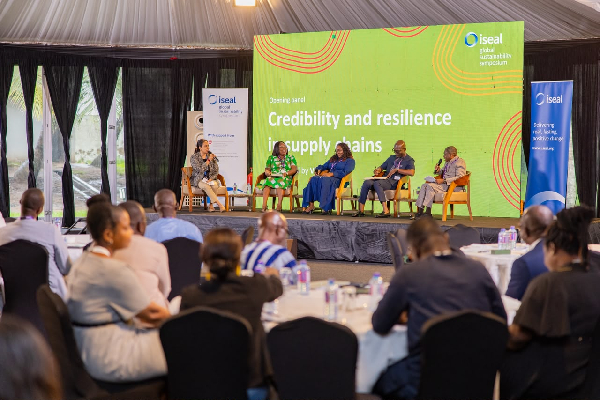
One of the keynote speakers was Juliana Asiedu, a certified Ghanaian cocoa farmer and financial secretary of the Offinso Fine Flavour Cocoa Cooperative. She spoke to resilience from the farmer and community level, and her message was direct.
"Producers should not simply be expected to comply with decisions made elsewhere. My call today is simple. To policymakers: create policies that work for producers, not just for markets. To companies: invest in long-term partnerships that support farmer resilience and living income.
“To sustainability systems and development partners: continue working with producers to build practical solutions that can be implemented on the ground."
Juliana Asiedu, certified Ghanaian cocoa producer and financial secretary, Offinso Fine Flavour Cocoa Cooperative (OFFCOP)
The other Ghanaian keynote came from Dr Francis Baah, Deputy Chief Executive for Agronomy and Quality Control at COCOBOD, who addressed how Ghana is working to align its cocoa policies and practices with international market expectations.
Together the two voices illustrated what Ghana's engagement with global supply chain sustainability looks like in practice: at the institutional level and at the farm level.
Across the day, discussions examined how climate risk, land use change and economic uncertainty are reshaping what supply chain resilience requires, how standards can strengthen livelihoods through living income approaches, and how community-based forest governance can be improved.
The final session focused on the growing complexity of global regulation and what governments and producers need to navigate it.
The conclusion of the Symposium was that resilience cannot be achieved by any single actor. It takes coordinated action between governments, businesses, producers and sustainability systems.
For Ghana, hosting the event was an expression of the country's active role in shaping those systems rather than simply being shaped by them.

Copyright © 1994 - 2026 GhanaWeb. All rights reserved.










