



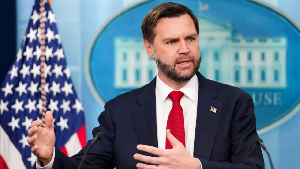
 US lead negotiator Vice-President JD Vance
The first round of negotiations between the US and Iran to reach a final deal to end the war has ended with "encouraging progress", mediators Qatar and Pakistan say.
In a joint statement early on Monday, Qatar and Pakistan said that the parties had agreed to "a roadmap towards reaching a final deal within 60 days".
Iran's foreign minister Seyed Abbas Araghchi said there had been "major progress" towards ending the conflict in Lebanon.
The memorandum of understanding (MoU) signed last week includes a commitment to ending the fighting on "all fronts" - including Lebanon - and the reopening of the Strait of Hormuz.
"Pakistani and Qatari mediation has delivered major progress to end Lebanon War," Araghchi posted on social media.
"Oil and petrochem exports are waived, blockade lifted, some frozen assets released, and major reconstruction & development plan launched for Iran."
The Iranian lead negotiators left the talks in Switzerland on Monday, Iranian media said, with technical discussions between the parties due to continue.
The mediators' joint statement said that a "communication line" had been formed "to avoid incidents and miscommunication with the aim of safe passage for commercial vessels through the Strait of Hormuz".
Both sides also agreed to the creation of a "de-confliction cell" between the US, Iran and Lebanon, facilitated by the mediating countries, to end military operations in Lebanon, their statement said.
Araghchi said the first "real test" would be the Lebanon de-confliction cell.
Lebanese President Joseph Aoun spoke to senior officials from the US and Qatar on Monday about the issue, and more broadly about consolidating a ceasefire in Lebanon, his office said.
Since the MoU was signed, there has been an upsurge in fighting between Lebanese armed group Hezbollah and Israeli forces in southern Lebanon, and Israeli air strikes that the health ministry says have killed dozens of Lebanese including women and children.
A new ceasefire between Israel and Hezbollah was declared on Friday. Continued clashes and air strikes prompted Iran on Saturday to announce it had shut the Strait of Hormuz, though tracking data shows vessels have continued to pass through it.
Earlier, as the talks began in the Swiss city of Lucerne, Trump posted that Iran "must immediately stop their highly paid PROXIES in Lebanon from causing trouble" and threatened to "hit Iran very hard again" if they did not.
Iran's lead negotiator Mohammad Bagher Ghalibaf responded by saying: "Don't they think that if their threats had any effect, they wouldn't be in this desperate situation today?... No matter how much they talk, it is we who take action."
On Sunday, fighting was reported to have diminished but Israeli Prime Minister Benjamin Netanyahu insisted that the Israeli military would remain in southern Lebanon for as long as was necessary to protect northern Israel.
Hezbollah leader Naim Qassem has rejected any Israeli military presence in southern Lebanon and said Hezbollah would defend itself.
Speaking before the talks at the Swiss resort of Bürgenstock, US lead negotiator Vice-President JD Vance said Trump had asked negotiators to "turn over a new leaf".
He added that if Iran's leadership was willing to give up being a "driver of regional instability" and its "nuclear weapons ambitions for the longer term", then the US "is willing to fundamentally transform our relationship with that country".
Iran has insisted its nuclear programme is peaceful.

Copyright © 1994 - 2026 GhanaWeb. All rights reserved.










