



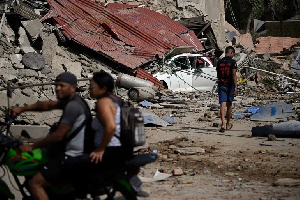
 A scene in Venezuela following the earthquakes
Yilsmaris Blanco stared in shock at the scenes of devastation in the city of Catia La Mar on Venezuela’s coast after powerful twin earthquakes levelled dozens of buildings.
“It was terrible. Everything, everything collapsed,” an unnamed 39-year-old woman told AFP news agency.
“We thank God because … we’re alive. But there are people right now suffering with their relatives buried – with their relatives crushed and they can’t get them out.”
Akomea reveals what Ken told Bawumia when he approached him to join his campaign
Authorities have yet to provide a figure for those missing as reports flooded in from across the country of people trapped under debris. The northern region of La Guaira, facing the Caribbean, was hit hardest.
Acting President Delcy Rodríguez says the earthquakes have killed at least 164 people and injured 971 as search-and-rescue teams deploy throughout the devastated country.
Specialist rescue teams certified by the United Nations are on their way to Venezuela to help find survivors, with thousands feared buried in the debris of collapsed buildings.
The UN has called on Venezuelan authorities to urgently lift restrictions on access to media outlets, saying the ability to receive information will soon become “a matter of life and death”. Secretary of State Marco Rubio says the United States has already deployed rescuers.
Some Venezuelan schools will be converted into emergency relief centres and shelters for the homeless in the disaster.
‘Terrifying’: Caracas resident recounts surviving back-to-back quakes By Julio Cesar Blanca
In La California, one of the hardest-hit areas of Caracas, 45-year-old Eunice Arias stood still shaken outside her damaged building.
Arias, who works at a currency exchange office in the neighbourhood, told Al Jazeera that it was “terrifying” when the first tremor hit.
“We were working as usual yesterday, and then I went out when the earthquake hit near La California. I can’t even describe how frightening it was. The buildings were shaking; you could hear the columns creaking. It was truly horrifying,” she said.
She recalled experiencing an earthquake last year but said this was far worse.
“I’d experienced an earthquake in Los Teques, but nothing like this. And on top of that, there were two quakes. The second one was even worse. I thought the building was going to collapse,” Arias said.
She had just arrived at her apartment when the second quake struck.
“I had just arrived at my apartment when lamps started falling, televisions toppled over, and the water tanks were shaking so violently that water was splashing everywhere. It was indescribable. Honestly, it was horrible.”
Venezuela quakes: How will sanctions impact aid operations?
The economic chokehold on Venezuela was partially lifted after US forces abducted President Nicolas Maduro in a raid in January.
The interim government led by Maduro ally, Delcy Rodriguez, has been on stable terms with US President Donald Trump’s administration, which has since sought to re-establish US investment in the oil industry.
While the partial lifting of sanctions – including on Rodriguez, who was Maduro’s vice president – allows Venezuela to transact more freely with US companies and financial institutions, experts are concerned about the effects on aid operations.
Venezuela quake response requires ‘massive collective effort’: UN The United Nations is “fully mobilised” to provide assistance in quake-hit Venezuela, its humanitarian aid chief says.
“We are fully mobilised to support the people of Venezuela,” said Tom Fletcher. “The coming days will require a massive collective effort to support the government-led response and help communities.”
A man carries a mattress past damaged residential buildings following an earthquake in Catia La Mar, La Guaira state, about 30 km northwest of Caracas, on June 25, 2026.
Damaged homes following the earthquake in Catia La Mar in La Guaira state [AFP] Click here to share on social media
Search and rescue ‘comes first’ as US pledges Venezuela support
US Secretary of State Marco Rubio says financial aid is not the immediate priority. The immediate priority is search-and-rescue efforts in which the US will assist.
He added that during this process the United States can also determine what is actually needed in terms of financial relief, possible reconstruction support and new housing.
But he stressed the priority now is finding those still alive and recovering the bodies of those who have died. During this period, Rubio said, the US can also assess what additional support it will need to provide.
European countries offer condolences, assessing humanitarian needs Several European countries have expressed solidarity with Venezuela following the devastating earthquakes:
British Foreign Secretary Yvette Cooper said the United Kingdom is working with international partners to assess humanitarian needs. “My thoughts are with those affected by the devastating earthquakes in Venezuela.” Cyprus’s Foreign Ministry said it’s “deeply saddened by the loss of life and destruction caused by the devastating earthquakes in Venezuela”.
Slovak Foreign Minister Juraj Blanar also offered condolences saying, “I extend my sincere condolences to the families and loved ones of the victims of the devastating earthquakes.”
Bulgaria’s Ministry of Foreign Affairs said: “In this time of profound suffering, Bulgaria expresses its most sincere condolences for the tragic loss of lives and the destruction caused by the earthquake in Venezuela.”
Italian Foreign Minister Antonio Tajani said he’s “closely following the evolution of the situation”. Tajani added Italy is “ready to provide support” and will ask the European Union to activate the bloc’s Civil Protection Mechanism to coordinate and fund emergency relief efforts.
These are terrifying times for people in Venezuela. People we have been in touch with are traumatised by the uncertainty.
Our producer was speaking to a friend and she described buildings collapsing and a big crack opening on the road. This was a long weekend in Venezuela so there were lots of people in their homes at the time the earthquakes hit.
Search-and-rescue operations are under way in the capital, Caracas. A political opposition group opened a link on social media asking people to report how many of their relatives have gone missing – and the number at this point is 11,000.
To clarify, this figure is just from people who have been able to access the internet and were able to report the missing to authorities in Venezuela.
He also announced “Iran’s readiness to provide any assistance required in relief and rescue operations”, while expressing “solidarity with the government and people of Venezuela”.
UN-coordinated specialist rescue teams on the way to Venezuela Specialist rescue teams certified by the United Nations are on their way to Venezuela to help search for survivors following the deadly earthquakes, acting President Delcy Rodriguez says.
The international rescuers “are already on their way to our country to support” relief efforts, Rodriguez said in a televised message, adding she spoke with several heads of state and with the UN coordinator in Venezuela.
A number of nations – including Switzerland and France – announced earlier they’re sending rescue teams to the earthquake-hit country.
Ukraine expresses solidarity with Venezuela Ukraine has expressed solidarity with the Venezuelan people.
“We extend our deepest condolences to the families of the victims,” Ukraine’s Foreign Minister Andrii Sybiha said.
“We wish a speedy recovery to the injured and strength to the rescue teams working tirelessly on the ground. We trust that all affected communities will be able to recover from this tragic catastrophe as soon as possible. Stay strong, Venezuelans,” he said.
I was able to go out on the streets, and what I saw are few cars circulating in the city and most of the businesses closed. The ones open are a few grocery stores and drugstores.
People are camping outside in public squares. They are guarded by local authorities. I think today people will start to process what has really happened and try to assess how many people died, how many are disappeared.
The severed connectivity makes it harder for people to locate their loved ones. So this is a very traumatic and critical situation we’re living through.
Earthquakes are a rare occurrence for Venezuela. We are not used to having this kind of natural disaster. The last one we saw in the capital was in 1967. I would say the country in general is ill-equipped to manage and to cope with a situation like this.
Local authorities are even asking private companies to come and help because they don’t have the equipment to remove the leftovers of the shattered buildings. They are asking citizens to help by bringing food and water to those in need.
It mobilised “the Swiss Rescue Chain, comprised of 80 members, eight rescue dogs, and 18 tonnes of rescue equipment”, to be sent to Venezuela “as soon as possible”, a statement said.
Television broadcasts on Thursday showed rescue workers using power tools to work their way into piles of rubble where buildings once stood. Panicked residents of the capital, Caracas, were sent pouring into the streets.
“We express our feelings of solidarity and support to the friendly Venezuelan people during this difficult time,” said a Kremlin statement.
Rescue teams rushed on Thursday to areas hit hardest by the pair of powerful earthquakes, killing at least 164 people, injuring nearly 1,000 and trapping many under the rubble.
Czech Republic pledges rescue support to Venezuela The Czech Republic’s prime minister sent his condolences to the Venezuelan people and is ready to send help.
“My thoughts are with the families of the victims and with all Venezuelans affected by this tragedy,” Andrej Babis wrote.
“The Czech Republic stands ready to provide immediate humanitarian assistance and support for rescue operations.”
Rubio says first priority to save ‘people trapped in rubble’
The US Secretary of State says the main objective in Venezuela is to rescue victims buried in debris.
“Right now we’re worried that there are people trapped in rubble. We want to help them get out. Some of those people are relatives that live in the United States, but no matter what the United States has always responded to humanitarian crises, especially in our own hemisphere. That’s what we’re focused on now,” Marco Rubio told reporters.
“We’re faced with this and now we have to respond to it, and we will in a very positive way.”
At least 164 people have been confirmed killed with nearly 1,000 injured as rescuers race to help.
“So right now we’re just going to focus on the human aspect of this. There are human beings that have been harmed, that have been hurt. Some have been killed, some have been severely injured, and some are still trapped in rubble. We’re going to focus on that,” said Rubio.
“I think that Venezuela is going to emerge stronger from it despite the tragedy that it’s confronting it right now.”
Spain, Netherlands ready to send army rescuers to Venezuela Spain’s defence ministry says 54 army rescuers are ready to respond to the crippling twin earthquakes in Venezuela.
A contingent from the army’s emergencies unit “combines the use of specially trained search dogs and specific devices like rescue cameras or geophones”, the ministry said on X.
The Netherlands also said it will send a team to Venezuela and allocate about two million euros to deploy rescue workers, search dogs and equipment.
Macron says 85 French rescuers sent to Venezuela The French president says a team of 85 French specialists in search-and-rescue operations are being sent to Venezuela immediately.
Emmanuel Macron spoke to Venezuela’s acting President Delcy Rodriguez and expressed solidarity with the Venezuelan people and said France and its partners are ready to provide assistance.
US to see what can be done to restore communications in Venezuela The US Secretary of State Rubio says there will be a better assessment of the situation after the next 48 hours in Venezuela.
“The second phase, of course, will be identifying their longer-term and acute needs,” he told reporters in Bahrain.
“We’ll have a better assessment of that after the next 48 hours when we are on the ground and as the Venezuelan authorities get more visibility regarding the level of damage in terms of housing.”
Rubio also said the US will see what can be done to help Venezuela restore the internet and telecommunications.
Rubio says US providing ‘big, fast, effective’ support to Venezuela The secretary of state says the US has already deployed search-and-rescue teams to Venezuela from Fairfax County, Virginia and Los Angeles.
“There will be some others,” he said, speaking to reporters in Manama, Bahrain. “We are also helping them with some overhead imagery, especially in coastal areas where they don’t have full visibility over what the damage has been and what the impact has been.”
“Those are the acute short-term needs over the next 48 to 72 hours,” he added.
Survivors describe scene as relatives remain buried under collapsed homes The Venezuelan coastal city of Catia la Mar is without electricity and many residents spent the night on the streets or searching for missing relatives.
“Right now we have nothing, not even the strength or the courage to go in there, just imagine,” said Larry Rojas, 49, standing in front of the collapsed building where family members are trapped.
Some residential buildings showed large cracks and fallen walls, with dozens destroyed.
“There are people alive in there and no one is coming to save them,” said a woman waiting for news of her daughter buried in the ruins of a 12-storey building.
Potential aftershocks create ‘very dangerous recovery process’ Adam Pascale, chief scientist at the Seismology Research Centre in Australia, says “there needs to be a very great awareness” of the potential for powerful aftershocks in Venezuela, especially during recovery efforts.
“It is a very dangerous time for those undertaking the recovery,” Pascale told Al Jazeera.
In addition to aftershocks, he said there’s also the potential for another quake of an equivalent or larger scale than the previous ones, but that likelihood significantly diminishes after a few days.
Turkiye’s President Erdogan offers condolences to Venezuela
The Turkish President has sent his country’s condolences to Venezuela, saying Ankara stands by “our Venezuelan friends during these painful and difficult days”.
“I sincerely share the grief of those who lost their lives in the two earthquakes that struck Venezuela, and extend my condolences and wishes for a speedy recovery to the friendly people and government of Venezuela,” Recep Tayyip Erdogan said on X.
Qatari Emir Sheikh Tamim bin Hamad sends message to Venezuela’s leader
Emir Sheikh Tamim bin Hamad Al Thani has sent a message of condolence to Venezuela’s acting president after powerful earthquakes struck Rodriguez’s country.
The death toll has climbed quickly with Rodriguez reporting at least 164 dead and more than 970 hurt with the state of La Guaira north of Caracas hit hard.
Sheikh Tamim bin Hamad wished the injured a speedy recovery, the Qatar News Agency reported.
Caracas Stock Exchange suspends trading after deadly quakes The exchange says trading has been frozen after the two major earthquakes, according to a statement.
Venezuela’s interim President Delcy Rodriguez said an initial fund of $200m will be created using resources from the International Monetary Fund to rebuild infrastructure, hospitals and housing.
About 30 aftershocks have been recorded following the two strongest quakes on Wednesday, according to Rodriguez.
UN official calls for swift international support for Venezuela
The United Nations migration agency chief, Amy Pope, says it is urgently mobilising efforts to assess the needs of thousands of people affected by the earthquakes.
“Heartbreaking news from Venezuela where two powerful earthquakes struck within moments. Lives lost, many injured, and communities affected,” she wrote. “Swift international support is critical to respond.”
Venezuela’s strongest earthquake since 1900. Roberto Gamas says he managed to escape his building as earthquakes rocked Venezuela.
“The building was swaying from side to side. It was unbelievable,” he told Al Jazeera. “Fortunately, there weren’t many people in the building. Can you imagine the panic of people trying to get out?”
Rescuers clambered in the dark over flattened buildings to search for survivors and pull them from under the ruins.
The 7.5-magnitude quake was the most powerful since October 29, 1900 when a 7.7-magnitude quake struck offshore.
Watch highlights of 2026 edition of GhanaWeb 'Walk with Dad' event at Aburi

Copyright © 1994 - 2026 GhanaWeb. All rights reserved.










