



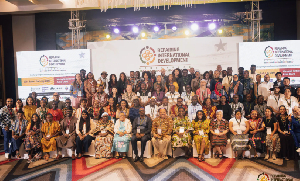
 Some of the stakeholders at the event
Development practitioners, indigenous leaders, civil society actors and policymakers from across Africa, Latin America, Asia and the diaspora have gathered in Accra for the 2026 Repairing International Development (RID) Conference, calling for a fundamental transformation of the global development architecture.
The four-day conference, organised by Reform Initiatives in partnership with the African Futures Lab, (AFALAB), Deep South Solidarity Fund, (DSSF) and PAWANKA Fund, has brought together more than 150 participants from over a dozen countries, including Brazil, Nicaragua, Guatemala, South India, Zimbabwe, South Africa, Nigeria, and Kenya to examine how international development can be reshaped to address historical injustices and centre indigenous knowledge systems.
The conference is convened under the theme “Amplity Indigenous Development Initiatives from the Global Majority”.
Founder and Director of Reform Initiatives, Makmid Kamara, said the conference seeks to move beyond the traditional discourse on decolonising development by advancing a broader framework aimed at repairing the multiple harms inflicted on Black, Indigenous and historically marginalised communities.
“We are here this week because the global development practice is in dire need of repair and recalibration,” he said.
According to him, while efforts to decolonise development have gained momentum over the years, colonialism was only one of several historical injustices that continue to shape inequalities in the global development system.
“Colonization was just one of the myriads of crimes committed against Black and Indigenous peoples across the global majority. If we are to focus only to decolonize, we will only be trying to solve one of multiple crimes. We need a comprehensive approach to right the wrongs that have been committed against us.” Kamara stated.
To address these challenges, Kamara proposed a “6Rs Framework” consisting of Reconnection, Re-education, Repair, Rebuild, Resist and Re-imagine, which he described as a roadmap for creating development models rooted in community well-being, indigenous knowledge and social justice.
He explained that reconnection focuses on restoring ties between people, their lands and communities, while re-education seeks to challenge dominant development narratives and promote liberatory forms of knowledge grounded in local realities.
Kamara also stressed the need to repair historical and contemporary harms, rebuild development systems around human well-being rather than economic growth indicators alone, and reimagine governance structures that promote equity, inclusion and community ownership.
He warned that efforts to transform development would face resistance from entrenched interests determined to preserve existing power structures.
“The international development mafia will fight back because they want to maintain the status quo,” he said, urging participants to remain vigilant and committed to collective action.
He noted that Ghana was deliberately chosen as host of the conference because of its growing role as a centre for Pan-African dialogue, reparatory justice and diaspora engagement.
“People are coming to the continent for the first time, and Ghana is serving as the gateway to their reconnection with their ancestral land,” he said.
The African Union Economic, Social and Cultural Council (AU-ECOSOCC) pledged to support the conference’s objectives and integrate lessons from the discussions into continental development processes.
Addressing delegates, the Head of the AU-ECOSOCC Secretariat, said repairing development required recognising indigenous expertise and ensuring that communities themselves shape the policies that affect their lives.
He announced that diaspora organisations can now apply for one of 20 seats reserved for the African diaspora within the AU-ECOSOCC General Assembly, describing the move as a significant step towards strengthening diaspora participation in African decision-making.
Co-convener of the conference and representative of the PAWANKA Fund, Dr Myrna Cunningham, called for a collective effort to transform development systems that have historically marginalised Indigenous Peoples, Afro-descendants and other vulnerable communities.
She said the gathering offered an opportunity to redefine development in ways that promote dignity, justice and sustainability.
“We want to hold all our hands together and build the future that we want to leave to our grandchildren and the next generations,” she stated.
Representing the Deep South Solidarity Fund (DSSF), Noel Didla described repairing international development as a shared responsibility across generations and urged participants to imagine development systems rooted in dignity, belonging and collective well-being.
African Futures Lab Executive Director, (AFALAB) Dr Liliane Umubyeyi, challenged participants to reclaim their power and reject narratives that position Africa and other formerly colonised peoples at the margins of global development.
She said communities across the Global South had contributed significantly to the creation of global wealth and innovation and must now play a leading role in shaping future development models.
“We are the global majority. We are the peoples whose lands, labor, bodies, knowledge, and creativity have built the modern world. It is time to reclaim that power, and reclaiming begins by reimagining the world beyond colonial structures,” she said.
Participants also highlighted the need to confront racism, discrimination, colonial legacies and other intersecting forms of exclusion that continue to influence access to resources, opportunities and decision-making.
Speakers argued that development policies often fail because they exclude the voices and experiences of the communities they are intended to serve.
The conference is expected to produce recommendations and practical tools aimed at advancing a more equitable and community-driven approach to international development while strengthening global conversations on reparatory justice, indigenous knowledge and systemic transformation.
As deliberations continue, organizers insist the outcomes of RID 2026 will not merely be left in the conference rooms, but will actively materialize into practical, transcontinental tools designed to permanently shift the global economic and developmental order.
The Repairing International Development Conference is a global platform dedicatad to amplifying Indigenous development initiatives and advancing conversations on reparatory justice, equitable partnerships, and community-led alternatives in international development.

Copyright © 1994 - 2026 GhanaWeb. All rights reserved.










