



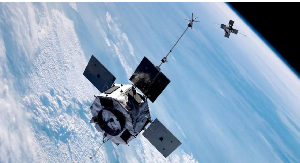
 The two Van Allen Probes were launched in 2012
The Van Allen Probe spacecraft weighing more than 1,300lb (600kg) has re-entered Earth's atmosphere, almost 14 years after its launch.
The US Space Force confirmed the probe's re-entry on Wednesday over the Eastern Pacific region around 06:37 EDT (10:37 GMT), roughly 12 hours later than originally predicted but within the expected margin of error.
Most of the probe, which launched in 2012, was expected to burn up as it travelled through the atmosphere, though some components may have survived.
The space agency said there was a one in 4,200 chance of being harmed by a piece of the probe, which it characterised as "low" risk.
The spacecraft and its twin, Van Allen Probe B, were on a mission to gather unprecedented data on Earth's two permanent radiation belts.
The mission, which was originally designed to last two years, went on for almost seven. It ended after the spacecraft ran out of fuel and was no longer able to orient itself toward the Sun.
The probes flew through rings of charged particles trapped by Earth's magnetic field from 2012 to 2019, in order to study how particles were gained and lost, per NASA.
Those rings, called the Van Allen belts, shield Earth from cosmic radiation, solar storms, and streaming solar wind, which are harmful to humans and can damage technology.
The mission made significant discoveries, including the first data that show the existence of a transient third radiation belt, which can form during times of intense solar activity, NASA said.
Van Allen Probe B is not expected to re-enter the Earth's atmosphere before 2030.



Copyright © 1994 - 2026 GhanaWeb. All rights reserved.










