



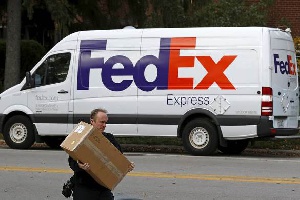
 Postal company FedEx
The global transportation and postal company FedEx has filed a lawsuit for a "full refund" of Donald Trump's emergency tariffs.
The US president introduced higher tariffs on imports from most countries last April under the International Emergency Economic Powers Act (IEEPA) - but the US Supreme Court ruled last week that the law did not allow him to impose the levies.
The decision has paved the way for companies to seek a refund on the additional import duties paid since they were introduced last year.
"Plaintiffs seek for themselves a full refund from Defendants of all IEEPA duties Plaintiffs have paid to the United States," FedEx said in its lawsuit.
The company did not say in its suit what value a refund it was seeking. It named US Customs and Border Protection (CBP), the agency's commissioner Rodney Scott and the US as defendants.
It said in its filing with the US Court of International Trade that it had been responsible for paying the tariffs and was seeking redress for that.
FedEx said in a statement on Monday that it had "taken necessary action to protect the company's rights as an importer of record to seek duty refunds" from CBP following the Supreme Court's ruling.
The BBC has approached the CBP for comment.
On Monday, 22 US Senators, all Democrats, introduced legislation that requires the Trump administration to fully refund all revenue, with interest, collected from tariffs within 180 days.
The legislation requires CBP, which would oversee the reimbursements, to prioritise small businesses.
It's estimated the Trump administration has brought in at least an additional $130bn (£97bn) from tariffs imposed on most goods imported into the US through the IEEPA.
While the court's ruling determined that Trump's IEEPA tariffs were not legal, it did not offer guidance on returning the money to those who had paid the taxes.
Speaking after the decision was released, both Trump and Treasury Secretary Scott Bessent said the issue of refunds could drag through the courts for years.
In recent weeks, prior to the decision release on Friday, hundreds of firms, including cosmetics company Revlon, aluminium giant Alcoa and food importers like tuna brand Bumble Bee, filed lawsuits contesting the tariffs, in a bid to get in line for a refund.
Costco was also among the companies that pre-emptively sued the Trump administration last year, writing in its lawsuit: "The text of IEEPA does not use the word 'tariff' or any term of equivalent meaning."
On Friday, Trump signed a proclamation using an alternative law, Section 122 of the 1974 Trade Act, which places a new 10% temporary tariff on goods from all countries. He said on Saturday that he would be increasing these new tariffs to 15%.



Copyright © 1994 - 2026 GhanaWeb. All rights reserved.










