



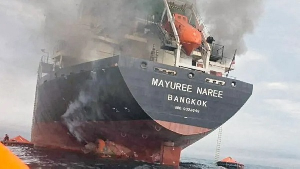
 A Thai cargo ship on fire after being struck by a projectile 11 nautical miles north of Oman
Drones, cruise missiles and fighter jets have become a common sight for many sailors stranded on oil tankers and freight ships in the Gulf, after Iran threatened to open fire on any vessels trying to cross the Strait of Hormuz, in response to US-Israeli attacks.
In recent days, there has been a growing number of reported attacks on ships in the Gulf region, as Iran responded to attacks by the US and Israel by threatening to open fire on any vessels trying to cross the Strait of Hormuz.
The Strait is a key artery for shipping, both for energy supplies and vessels carrying other goods. The sudden outbreak of war has left many ships – and their sailors stranded at sea as they watch strikes play out on land around them and overhead.
"I have seen Iranian drones and cruise missiles flying at low altitude," says Amir, a Pakistani sailor who is on board an oil tanker in the United Arab Emirates, which cannot leave the area. "I also hear the sound of fighter jets, but we can't identify which country they belong to."
What scares him the most is the thought of an intercepted drone or missile falling on his vessel.
Hein, a sailor from Myanmar, sees skirmishes every day. "Just this morning, two fighter jets fired at each other while we were still working," he says. "There's no specific hiding place on the ship for this, and we just had to run inside."
We have changed the names to Amir and Hein, along with those of the other sailors at sea and their families, to protect their safety.
While it is difficult to get an accurate figure for how many sailors are stranded on ships in the Middle East, Captain Anam Chowdhury, president of the Bangladesh Merchant Marine Officers' Association, estimates that the number is around 20,000.
Some are at sea, and some are stuck in port, but he says it is difficult to assess which is the more dangerous position.
"Inside the port, people might think it's safe, but there have been ships which have been bombarded when they were anchored," he explains.
His organisation has tracked at least seven ships, it says, that have been hit by projectiles and damaged in the war so far.
He says on 1 March, a sailor was killed on board the Skylark, a tanker registered to the Republic of Palau.
Captain Chowdhury says the surviving sailors have been "traumatised" by the attack, during which the engine room caught fire and the crew evacuated.
Other mariners agree. Captain M Mansoor Saeed sails oil tankers, and tells BBC News he believes that when it comes to avoiding attack, there is little difference between being at port or sea: "If they want to target my ship, they will target it."
But, he says, generally large ships can be safer away from the coast. "In heavy weather conditions, we always run to open sea, where we have more water and depth to manoeuvre freely. In ports and confined waters, weather can damage the vessel by grounding or hitting the quay walls."
Difficulties getting information at sea
The precarious situation has made the families of seafarers burn with worry.
Because authorities in Iran have blocked internet and phone networks for most people in Iran, it has been difficult for the family members of sailors to get news about their whereabouts. Although access does sometimes come back, it is unpredictable and usually for short periods.
Ali Abbas's son is on a ship at an Iranian port near the Strait of Hormuz. He last spoke to his son several days ago, when he was telling him about a missile attack. His son escaped, but an Indian sailor was wounded.
"I have hidden this from my wife and daughter-in-law," he says tearfully.
On Tuesday night, there was another severe attack on the port and Ali hasn't been able to talk to his son. "For God's sake, please help me," he says, breaking down with emotion. Ali hopes his son is still alive and well, and the communication system failure is to blame for the lack of contact.
Sat-nav interference
Seo-jun (name changed) captains a boat with more than 20 crew members from South Korea and Myanmar. He says satellite navigation has been breaking up – posing extra risks.
"Since the war began, GPS interference has occurred intermittently, but it has become much worse over the past three or four days," he says.
When their boat entered Dubai, the sailors had to navigate without GPS.
"There's a Korean saying that describes it as 'like a blind person feeling for a doorknob'," he says.
Supplies running low
Apart from worrying about their safety, many sailors fear that water and food will run out soon.
On Seo-jun's ship they have enough fresh food for 15 days, but drinking water has become a worry.
"The ship can produce fresh water by desalinating seawater, but that becomes difficult if we are not sailing," he says.
"It's already been two months since we got the provisions on board," a Pakistani sailor, Masood, says.
Before the war, Hein says his ship offered buffet meals and the crew could get fresh food like eggs, and water whenever they wanted.
But now a quota system is in place on Hein's ship and they only get one meal of four small pieces of meat and one bowl of fried vegetables daily. Their supplies will only last for a month, and the boat's fresh water generators aren't working.
"Our life is very humiliating here and we have very little fuel and food," says another Pakistani sailor, Zeeshan.
"Nobody can be happy and relax in this situation," Amir says. "We keep ourselves busy in daily routine jobs. Drills, safety and security training."
Hein, who works as a senior engineer on the vessel, agrees. "I don't allow myself to become desperate because I am in charge of 20 other Myanmar crew members."
He has also prepared a contingency exit plan if the situation deteriorates further. "I told my team how to run, where to jump from and what to carry if something happens."
Even if the sailors reach land after their vessels are docked in a safe port, there may be no easy way for them to get home or leave the region.
Hamza says his son, who is stuck on a ship, is among sailors "not being allowed to leave" because their companies have their passports.
At the same time, frightened sailors who don't fulfil their contracts by abandoning ship will have difficulties finding future employment as shipping companies may blacklist them.
The situation is desperate, and Amir says he can only hope for the best and pray for the safety of all seafarers.
He also urges shipping companies not to force their crew to pass the Strait of Hormuz.
Those fears are hypothetical, but he worries that financial pressures could override safety. He says if any vessel is hit by a drone or a missile it is the sailors who pay the human cost, while cargo and ships can be covered by insurance. "Human life cannot be replaced by any insurance," he says.
He believes that the war will significantly change the seafaring industry.
"The style and purpose of this war is very different from what we saw in the past few years. This war will have long-term effects on the trade in the Persian Gulf."
Captain Chowdhury believes sailors are caught up in events they have no responsibility for.
"People should not victimise the ships. When you victimise the ship, you victimise the seafarers also, who are innocent people," he says.



Copyright © 1994 - 2026 GhanaWeb. All rights reserved.










