



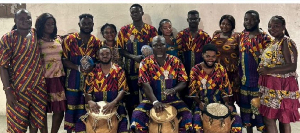
Bright Lodo is a recognized kora player known for his exceptional skill on the instrument. Performing within a group setting, he utilizes the kora’s 21 strings to weave intricate melodies that highlight his mastery of the traditional West African "harp-lute". The kora is a traditional West African stringed instrument often classified by ethnomusicologists as a "bridge harp" or "harp-lute". It features a large, rounded body made from a hollowed-out calabash gourd covered in animal hide, which serves as a resonator to produce a warm, earthy tone. • During performance, Bright grips two wooden hand posts on either side of the neck for stability, uses his thumbs and index fingers of both hands are used to pluck the strings. This technique allows the player to perform complex polyphonic music, often playing a steady bass line (kumbengo) with the thumbs while simultaneously improvising melodic solos (birimintingo) with the index fingers.
Isaac Owusu is a dedicated member of the cultural group and known for playing the Gome drum, a traditional "box drum" fundamental to the Ga and Ashanti musical heritage of Ghana. Originally introduced to Ghana by coastal Ga fishermen, the Gome is now a staple in various social occasions and cultural festivals across the country. The Gome is a unique percussion instrument known for its versatility and distinctive physical form:. It is handcrafted from solid Odum hardwood into a large rectangular frame, with a goat or cow skin head stretched over it and a mechanical or metal press system for tuning. Isaac plays the drum by sitting directly on top of its wooden frame, which rests on its side. Unlike many other drums, Isaac uses both his hands and the heels of his feet to perform. He strikes the skin with his hands while using his heels to press against the drum head, allowing him to modulate the pitch and produce a wide tonal range that includes thick, warm tones, sharp slaps, and deep bass notes.
Leticia Adobea is a prominent performer within the Manklalo Cultural Group, a renowned Ghanaian group dedicated to preserving and showcasing the nation's rich folk heritage. Within the group, she plays a vital role as a skillful Atumpan player, which happens to be the iconic "talking drum" of the Akan people of Ghana. As an instrumentalist in the Manklalo Cultural Group, when on stage, Leticia typically uses two wooden sticks shaped like the number seven (known as nkonta) to strike the drumheads. To achieve the complex "speech" patterns of the talking drum, she uses her palm or fingers to dampen the membrane while striking, further modulating the sound. She performs with the drums positioned side-by-side (traditionally with the female drum on the right and male on the left) to allow for the rhythmic interplay required for traditional Adowa and Kpanlogo patterns. The Atumpan is a large, goblet-shaped drum carved from the durable wood of the Tweneboa tree and covered with a drumhead made of animal hide (typically goat or antelope).
Henry Akuetteh is a versatile vocalist and also a key member of the Manklalo Cultural, known for their dynamic presentations of West African music and dance. Within the group, Henry serves as a multi-range male vocalist, expertly performing both tenor and baritone roles. In the context of West African cultural and choral music, these vocal parts serve distinct structural and emotional functions; The Tenor (High Male Voice): Known as the "high-flying" voice, the tenor part is typically bright, agile, and powerful. In traditional Ghanaian music, tenors often lead melodic phrases or provide the upper-harmonic intensity required for high-energy styles like Asafo (warrior songs) or choral works. The Baritone (Middle Male Voice): Often described as the "glue" of an ensemble, the baritone occupies a warm, rich middle range. In African vocal arrangements, baritones bridge the gap between the high tenors and deep basses, providing harmonic depth and resonant fullness to the group's sound. Henry utilizes his dual vocal ability to enhance the Manklalo Cultural Group's varied repertoire through several traditional performance techniques.
Rita Addo is member of the cultural group , where she performs as a high tenor vocalist and a traditional dancer. Her vocal part is characterized by bright Timbre. Her voice adds a "high-flying" intensity to the group’s sound, often heard over the other voices.Typical of African choral traditions, her singing emphasizes a clear, stable tone with minimal vibrato for a precise and unified group sound. Rita doubles as a traditional dancer, mastering varied regional styles that represent the cultural fabric of Ghana: some dances she performes are Adowa (Akan): She performs this graceful dance using rhythmic swaying, expressive hand gestures, and intricate footwork that imitates the movements of a royal antelope. Borborbor dance by the ewe tribe of Ghana is a spiritual and communal dance, Rita sways to rhythmic beats while spinning white handkerchiefs in the air, often in a circular formation. Another famous cultural Ghanaian dances she performs is Kpanlogo (Ga): A high-energy recreational dance where she uses rapid torso movements, waist-spinning, and rhythmic hand-clapping to engage the audience. In performance, Rita often integrates both roles, maintaining the complex polyrhythms of the high tenor vocal lines while simultaneously executing the precise physical steps required for each traditional dance.
Eliasu Mustapha is a musical genius in the Prempensua, a traditional Ghanaian "box piano" that serves as the rhythmic and melodic foundation for many West African folk ensembles. This fascinating percussion instrument is characterized by its large, rectangular wooden resonance box, which typically features a central sound hole in the front to amplify its deep, earthy tones. The Prempensua instrument is often described as a distant relative of the Mbira or Kalimba, though it is significantly larger in scale. The instrument features three to five large tongues (or keys) traditionally crafted from split bamboo, though modern versions may use tempered metal for enhanced resonance and durability. Each key is tuned to a specific low-frequency pitch, allowing the instrument to function as a portable "bass guitar" within a traditional acoustic setting. How Eliasu Mustapha Performs
Eliasu plays the instrument by sitting directly on the wooden box or positioning it between his legs. His performance technique plucking: (using his fingers and thumbs, he plucks the ends of the bamboo or metal tines to create a percussive, melodic thump), rhythmic anchoring ( Unlike the mbira, which is often used for intricate solo melodies, Eliasu utilizes the Prempensua as a bass rhythm tool. He provides a steady, pulsing foundation that anchors the polyrhythms of the drums and supports the vocalist) and acoustic modulation: By partially covering or uncovering the sound hole with his hand while plucking, he can subtly alter the timbre and volume of the notes, adding a dynamic "breathing" quality to the groups overall sound.
Richmond Kofi Asare is a distinguished percussionist and a key member of the group, where he plays the conga drums. Renowned for his technical precision and deep understanding of West African polyrhythms, Richmond has built a career centered on preserving and innovating traditional sounds within modern cultural performances. Within the group, Richmond’s conga playing serves as the rhythmic "heartbeat" that bridges traditional drum sets, like the Kpanlogo or Djembe, with melodic elements. His patterns provide a steady, driving energy that anchors the dancers' movements and maintains the tempo for the vocalists. Because the conga has roots in both African and Afro-Cuban traditions, Richmond uses the instrument to add a unique tonal warmth and "groove" that modernizes the group’s traditional repertoire. Richmond is highly skilled in the diverse array of strokes required to bring the conga to life: He utilizes a sophisticated combination of open tones for resonance, sharp slaps for high-pitched accents, and bass tones(palm strikes) to produce deep, percussive thumps. he uses dynamic modulation by varying the pressure of his hands and the location of his strikes on the drumhead, he can mimic the "talking" qualities of traditional Ghanaian drums, communicating emotion and intensity to the audience. Richmond uses physical engagement when playing. He typically performs with a set of two or three congas (the quinto, conga, and tumba), allowing him to play multi-tonal melodies that complement the higher-pitched percussion in the ensemble.
Mohammed Affum is a highly skilled bass guitarist and a vital member of his cultural ensemble, where he provides the harmonic and rhythmic foundation for their West African repertoire. Within the group, his role is to bridge the gap between the complex polyrhythms of the percussion and the melodic lines of the vocalists and instrumentalists. Mohammed Affum’s playing style is characterized by a blend of technical precision and cultural sensitivity. He performs using several key techniques, finger style and thumping. Mohammed primarily uses his fingers to pluck the strings, creating a warm, round tone. To emulate the percussive nature of traditional Ghanaian drums, he may also use slap-and-pop techniques, adding a rhythmic "crack" to the music. another technique is locking with the percussion: Mohammed’s primary objective is to "lock in" with the master drummer and the Gome or Conga players. By aligning his bass notes with the low-pitched strikes of the drums, he creates a unified, driving rhythmic force that is essential for both the dancers and the audience.
Princess Owusu is a distinguished performer of the Seprewa, a traditional Ghanaian "harp-lute" with deep roots in Akan culture. Historically significant as the precursor to the modern guitar in West Africa, the Seprewa was once the primary melodic instrument for storytellers and royal courts before Western instruments became more common. Though it shares a common ancestry with the Senegalese Kora, the Seprewa possesses several unique structural features, the instrument is made of wooden sound box. Unlike the Kora, which uses a large calabash gourd, the Seprewa features a rectangular or square sound box handcrafted from solid wood and covered with animal hide. It has a compact design: It is significantly smaller and more portable than the Kora, making it an intimate instrument traditionally used for personal reflection and historical narration. One characteristic of the instrument is the bridge and strings: It utilizes a bridge system to support its strings (traditionally six to ten), which are arranged in two parallel rows. Princess Owusu performs the Seprewa using a bilateral plucking technique similar to that of a Kora player. Dual-Hand Plucking: She uses her thumbs and index fingers to pluck the strings, allowing her to play a melodic line on one side while providing a rhythmic accompaniment on the other.
Comfort Amoah is a skillful performer within the group, embodying the multifaceted nature of Ghanaian folk music, where vocal performance, instrumentation, and movement are inextricably linked. Serving as the group’s treble singer, she provides the high-register melodic clarity that is essential for traditional West African vocal arrangements. As a treble vocalist, Comfort is responsible for the ensemble’s highest vocal parts, characterized by melodic leadership (her bright, soaring voice often carries the primary melody or provides the sharp, distinctive "call" in call-and-response sequences) and harmonic brilliance (she adds a layer of shimmering harmonic texture that cuts through the percussive weight of the drums, ensuring the group's singing is both powerful and emotive).
Peter Ayamga is the percussionist responsible for the claves within the ensemble, an instrument that provides the foundational rhythmic "key" for West African and Afro-Latin music. The instrument consists of two solid, short wooden sticks—traditionally 8 to 10 inches long—crafted from dense hardwoods like rosewood, grenadilla, or ebony to ensure a sharp, penetrating tone. Playing the claves is a sophisticated technique that relies on acoustic physics rather than brute force. Peter utilizes a specific method to ensure the instrument resonates with maximum clarity; The Resonating Chamber. Peter holds the resting stick (known as the hembra) loosely in his non-dominant hand. By cupping his palm and supporting the stick only with his fingertips and thumb, he creates a natural sound chamberbeneath the wood.the second is the strike: Using his dominant hand, he strikes the center of the resting stick with the end of the second stick (the macho). Lastly, acoustic amplification: This "cupping" technique is essential; if the stick were held tightly against the palm, the vibrations would be muffled. Instead, Peter’s technique allows the wood to vibrate freely, amplifying the sound so it can cut through the dense polyrhythms of the drums and the voices of the singers.
Ebenezer Sarpong os one of the renowned djembe players in the cultural fraternity, masterfully performing on this traditional rope-tuned, goblet-shaped drum that features a skin-covered head designed to be played with bare hands. The djembe is celebrated for its remarkable tonal range, which Ebenezer achieves by striking specific areas of the drumhead to produce three fundamental acoustic notes, bass (a deep, low-pitched resonance created by striking the center of the drum with a flat palm). Tones (full, medium-pitched sound produced by striking the edge of the drum with the fingers kept together). Slap (sharp, high-pitched "crack" achieved by striking near the rim with relaxed fingers, allowing them to rebound quickly). Through his technical proficiency, Ebenezer utilizes these distinct sounds to drive the group’s rhythmic intensity and provide the essential percussive foundation required for West African dance and song.
As a master in playing Mpintintoa, Jazzy Akakpo plays a critical role in ensuring the group delivers an authentic Ghanaian cultural experience by performing on this traditional gourd drum originating from Northern Ghana. The Mpintintoa is a distinctive percussion instrument crafted from natural, durable materials that contribute to its unique acoustic profile, body (It features a large, hollowed-out calabash gourd that serves as a resonant sound chamber), head and tension (supple piece of goatskin is stretched across the opening and secured with a network of leather ropes, which allow for tuning and provide the drum with its rustic, traditional appearance) and portability (the drum is designed with a shoulder strap, allowing it to hang comfortably against the player's chest during high-energy performances). Jazzy Akakpo’s mastery of the Mpintintoa involves a high degree of physical coordination and rhythmic precision like bimanual striking which performs using both hands directly on the goatskin head, utilizing a combination of palm strikes and finger taps to produce a variety of tones. He also uses tonal variation by adjusting the positioning of the drum against his body or varying the force of his strikes, Jazzy can produce deep, thumping bass notes or sharper, more melodic accents. There’s is also Ensemble Integration, within the group, his role is to provide the steady, rhythmic pulse characteristic of Northern Ghanaian folk music, creating a textured layer of sound that complements the higher-pitched percussion and vocal harmonies.
Kingsley Osei is a seasoned musician within Manklalo cultural group, serving as the talking drum (often known as the Dondo in Ghana), an iconic hourglass-shaped instrument prominent across Northern Ghana and the West African region. The talking drum is distinguished by its unique engineering and expressive capabilities, firstly, hourglass shape: The drum features a wooden body narrowed in the middle, with two drumheads connected by a series of tension cords or leather "ribs" running the length of the instrument. Lastly, dual-head system: It is designed with animal hide membranes on both ends, allowing it to resonate with a distinctive, fluid pitch. Kingsley demonstrates technical mastery through a physical playing style that allows the drum to "speak”, there is pitch modulation: He holds the drum under one arm and uses his arm muscles to squeeze and release the vertical cords. By increasing the tension on the cords, Kingsley raises the pitch of the drum; by releasing them, he lowers it. Another is stick and sand play: He strikes one drumhead with a specially curved wooden stick while his other hand can provide additional dampening or rhythmic accents Mimicking speech is also the ability to shift pitch mid-strike allows Kingsley to mimic the tonal fluctuations, glides, and rhythms of human speech, enabling him to "talk" to the audience and fellow performers through his music.
Having been a member of the group for several years, Kingsley utilizes the talking drum to add a sophisticated layer of tonal communication that is central to an authentic Ghanaian cultural performance.



Copyright © 1994 - 2026 GhanaWeb. All rights reserved.










