



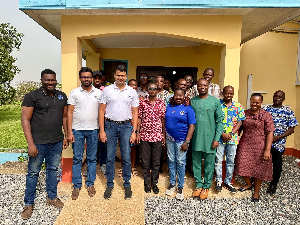
Ghana is taking a bold step toward climate-smart agriculture with the launch of an innovative early detection system designed to combat palm weevil infestations in coconut and oil palm plantations. The initiative forms part of Innovate UK Climate Smart Agricultural Partnership project (UK (Permia Sensing) Brazil (Embrapa) and Ghana (CSIR OPRI) titled “Early Detection of Palm Weevils Using Bioacoustic and Multimodal Sensing in Ghana.”
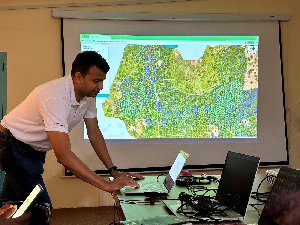
Palm weevils are among the most destructive pests affecting coconut and oil palm production, often causing irreversible damage before visible symptoms appear. To address this challenge, the project is piloting and validating an AI-driven surveillance system that detects infestations at an early stage—before widespread crop losses occur.
The project integrates three complementary technologies to enhance detection accuracy and speed. First, bioacoustic sensors are deployed to detect the subtle sounds of larval feeding within palm trunks—an early indicator of infestation. Second, pheromone-baited traps are used to monitor adult weevil populations and track pest pressure across plantations. Third, drone-based multispectral imaging systems capture high-resolution canopy data, enabling researchers to identify early stress signals in palms by analyzing vegetation indices and reflectance patterns associated with infestation.
By combining these technologies with artificial intelligence, the system analyzes complex data streams to distinguish between healthy and stressed palms, allowing for rapid intervention. The ultimate goal is to develop an operational protocol for routine surveillance and rapid response that can be adopted by farmers and plantation managers nationwide.
Elizabeth Tettey, an entomologist(CSIR-OPRI), explained that the technology will help farmers save money by avoiding the need to spray the entire farm. Instead, they will be able to target only the specific palm tree that is infested
Dr. Isaac Danso, Director of CSIR-OPRI, also stated that incorporating drones into agricultural services is the way forward
Early detection helps identify when the insect appears so that the appropriate method can be used to control it and prevent damage to coconut and palm trees, said by Dr. Daniel Ansah Fianko(CSIR-OPRI)
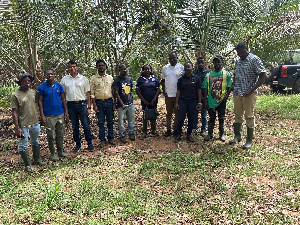
The expected beneficiaries include coconut farmers, oil palm growers, and agribusiness companies across Ghana. Early detection will reduce crop losses, lower management costs, and minimize excessive pesticide use—supporting both environmental sustainability and farmer livelihoods.
Beyond immediate agricultural benefits, the project is expected to strengthen domestic coconut and oil palm production, contributing to food security and retaining economic value within Ghana.
The initiative also contributes significantly to scientific knowledge. It will generate empirical evidence on the effectiveness of AI-driven pest detection tools while deepening understanding of palm weevil biology, infestation progression, and early-stage indicators in tropical plantation systems.
The findings will guide policymakers, extension services, and agri-tech developers on best practices for deploying AI-enabled pest surveillance technologies.
As Ghana confronts the growing threats posed by climate change and agricultural pests, this pioneering partnership positions the country at the forefront of smart, technology-driven solutions for sustainable crop protection.
(Story by Danquah Enock idan CSRI-OPRI KUSI E/R)

Copyright © 1994 - 2026 GhanaWeb. All rights reserved.










