



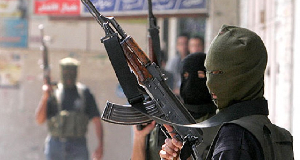
 Terrorist assault in Mali led to the death of the country’s Defence Minister
Last weekend’s terrorist assault in Mali that led to the death of the country’s Defence Minister, Sadio Camara, has sent shockwaves across West Africa, with foreign policy experts warning that Nigeria could be next if regional coordination and intelligence do not improve.
The experts, who spoke in separate interviews with Vanguard, warned of a domino effect that could see similar attacks spill into Nigeria’s North-West and North-Central regions if urgent action is not taken.
Jihadist militants, in a rare show of unity with Tuareg separatists, had over the weekend launched coordinated attacks across multiple regions in the country, thereby renewing fears about the southward spread of Sahelian jihadism into Nigeria’s North-West and North-Central regions.
The assault comes amid rising jihadist violence in the Sahel following coups in Mali, Burkina Faso and Niger, the withdrawal of French forces, and the exit of United Nations (UN) peacekeepers.
Nigeria’s North-West and North-Central are already battling banditry and insurgent-linked attacks, including a recent raid on an orphanage in Kogi State.
The experts, meanwhile, agree that while Nigeria has security architecture in place, the Mali precedent shows that jihadist groups are scaling up coordination and ambition, and warned that without regional unity, intelligence, and clear results, Nigeria could be the next target.
Domino theory playing out — Otubanjo
Prof Femi Otubanjo, Research Professor at the Nigerian Institute of International Affairs (NIIA), said Nigeria obviously has reason to worry over the development in Mali, saying the “domino theory” seems to be playing out.
“There’s a military principle called the domino theory. If one domino falls, the other dominoes are likely to fall. West Africa is the epicentre of extreme jihadism in the world now. If any jihadist group has the upper hand in any country, it’s going to be an encouragement to the others around,” Otubanjo said.
“If they take Mali and become the government of Mali, obviously it means that we should be expecting the expansion of jihadism in the sub-region.”
He lamented that Nigeria’s insurgency does not seem to be diminishing despite years of military operations, and criticised the lack of tangible results from Nigeria’s security strategy.
“It’s like somebody goes into an exam and spends three hours writing the paper. The fact that he completes the paper does not mean that he will pass. The result is what will determine the outcome. We are not seeing any tangible results from our military or our security strategy,” he said.
He pointed to external support and encouragement, saying: “When terrorist organisations begin to come together, it means that there are forces outside that are bringing them together. It means that they are being supplied and encouraged.”
On the Multinational Joint Task Force (MNJTF), he said: “They ought to be equipped. We are spending a very huge proportion of our budget on security affairs, but we have not seen the results.”
He warned that insecurity was displacing northerners and crippling commerce. “Any fever in any part of West Africa will have serious consequences for the other parts. There’s no country in West Africa that can take the scourge of refugees that will come from Nigeria if we get into any violent altercation with ourselves.”
He urged ECOWAS to become the centre of counterinsurgency in West Africa and called for proactive regional coordination, open national conversation on security, and better intelligence gathering. “We need to be proactive… If we are not able to deal with it ourselves, seek international assistance. Until the problem is solved, you must continue to find solutions,” he stressed.
No need to panic, but tighten security — Ochogwu
Dr Joseph Ochogwu, Director-General of the Institute for Peace and Conflict Resolution (IPCR), said coordinated attacks can happen anywhere if intelligence fails.
“You can see the attack on the President of the United States, Donald Trump. Enemies of the state are daredevil people who want to create a sense of insecurity,” he said, citing the Kuje prison attack near Abuja.
He emphasised the need for the government to strengthen intelligence and tighten security, stressing that the state must create a strong deterrent effect: “that if you dare, you won’t succeed and you’ll pay dearly for it.”
Ochogwu argued that Nigeria’s security architecture was holding firm.
He said: “If they are not in place, we would have been overrun. You know the number of Guards Brigade, artillery divisions and intelligence units that are out there.”
He, however, urged citizens’ cooperation, saying it is key to curtailing insurgency. “When you as a citizen see something, you alert them, you’ve played your role… Once the information comes, there should be action. Oftentimes, that is where the problem lies.”
On counterterrorism, he said Nigeria needs partners to provide satellite imaging and precision equipment. “We have the men on the ground. We have the air component. This is a time for counterterrorism partners to support Nigerian counterterrorism efforts.”
Ayeleru warns of wider risks
Prof Babatunde Ayeleru of the Department of European Studies, University of Ibadan, and former CEO of the Nigeria French Village, Lagos, said it would be unwise to assume such coordinated attacks cannot happen in any West African country, including Nigeria, and called on the government to intensify efforts against insurgency.
He said: “Nigeria needs to learn from the Malian experience and double her efforts in the war against insurgency and insecurity. Nigeria is currently vulnerable given the spate of violent attacks going on in a number of northern states.”
He called for the MNJTF to be further strengthened and warned that ECOWAS disunity was a threat. “The crack experienced as a result of the exit from ECOWAS by the Sahel countries of Mali, Niger and Burkina Faso is already a source of concern for the maintenance of peace in the subregion,” he said.
Ayeleru said the capture of Malian cities “is capable of weakening the security architecture of Nigeria as a neighbouring country.”
He predicted illicit trade, weapon smuggling and disruption of food supply to Nigeria as a result, and urged Abuja to “suspend ongoing efforts at reopening its borders with those troubled countries.”
The real gap is operational — Ojumu
Femi Ojumu, foreign policy expert and international lawyer, said the Mali experience mirrors the devastation Boko Haram, ISWAP and Lakurawa groups have inflicted in northern Nigeria.
He noted that despite gallant troops, Nigeria was hampered by an operational gap between strategic interagency coordination, actionable intelligence and effective kinetic operations.
He said though foreign partnership is good, Nigeria needs “organic development of its own security arrangements which prioritise its national interests.”
He stated that MNJTF and ECOWAS security arrangements have proven incapable of sustainably quelling terrorism. “That challenge speaks to significant internal divisions within ECOWAS itself, not least with the exit of Burkina Faso, Mali and Niger. Again, that lacuna imperils the effectiveness of counter-terrorist activities in the Sahel,” Ojumu said.
Similar attacks already happening in Nigeria — Oshodi
Also speaking, Dr Abdul-Gafar Tobi Oshodi of the Department of Political Science, Lagos State University, said the Mali killings are not new to Nigeria, noting that similar daring attacks are already occurring.
“The question isn’t about whether similar attacks can happen in Nigeria; they’re already here,” he said.
“The last couple of months have been deadly. From Adamawa, Borno to Jos, the lives of Nigerians have been cut short. Just like Gen Camara, Brig Gen Oseni Braimah was killed by Boko Haram a few weeks ago. Earlier, Brig Gen Musa Uba was killed by ISWAP late last year. In many ways, the same daring attacks have happened in Nigeria this year. Certainly, the North-West and North-Central are in the eye of the storm,” Oshodi said.

Copyright © 1994 - 2026 GhanaWeb. All rights reserved.










