


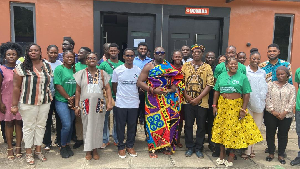
 Some of the stakeholders at the event
A Professor of Global Development Studies and Director of the African Studies Program at the University of Calgary, Canada, Professor Caesar Apentiik, has called for a coordinated and multidimensional approach to combat transnational crime, stressing that the growing threat cannot be addressed by law enforcement agencies alone.
“We need to work as a team because the problem of transnational crime is multidimensional. We need the law enforcement, the banks, the government and psychologists. It is a multidimensional problem that needs multidimensional solutions,” he stated.
Professor Apentiik made the remarks at the launch of the Civil Society Coalition Against Transnational Crime in Accra on August 12, 2026, held to coincide with the commemoration of International Youth Day.
The newly formed coalition is advocating a united front involving government institutions, civil society organizations, traditional authorities and the private sector to dismantle organized crime networks operating across the country.
The coalition will coordinate the efforts of civil society organizations working across nine critical areas: human trafficking, cybercrime, illicit finance, illegal mining, drug trafficking, weapons trafficking, maritime crime, extremism and corruption.
The initiative builds on discussions from the national forum, “Trapped Behind the Scam,” held on July 30, 2026, which drew attention to the increasing incidence of trafficking for forced criminality.
Speaking on behalf of the convenor, Daniel Duncan, at the launch, Princess Yanney, said a key objective of the initiative is to ensure that victims of trafficking are properly identified and supported rather than being treated as offenders.
Referring to a July 21, 2026 operation in Afienya, where nine victims were rescued and 10 suspects arrested, she questioned whether adequate victim-support mechanisms had been activated.
“Was anybody assigned to them? Was there a file? Did anyone sit down with each of them and ask the questions that determine whether a person has been trafficked?” she asked.
Princess Yanney explained that the coalition would establish nine specialized working groups guided by a strict charter that promotes ethical conduct and safeguarding standards.
She described the initiative as “one coalition working nine fronts of a single economy,” emphasizing the interconnected nature of organized crime.
Highlighting the scale of the challenge, Professor Apentiik cited findings from the 2025 Global Organised Crime Index, which showed that Ghana scored 5.77 out of 10, ranking 21st among 54 African countries and sixth in West Africa.
“Organised crime in Ghana is no longer an abstract threat discussed in the media or security briefings. It is here with us, and it is entrenched,” he warned.
He stressed that civil society organizations have a crucial role to play by complementing government efforts through community-based intelligence gathering and advocacy for accountability.
Also speaking at the event, the Head of Programmes at the Ghana Red Cross, Jeremiah Afako, called for a human-centred approach to tackling organized crime. He noted that young people, who are often targeted by criminal networks, must be engaged as active partners in prevention efforts rather than being viewed solely as victims.
The Guest of Honour and Dufia of the Agbesia Traditional Area, HRM Togbe Adze II, underscored the importance of involving traditional leaders in efforts to combat trafficking and exploitation.
He cautioned young people against fraudulent job offers, noting that legitimate employers do not confiscate passports or demand recruitment fees.
Togbe Adze II further challenged the coalition to extend its work beyond conferences and workshops by drawing on the knowledge and influence of community leaders.
“We know which families have someone away, we know when money has appeared without explanations. That knowledge is worth more than your workshops and it is free,” he said.
He urged stakeholders to strengthen grassroots collaboration to identify vulnerable individuals, rescue victims and disrupt criminal networks operating within communities.
AM
#TrendingGH: 'Revisit the case' - Netizens react to controversial court ruling

Copyright © 1994 - 2026 GhanaWeb. All rights reserved.










