



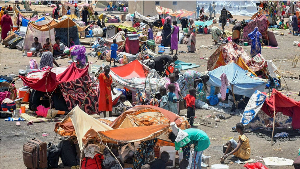
 File photo of refugees
Two European Union (EU) MPs on a working trip to Kampala three weeks ago reportedly broached the idea of Uganda hosting a “return hub”, an offshore detention centre for rejected or unwanted migrants and asylum seekers, Daily Monitor has learnt.
The two EU MPs, Tineke Strik and Anna Strolenber, visited Uganda from September 20, during which they met with among others, the Deputy Speaker of Parliament, Thomas Tayebwa, Office of the Prime Minister (OPM) and Ministry of Foreign Affairs.
The trip, knowledgeable sources told this newspaper, was to facilitate engagements on migration and refugee policy between Uganda and the 27-country political and economic bloc.
In the proposals seen by this publication, the MPs floated financial returns for Kampala in return for cooperation on a third-country migration deal and an offshore detention centre to house between 5,000 and 10,000 unwanted migrants from EU member countries.
The EU Delegation, that represents the EU bloc in Kampala, however, declined to be drawn into discussions on the matter saying the visit by Ms Strik and Ms Strolenberg in September 2026 constituted “a privately organised study visit and not an official visit organised or facilitated by the European Parliament or the European Commission.”
“In this context, the EU Ambassador to Uganda met with Ms Strik and Ms Strolenberg to discuss the objectives of their visit, the visit programme and itinerary. The EU Delegation to Uganda did not facilitate nor participate in any of of their visit, the visit programme and itinerary.
Inexplicably, the Greek English daily, Kathimerini, first reported about the deal, as supported by Germany, Austria, the Netherlands, Denmark and Greece, on August 12 under the headline: “Uganda emerges as migration hub.”
Uganda’s refugee ‘appeal’
During engagements with Deputy Speaker Thomas Tayebwa on September 21, according to a news story published on parliament’s website, he called upon the EU to return to funding Uganda’s multi-sectoral refugee response plan that is currently under weight of seismic shifts in Official Development Assistance (ODA) as traditional donors led by the United States, EU, and elsewhere, Japan, turn focus to local problems.
From our assessment, the current humanitarian funding model is no longer sufficient. Without alternative financing, pressure will overwhelm the government and host communities,” Mr Tayebwa was quoted as telling the two MPs.
According to the government-UNHCR 2025 refugee response plan, at least $980m (Shs3.6 trillion) is required to take care of the 2 million refugees spread across the 13 designated rural refugee settlements along with an urban refugee population in Kampala.
The EU MPs on their part lauded Uganda’s locus in hosting refugees and said European countries could learn from Kampala’s approach to receiving people fleeing all forms of persecution.
“The EU and also the Netherlands can take Uganda as an example of hospitality,” Ms Strik, affiliated to the Dutch Green-Left Party that metamorphosed to Progressief Nederland in July, was quoted by the parliament press time.
Potential migration hub
sources told this newspaper that during the meeting and elsewhere, the two MPs broached a proposal of Uganda hosting an offshore detention for unwanted migrants and asylum seekers from EU member states.
The proposed arrangement would duplicate a 2025 arrangement entered between Kampala and Netherlands “to facilitate the return of migrants who are required to leave the Netherlands to their country of origin via Uganda.”
Gen Jeje Odongo, as Uganda’s Foreign Affairs minister, signed a memorandum of understanding (MoU) for the deal, with the Dutch Minister of Foreign Affairs and Asylum and Migration David van Weel, last year on the sidelines of the UN General Assembly (UNGA) in New York.
On the sidelines of the 81st session of the UNGA last month, Uganda signed another MoU with Austria on “cooperation in the areas of development, migration and mobility.” Uganda’s Foreign Affairs Minister Adonia Ayebare and Austrian counterpart Beate Meinl-Reisinger inked the MoU.
Irregular migration can only be effectively reduced together with our international partners,” Ms Meinl-Reisinger was quoted in a statement by the Austrian Foreign Affairs ministry, adding: “It makes returns possible for people who do not have a right of residence in Austria and creates legal pathways for access to the labour market. For successful migration management and functioning returns, we need reliable partners. We are consistently expanding precisely these partnerships."
Separately, in July 2025 Uganda entered into a similar MoU with Washington to accept migrants who do not qualify to remain in the United States, upon which eight citizens of Ethiopia, Mali, Togo, Mauritania, and Guinea were dumped in Kampala early this year.
The big five involved
During discussions, the EU MPs indicated that a cross-section of EU countries, notably Netherlands, Denmark, Austria, Germany and Greece, were currently in talks for external management of migrants.
The “return hub” in Kampala, once realised, would primarily house between 5,000 to 1,000 migrants and unwanted asylum seekers who decline to return to their home countries, with the assumption that marooning them in Uganda would give them room to ponder to return to their home countries.
In return, Uganda would receive cash compensation and political capital, from the
EU-partner countries involved with a loaded purse.
Mr Vincent Bagiire, the Permanent Secretary in Uganda’s Ministry of Foreign Affairs, confirmed the MoUs with Netherlands and Austria but said he was yet to be appraised about the engagement between his team and the Dutch MPs.
Ambassador Ayebare told this newspaper last evening that the EU Parliament does not determine foreign policy direction for the bloc.
“If we were to enter into such an agreement it would have to be with the respective member countries,” Ambassador Ayebare said.
However, the Greek English daily, Kathimerini, citing diplomatic sources, reported in August that the deal was in advanced stages.
“The five countries’ migration ministers are scheduled to meet in Copenhagen on September 4 to assess progress in the negotiations. Technical teams are expected to travel to Africa before the end of the month for final discussions. Rwanda remains the main alternative option, while Kenya, which had also been considered, appears to have been excluded,” Kathimerini reported.
EU-Uganda relations
The EU is a huge funder of Uganda’s development aspirations, currently through the bloc’s bilateral development cooperation envelope, for 2021–2027, in the region of €539 million (Shs2.4trillion) to Uganda.
Individual EU member states funnel over €750 million (Shs3.3trillion) annually in development assistance to various programmes.
Over the course of 50 years of Uganda – EU relations, the bloc has splurged €5billion (Shs22 trillion) on development assistance in Uganda.
In return, Uganda does security leg work in the region, more significantly fighting al-Shabaab in Somalia, and playing its diplomatic power favourably at international fora.
Uganda and the EU enjoy warm bilateral relations marked by occasional strains.
Most recently, in the aftermath of the 2026 polls, in which President Museveni secured a seventh term with 71.65 percent of the valid votes, the EU Parliament adopted a non-binding resolution condemning post-election violence, marked by the brutalising of Opposition supporters.
The resolution urged the bloc and its member states to review bilateral cooperation with Kampala and called for targeted sanctions against specific political and military personnel responsible for human rights violations.
For long spells Kampala also turned the open-door refugee policy into a political bargaining chip with the Western donors, until development assistance started dwindling.
Consequently, the Ministry of Relief, Disaster Preparedness, and Refugees in late March 2026 announced temporarily halting the country’s years-long open-door policy citing diminished donor inflows.
This as some district local governments hosting refugee settlements have variously decried, particularly refugee youth escaping to the town centres in search of food and employment, which they worried could upset the fragile relations with host communities.
In response to our inquiries, Mr Gyezaho deflected that the proposal in question “would concern bilateral negotiations between EU member states and Uganda, for which the European Commission has received no mandate.”
“The delegation is not in a position to provide further information beyond what was communicated to the media by Ms Strik and Ms Strolenberg,” he added.
However, in the proposals seen by this publication, Uganda, once it agrees to the suggestion of offshore detention centre, would be eligible for trade benefits, including the high preference utilisation rates for local agricultural exports.
Uganda benefits from the EU’s duty-free, quota-free Everything but Arms (EBA) arrangement, alongside high preference utilisation rates for local agricultural exports like coffee.
Attempts to get a comment from the Deputy Speaker’s office were futile by press time as his press secretary, Mr Alex Esagala could not pick or return our calls. The OPM referred this publication to the Ministry of Foreign Affairs.
From asylum seeker to refugee When a system meant to help is abused
At one point in our lives, we were also asylum seekers—not by choice, but because circumstances forced us to flee. Above all, we had to respect the laws and regulations of a country that had...Life

Copyright © 1994 - 2026 GhanaWeb. All rights reserved.










