



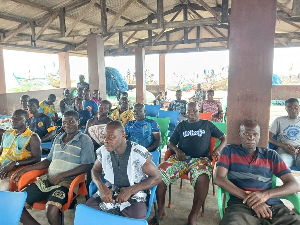
 The exercise forms part of the government's ongoing reforms
Landing Beach Committees (LBCs) across Cape Coast, Abura Asebu Kwamankese (AAK) and Mfantseman in the Central Region have collectively accounted for GH¢545,513.62 in community development funds following an intensive accountability exercise by the National Premix Fuel Secretariat.
The exercise forms part of the government’s ongoing reforms to enforce compliance with Legislative Instrument (L.I.) 2233, which mandates that 53 per cent of proceeds from premix fuel sales be reserved strictly for community development projects within fishing communities.
Minister for Fisheries and Aquaculture, Emelia Arthur, described the exercise as a turning point in fisheries governance.
“Premix fuel is not merely a subsidy. It is a social intervention designed to uplift fishing communities. Government will ensure that funds meant for development reach the people they are intended for,” she said.
According to the Minister, strict enforcement of L.I. 2233 is restoring public confidence and curbing the diversion of resources meant for coastal development.
Premix sector records GH¢27 million in irregularities - Fisheries Minister
The Administrator of the National Premix Fuel Secretariat, Ebow Mensah, said the three-day monitoring tour revealed that many residents were previously unaware that a significant portion of premix sales legally belonged to their communities.
“This exercise has opened the eyes of the communities themselves. People now understand that 53 percent of premix proceeds must return to them in the form of development projects,” he explained.
He added that the engagements had empowered residents to demand transparency and accountability from committee members entrusted with managing public funds.
District-by-district breakdown
Figures released by the Secretariat show that 20 landing beaches in the Central Region’s coastal belt rendered accounts as of February 25, 2026, covering three major districts.
Cape Coast Metropolis
Ola Landing Beach – GH¢14,135.95
Brofoyedur – GH¢28,842.37
Abrofo Mpoano – GH¢21,873.65
Ekon – GH¢32,070.61
Duakor Abakam – GH¢80,744.16
Abura Asebu Kwamankese (AAK) District
Moree – GH¢32,311.26
Efano Moree – GH¢8,000.00
Moree Main – GH¢44,094.62
Mfantseman Municipality
Birwa Main – GH¢16,143.25
Birwa Lower Main – GH¢19,856.37
Komantse – GH¢21,981.03
Komantse Hasowodze – GH¢19,702.52
Nankesedo – GH¢16,274.24
Egyaa – GH¢26,159.24
Anomabo Main – GH¢20,657.43
Anomabo Lower – GH¢47,400.00
Abandze – GH¢28,629.15
Hinii – GH¢17,808.58
Ankaful Saltpond – GH¢31,045.20
Saltpond Main – GH¢17,784.61
The Secretariat indicated that some withdrawals captured in the accounts are currently under review as part of strengthened financial oversight measures.
Communities welcome reforms
Residents across the landing beaches say the renewed accountability measures are already reshaping attitudes toward premix fuel management.
At Moree Landing Beach, fisherman Kojo Mensah, 54, welcomed the reforms.
“For years, we only heard about premix money, but we never saw what it was used for. Now they are explaining everything to us. If this continues, our landing beach will finally see real development,” he said.
In Anomabo, fish processor Maame Efua Nyamekye said the exercise had strengthened community oversight.
“We now know the money belongs to us. The committees must account to the people. This will help improve sanitation and storage facilities for our work,” she noted.
Meanwhile, canoe owner Opanyin Kweku Atta at Birwa Main Landing Beach described the engagement as long overdue.
“Transparency brings peace. When accounts are clear, there is less conflict in the community. We support the government to continue these inspections,” he said.
Reforms under L.I. 2233
The National Premix Fuel Secretariat says the accountability exercise will become a quarterly requirement to ensure strict adherence to L.I. 2233 across all landing beaches nationwide.
According to the Secretariat, the initiative forms part of a broader government effort to restore discipline, strengthen transparency and promote equitable distribution within Ghana’s premix fuel system, while redirecting resources into tangible community development projects along the coast.

Copyright © 1994 - 2026 GhanaWeb. All rights reserved.










