



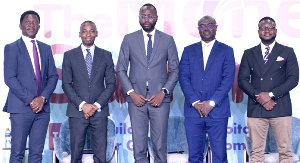
 The market is open and ready to provide patient capital for businesses
Confidence in Ghana’s capital market is steadily returning, creating renewed opportunities for businesses to access long-term financing needed for expansion and sustainable growth, experts at the 2026 Money Summit have observed.
Speaking during the summit’s second plenary session on the theme ‘Mobilising long-term capital for growth and enterprise’, industry leaders highlighted improving investor sentiment, stronger market performance and the need for greater financial literacy and corporate governance to unlock capital for businesses.
Capital market recovery gathering momentum
Head of Marketing and Public Relations at Ghana Stock Exchange (GSE), Jerry Boachie-Danquah, said the country’s capital market has demonstrated remarkable resilience over the past three years – recovering strongly from effects of the Domestic Debt Exchange Programme (DDEP).
According to him, investor confidence is gradually returning; as reflected in sustained growth of the GSE Composite Index and increasing participation in the market.
“As of today the GSE Composite Index has returned 64.21 percent, with total market capitalisation reaching GH¢263billion,” he disclosed.
Boachie-Danquah noted that the market’s recovery has been underpinned by growing confidence in economic outlook and increasing demand for equities as investors search for alternatives to traditional fixed-income investments.
He pointed out that the stock market delivered returns of about 28 percent in 2023, over 56 percent in 2024 and approximately 79 percent in 2025. So far in 2026, the market has already generated returns of around 63 percent.
The strong performance, he said, has enabled listed companies to reward shareholders with improved dividend payments while attracting fresh investor interest.
He also revealed that the exchange has recorded three initial public offerings (IPOs) within the last six months, ending a seven-year period without any new listings.
“Capital will always flow to where there is trust, transparency, accountability and good governance,” he stressed.
The GSE, he added, has intensified investor education programmes and enhanced disclosure requirements to improve transparency and strengthen market confidence.
Boachie-Danquah further highlighted the growing role of institutional investors, particularly pension funds which currently manage assets exceeding GH¢108billion.
“The market is open and ready to provide patient capital for businesses that want to expand and create value,” he said.
Governance key to attracting investment
Director of Stratgrowth Management Partners Ltd., Nana Yaw Owusu Banahene, emphasised that Ghanaian businesses must strengthen corporate governance structures if they hope to attract quality equity investment.
He noted that investors increasingly scrutinise governance standards, regulatory compliance, management capacity and growth potential before committing capital.
“If businesses want to attract proper equity investment, they must be transparent, properly regulated and capable of scaling their operations,” he said.
According to him, many entrepreneurs focus excessively on grants and concessional funding instead of building businesses that are attractive to investors.
“We need to move beyond seeking grants and focus on creating viable businesses with strong investment propositions,” he added.
Banahene stressed that a strong governance framework remains one of the most important factors influencing investment decisions.
Financial literacy critical for wealth creation
Advisory Board Chair of Financial Literacy Africa, Dr Richmond Kwame Frimpong, argued that improving financial literacy is essential to expanding investment participation and reducing poverty.
He explained that financial literacy extends beyond personal budgeting and savings and should encompass a broader understanding of economic developments and financial systems.
“Financial literacy exists at three levels – the macro level, where citizens understand economic developments and their implications; the institutional level, where organisations manage resources effectively; and the micro level, which focuses on personal financial management,” he said.
Dr Frimpong encouraged Ghanaians to leverage opportunities within the banking, pension and insurance sectors to build long-term wealth and strengthen their financial resilience.
He also highlighted the growing role of financial technology in expanding access to investment opportunities and financial services.
Inclusion of informal sector remains a priority
Managing Director-EDC Investment Ltd., Paul Mantey, underscored the importance of long-term investing and broader financial inclusion.
According to him, wealth creation requires discipline and patience regardless of prevailing economic conditions.
“You cannot build sustainable wealth without a long-term mindset and financial discipline,” he stated.
Mantey expressed concern about the low level of pension participation in Ghana, noting that only about 2.1 million people currently contribute to pension schemes despite the country’s large workforce.Ghana Economic Forum
He argued that increasing financial literacy among informal sector workers could significantly boost participation in the financial system and expand the pool of long-term capital available for investment.
To achieve this, he called for more aggressive financial education campaigns through schools, churches, mosques and community-based organisations.
“The conversation around financial literacy is critical if we want more people in the informal sector to participate in investment and pension schemes,” he said.
Long-term capital essential for economic transformation
Participants at the summit agreed that strengthening Ghana’s capital market will be critical to financing enterprise growth, supporting industrialisation and creating jobs.
They noted that while recent improvements in market performance are encouraging, sustaining investor confidence will require continued macroeconomic stability, robust corporate governance, greater transparency and enhanced financial literacy.
With the stock market regaining momentum and institutional assets growing steadily, experts believe Ghana is well-positioned to mobilise the long-term capital needed for driving private-sector development and accelerating economic transformation.
The Money Summit
The B&FT Money Summit, organised by the Business & Financial Times is a premier financial sector conference that brings together policymakers, economists and industry leaders to discuss crucial economic issues.
The event serves as a platform to tackle critical issues affecting the country’s economy.

Copyright © 1994 - 2026 GhanaWeb. All rights reserved.










