



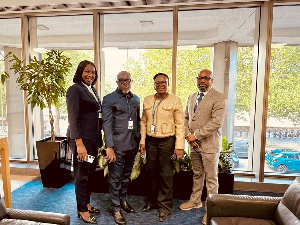
 Professor Ransford Gyampo, GSA CEO (Second Left) with other officials from Ghana Shippers' Authority
Ghana has participated in the 11th session of the International Maritime Organisation’s (IMO) Sub-Committee on Carriage of Cargoes and Containers (CCC-11), held in London from September 8 to 12, 2025.
The country’s delegation was led by Professor Ransford Gyampo, Chief Executive Officer of the Ghana Shippers’ Authority (GSA), together with Sylvia Asana Dauda Owu, GSA’s Deputy CEO in Charge of Technical Services; Captain Derrick Attachie, Executive (Technical II); and Lydia Tsotsoo Odai-Tettey of the Ghana Maritime Authority.
The CCC is the IMO’s technical body responsible for developing and reviewing international codes and guidelines on the safe handling and transport of cargoes at sea. Its mandate covers bulk cargoes, dangerous goods, containers, and the adoption of safety standards for new fuels, as well as inspection regimes to prevent accidents and protect the marine environment.
This year’s meeting focused on several issues, including the increasing problem of containers lost at sea, which disrupt supply chains, pose navigation hazards, damage marine ecosystems, and increase port business costs.
Delegates also considered amendments to the International Maritime Solid Bulk Cargoes (IMSBC) Code, revisions to cargo-securing manuals, and guidelines for alternative fuels such as ammonia and hydrogen.
ILO Convention 188 ratification reaffirms Ghana's commitment to fishers' rights
Speaking on the sidelines of the meeting, Professor Gyampo said, “The global conversation on container safety is not just technical, it has a direct bearing on the competitiveness of our traders and the safety of our maritime space.”
By contributing to the technical deliberations, Ghana aims to safeguard its trade interests while strengthening its position as a key maritime player in West Africa.
Key recommendations emerging from CCC-11 included:
• Revising cargo-securing manuals to incorporate harmonised performance standards for lashing software.
• Establishing stronger inspection regimes for containers and securing gear.
• Improving stowage planning and operational guidance to reduce the likelihood of container losses in adverse weather.
• Developing further guidelines for ships using alternative fuels.
These recommendations will now be forwarded to the IMO’s Maritime Safety Committee for consideration and possible adoption.

Copyright © 1994 - 2026 GhanaWeb. All rights reserved.










