



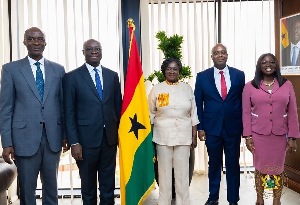
 Vice President Professor Jane Naana Opoku-Agyemang with MoF officials during the working visit
Vice President Prof Jane Naana Opoku-Agyemang has cautioned that Ghana’s heavy debt servicing obligations continue to consume resources that could otherwise finance critical infrastructure and socio-economic development projects, reinforcing the need for sustained fiscal discipline and economic reforms.
She said while government has made progress in restoring macroeconomic stability, the country’s debt burden remains a significant constraint on development financing.
“Every decision made by the Ministry ultimately affects the lives of ordinary Ghanaians, and our responsibility is to ensure that public finances are managed prudently and transparently,” the Vice President said.
“Resources that could otherwise finance critical development projects are instead being absorbed by the country’s significant debt obligations, underscoring the importance of staying the course on the current reform agenda.”
Prof. Opoku-Agyemang made the remarks during a working visit to the Ministry of Finance as part of a series of engagements with Ministries, Departments and Agencies (MDAs) aimed at strengthening coordination between the Presidency and public institutions responsible for implementing the government’s Reset Agenda.
According to her, the visit provided an opportunity to assess the Ministry’s progress, understand the fiscal and operational challenges confronting it and identify areas where additional support may be required to accelerate Ghana’s economic recovery programme.
Progress on economic reforms
The Vice President disclosed that officials of the Ministry briefed her on the difficult fiscal situation inherited by the government and outlined measures being implemented to restore macroeconomic stability and improve public finances.
The briefing included updates on Ghana’s ongoing debt restructuring programme, including the successful servicing of Eurobond obligations and other major debt commitments, as well as preparations to meet significant debt repayments scheduled over the coming years.
Officials also highlighted efforts to restore fiscal discipline by reducing the budget deficit over the medium term as part of broader measures to place the economy on a more sustainable growth path.
Public finance reforms
The Ministry further outlined a number of reforms aimed at strengthening public financial management and improving the efficiency of public expenditure.
These include amendments to the Public Financial Management Act and the Public Procurement Act, the enactment of the Value for Money Act, measures to improve domestic revenue mobilisation and reforms to restructure the Ghana Cocoa Board (COCOBOD).
The Vice President was also briefed on government’s decision to uncap statutory funds, including the National Health Insurance Fund, the Ghana Education Trust Fund (GETFund) and the Road Maintenance Trust Fund, to improve financing for essential public services and infrastructure.
In addition, Ministry officials provided updates on budgetary allocations to key government initiatives, including the Big Push infrastructure programme and the operationalisation of the Women’s Development Bank.
Call for prudent resource management
Prof. Opoku-Agyemang commended the Minister for Finance, Dr. Cassiel Ato Forson, Deputy Finance Minister Thomas Nyarko Ampem, and the management and staff of the Ministry for their commitment to implementing reforms aimed at restoring economic stability.
She urged the Ministry to remain focused on promoting fiscal responsibility, efficient budgeting and value addition across the economy to ensure that limited public resources generate the greatest possible impact.
The Vice President stressed that prudent management of public finances remains essential to sustaining investor confidence, supporting economic recovery and creating the fiscal space needed to finance Ghana’s long-term development priorities.
She expressed confidence that continued implementation of the government’s reform agenda would help build a more resilient economy capable of delivering sustainable growth and improved living standards for Ghanaians.

Copyright © 1994 - 2026 GhanaWeb. All rights reserved.










