



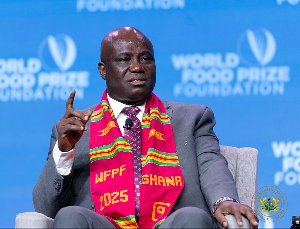
 Eric Opoku is the Minister of Food and Agriculture
Eric Opoku, Minister of Food and Agriculture, has outlined reforms under the Agriculture for Economic Transformation Agenda (AETA) to rebuild Ghana’s agricultural sector.
Speaking at the Government Accountability Series in Accra, he said the initiatives were aimed at restoring food security, expanding agro-industrialisation, and positioning agriculture as a driver of economic growth.
He noted that the Ministry had prioritised seed sovereignty, fertiliser quality control, modern soil management, climate intelligence systems, irrigation development, mechanisation expansion, and the strengthening of farmer cooperatives.
“We are rebuilding the food system from the ground up, with resilience, sustainability, and equity at the centre,” he said.
Opoku announced that from 2026, only locally produced seeds would be distributed to farmers to end delays associated with imported seed supply.
He cited investment in seed testing equipment, soil laboratories, and nationwide soil sampling to guide fertiliser blending and crop suitability.
On irrigation, the minister said 10 new dams were being constructed, eight others rehabilitated, and 250 solar-powered boreholes installed. Major schemes such as Vea, Weta, Tanoso, Ashaiman, Kpong, and Aveyime were also undergoing refurbishment.
He said that mechanisation was being advanced through Farmers’ Service Centres, with more than 4,000 units of machinery, including tractors and combined harvesters, procured to support farmers.
Eric Opoku said 70,000 community commodity-focused cooperatives had been formed to enhance farmer organisation, market access, and participation in value chains.
He stated that in the coming years, the Ministry would scale up irrigation and mechanisation, strengthen agricultural research, expand agro-industrial partnerships, roll out climate-smart technologies, and digitise agricultural systems.
“Agriculture must no longer be seen as a way of life, but as a business that will drive employment, industrialisation, and food sovereignty,” he said.



Copyright © 1994 - 2026 GhanaWeb. All rights reserved.










