



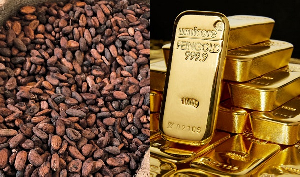
 Two of Ghana's most essential export commodities
A red, gold and green flag will flutter on Ghana’s public buildings on March 6, 2026 to celebrate 69 years of independence. But below the pomp of yet another sovereignty ceremony lurks an enduring problem: Ghana attained political independence in 1957 but economic independence is yet to be won.
For over 60 years, Ghana’s export profile has changed little compared to its politics. Gold still accounts for over half of annual export receipts. Cocoa is still another mainstay of foreign exchange. Oil, timber and other primary commodities also feature largely in Ghana’s export mix.
Meanwhile, someone else manufactures refined gold, processes cocoa into chocolates, kicks our footballs around fancy stadiums and bottles our timber into designer perfume. This is known as the raw export trap.
For many years governments have recognised Ghana’s dependence on primary commodities for exports as untenable.
President John Mahama gave voice to a common sentiment that Ghana and indeed Africa must rethink how it trades with the rest of the world.
“When I think of how Africa trades with the rest of the world, I am taken aback by our inefficient use of our natural resources. For decades, Africa has exported cocoa, oil, cotton, timber and minerals in their raw forms only to re-import finished goods made from these same products at many times their original value”, he said at an Africa trade forum.
On another occasion, the President noted that “Ghana must earn more from its natural resource endowment if we are to create wealth and prosperity for our people”.
Simple enough. By selling unprocessed resources overseas, we earn limited profits and remain at the mercy of volatile international commodity prices. If we add value to those resources locally, we keep more of the profit, create jobs and grow our industries.
Take former President Nana Akufo-Addo for instance. Industrialisation featured prominently during his administration.
When launching the One District, One Factory programme, he vowed: “There can be no future prosperity for our people if we continue to maintain economic structures which are dependent on the production and export of raw materials. We must add value to these resources and we must industrialise”.
Truth be told, almost every President since independence has made promises to increase local processing and move away from exporting raw materials. With each fleeting season of Ghanaian politics we hear a familiar promise to break the raw export trap and diversify the economy.
Words are easy. Turning them into results that better the lives of Ghanaians is hard.
You do not have to take my word for it. Look around you. After 69 years of independence Ghana imports more than it exports. Even small price changes on the world market can translate into shocks to consumers. How many of us can truly say we have benefitted from sixty-nine years of independence?
After nearly seven decades, it is high time we moved from inspirational speeches to decisive actions. And more than that, it is time we see real results from those actions. By now we should be so far past the starting line. Instead, we are still desperately chasing economic independence.

Copyright © 1994 - 2026 GhanaWeb. All rights reserved.










