



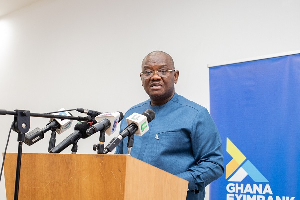
 Sylvester Mensah, CEO of Ghana Export-Import Bank (GEXIM)
The Chief Executive Officer of the Ghana Export-Import Bank (GEXIM), Sylvester Mensah, has said that the maiden edition of the Ghana AgroTech Fair 2026 promises to boost productivity across Ghana’s agricultural value chain.
The fair was officially opened on Tuesday, March 17, 2026, at Independence Square, Accra, in a ceremony attended by President John Dramani Mahama, ministers, industry leaders, farmers, entrepreneurs, and development partners.
Held under the theme “Transforming Agribusiness through Local Innovation and Technology,” the fair is a joint initiative of Ghana EXIM Bank and the Ministry of Trade, Agribusiness, and Industry, launched at the behest of President Mahama.
Export finance key to Ghana's industrial transformation – GEXIM board chairman
Welcoming participants, Sylvester Mensah said the fair is designed to be a regular platform to promote agrotechnology, strengthen agribusiness, and accelerate Ghana’s economic transformation through agro-processing, value addition, and increased exports.
Highlighting the objectives of the event, he noted that the fair “serves as a pedestal to showcase practical domestic agricultural technologies and solutions that can improve productivity across the entire agricultural value chain.”
Sylvester Mensah explained that the fair also seeks to connect farmers, agribusinesses, innovators, investors, and policymakers, helping to transform ideas and prototypes into profitable business ventures.
“It is aimed at stimulating investment in agriculture not only as a development priority, but as a crucial engine for trade, jobs, and industrial growth,” he said.
On the role of agricultural technology, the GEXIM CEO said, “It helps farmers produce more efficiently, reduce post-harvest losses, improve quality, and increase incomes. It helps processors add value to local raw materials. It supports exporters to meet global standards and access wider markets.”
He added that technology also makes agriculture more attractive to young people by showing that the sector involves engineering, innovation, logistics, data, manufacturing, and entrepreneurship, not just traditional farming.
Mensah emphasised the fair’s long-term impact, noting that it is expected to “inspire innovation, stimulate investment, encourage technology adoption, and strengthen linkages across the agricultural value chain.”
He added that it will create opportunities for startups and local fabricators, support agribusiness expansion, and position Ghanaian products competitively in regional and global markets.
“Our mandate is to help build a strong export-led economy by promoting value addition and supporting productive sectors. For us, agriculture does not end at the farm gates. It extends through processing, packaging, storage, branding, distribution, and export,” Sylvester Mensah said.
He also stressed the importance of sustainability, emphasising “efficient resource use, reduced waste, climate-conscious practices, and resilient systems” while ensuring that women, youth, and small enterprises are fully part of the transformation.
In his concluding remarks, Sylvester Mensah called for collaboration across all sectors to enhance Ghana’s agricultural productivity.
“No single institution can achieve this alone. Progress requires strong collaboration between the government, financial institutions, industry, scientists, researchers, farmers, and innovators. That is why this partnership matters, and that is why this fair matters,” he urged.
The Ghana AgroTech Fair 2026 will feature exhibitions, workshops, panel discussions, and live demonstrations, encouraging the adoption of modern agricultural technologies and innovations across Ghana.
MA

Copyright © 1994 - 2026 GhanaWeb. All rights reserved.










