



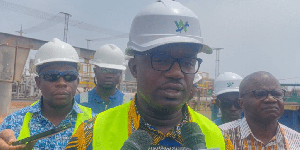
 Minister of Energy and Green Transition, John Abdulai Jinapor
Minister of Energy and Green Transition, John Abdulai Jinapor, has disclosed that Ghana’s power supply system is now stable, with surplus energy being exported to other countries.
Speaking at a press briefing during the 7th Meeting of the International Solar Alliance (ISA) Regional Committee for the Africa Region in Accra on September 4, Jinapor highlighted the government’s commitment to achieving universal electricity access and boosting renewable energy integration.
“Our power supply is fairly stable. We have enough, and we are even exporting. Our vision is to have a minimum of 10 percent of our energy mix from renewables, excluding our high-flow potential. Immediately, we want to work to deploy solar irrigation pumps across the country,” he stated.
The summit, held from September 2 to 4, brought together 19 African Energy and Power Ministers—including those from Malawi, Liberia, Seychelles, Comoros, Nigeria, The Gambia, Somalia, and Sao Tome and Principe—as well as representatives from 39 member countries and seven signatory nations. Discussions focused on energy access, solar innovation, and climate-resilient growth.
Jinapor emphasized that solar irrigation technology would be key to supporting year-round farming, particularly during dry seasons, adding that Ghana plans to collaborate with India to roll out the initiative, backed by a Memorandum of Understanding (MoU) that includes training for local artisans.
The Minister also stressed Africa’s urgent energy challenges, noting that more than 600 million Africans still lack access to electricity, while nearly one billion lack clean cooking solutions.
“Africa’s energy inequity reflects underinvestment, unequal access, and structural barriers that hinder progress. Without affordable, clean, and reliable energy, our ambitions—industrialisation, job creation, food security, and climate resilience—will remain out of reach,” he said.
Jinapor described universal access to energy as both a “moral imperative” and a crucial step toward achieving Sustainable Development Goal Seven (SDG 7) by 2030, stressing that the continent’s energy transition must focus on empowering communities and supporting sustainable development.
On his part, ISA Director-General Ashish Khanna announced that the organization, which now boasts 124 member countries, had ratified the Africa Solar Facility—a $200 million catalytic fund, of which $75 million would be operational by the end of 2025. The fund is expected to unlock over $800 million in private-sector investments for decentralized renewable energy projects, starting in Nigeria.
Khanna added that ISA would establish 12 solar technology education resource centers across Africa, including one in Ghana, to provide technical training, testing labs, and youth incubation programs aimed at fostering local expertise and innovation in the renewable energy sector.

Copyright © 1994 - 2026 GhanaWeb. All rights reserved.










