



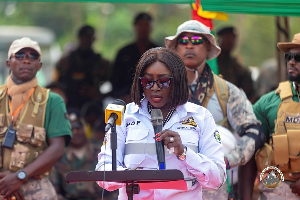
 Dr Hanna Louisa Bisiw-Kotei, Administrator of the Minerals Development Fund
The Minerals Development Fund (MDF) has launched an environmentally sustainable mining initiative aimed at reducing water and land degradation in the small-scale mining sector.
The MDF Modular Sustainable Mining Turnkey Initiative integrates green technologies, closed-loop water recycling, and mercury-free gold processing methods.
Administrator of the Fund, Dr Hanna Louisa Bisiw-Kotei, said the initiative is expected to significantly reduce the harmful environmental impact of small-scale mining.
“This initiative deliberately incorporates land reclamation and biodiversity conservation to ensure that mining no longer leads to environmental destruction but is transformed into a regenerative process for the renewal of our soil,” she said.
She made the remarks at the launch of the RoyzGold Eco-Dig Modular Sustainable Mining Site in the Ahafo Region, the first of MDF’s modular sustainable mining turnkey projects to be deployed nationwide.
RoyzGold 92 Ltd, a small-scale mining company, partnered with the MDF to establish the site.
The small-scale mining sector remains a government priority due to illegal mining activities that continue to threaten environmental sustainability.
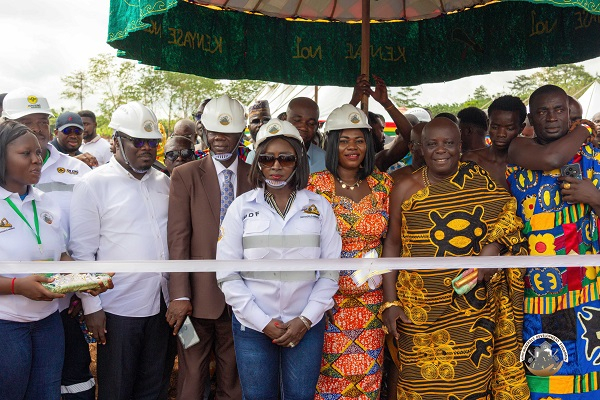
Established in 2016, the Minerals Development Fund was mandated to address negative mining impacts in host communities. The modular sites being rolled out form part of efforts to fulfil this mandate.
Dr Bisiw-Kotei added, “Through its Modular Sustainable Mining Turnkey Initiative (MDF-MSMTI), the MDF is implementing the beginning of a permanent solution to Ghana’s most pressing challenge, the extreme danger to human health and the unacceptable environmental degradation caused by illegal, irresponsible and unsustainable mining practices.”
The first MDF-MSMTI site is built on previously mined land, with parts of the degraded area reclaimed for the project.
Mining zones are selected based on geological surveys by experts. After the layout is finalised, contractors set up all required operational infrastructure.
The site features tailings dams fitted with filtration systems that cleanse water used in washing gold deposits. Recycled water from the dams feeds boreholes that support mining operations.
The process eliminates the use of mercury and cyanide. Instead, it employs a shaking board system capable of retaining up to 90% of gold content. Sand is separated from the precious metal, and remaining waste is heated to extract additional deposits, which are collected in cotton.
James Opoku, CEO of Lion King Engineering and Mining Support Services, explained, “The process helps us attract all the gold. We lose only about ten percent, which is still more profitable than using mercury or cyanide.”
The site includes road infrastructure, an office complex, workers’ quarters and security checkpoints. Lion King Engineering, a Ghanaian-managed firm, designed and constructed the project, incorporating land reclamation technology.
The Ghana National Association of Small-Scale Miners has expressed interest in replicating the technology across mining sites.
Representing the Association, Richard Graham Okine noted that in the absence of a government-supported framework, miners had resorted to crude methods that contributed to environmental damage.
“When our industry needed mechanisation, we saw an influx of foreign technology, largely from China. Our members adopted these methods not out of defiance, but out of necessity.”
He emphasised that the Association has endorsed the initiative after carefully reviewing the site.
“The small-scale miners are willing, ready and prepared to accept the initiative MDF has introduced,” he added.

Copyright © 1994 - 2026 GhanaWeb. All rights reserved.










