



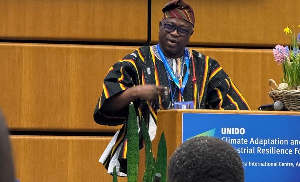
 Seidu Issifu is the Minister of State in charge of climate change and sustainability
The Minister of State in Charge of Climate Change and Sustainability, Seidu Issifu, has warned that climate change poses a serious threat to Ghana’s food security, agricultural productivity, and long-term economic stability, calling for urgent action to build a resilient and sustainable food system.
His warning comes amid growing climate-related challenges affecting Ghana’s agricultural sector, including erratic rainfall patterns, prolonged droughts, flooding, and land degradation, which continue to impact food production across the country.
Speaking at the Technical Workshop on Ghana’s Journey Towards Food System Resilience in Accra on June 1, 2026, he said the country’s food system is increasingly under pressure from climate change, environmental degradation, and public health concerns.
He noted that agriculture remains a key pillar of Ghana’s economy, contributing about 19 percent of Gross Domestic Product (GDP) and providing livelihoods for nearly one in every three Ghanaians.
“The United Nations Secretary-General has described the climate crisis as a ‘code red for humanity’. For Ghana, that warning is perhaps nowhere more evident than within our food system,” he stated.
Arise Ghana warns government to reject Gold Fields lease renewal
He also raised concern about Ghana’s rising dependence on imported food, revealing that the country spends more than $400 million annually on poultry imports alone.
“Every tonne of food imported is not only a missed opportunity for local production and employment, but also a transfer of wealth away from our rural economies,” he said.
Issifu warned that reliance on imports continues to weaken local production, strain foreign exchange reserves, and undermine agricultural resilience.
He further cautioned that climate change is threatening key staple crops such as cassava, yam, and plantain, which are central to Ghanaian diets.
“Cassava, yams, and plantains, which are the foundation of Ghanaian diets, are becoming more vulnerable to changing weather patterns,” he stated.
He disclosed that districts such as Fanteakwa have already recorded significant declines in crop yields, while projections for Northern Ghana suggest severe crop failures could occur as frequently as once every five years if current trends continue.
“These are not distant possibilities; they are emerging realities that demand immediate attention,” he stressed.
He also highlighted the environmental impact of agriculture, noting that agriculture and land-use change account for about 44.6 percent of Ghana’s greenhouse gas emissions, with livestock contributing significantly to methane emissions.
Despite the challenges, Baba Seidu Issifu expressed optimism that Ghana can transform its food system through climate-smart agriculture, improved nutrition, and stronger local value chains.
“Evidence from scientific research, combined with lessons from our rich traditional dietary heritage, points toward pathways that can simultaneously strengthen resilience, improve nutrition, enhance rural livelihoods, and reduce emissions,” he said.
He urged stakeholders to move beyond discussions and focus on practical interventions.
“This is intended to be a working session, not a talking shop,” he added, calling for policy reforms, financing mechanisms, and investment strategies to strengthen Ghana’s food system.
ANAS/MA
Ghana must turn economic recovery into industrial growth - Dr Asiama

Copyright © 1994 - 2026 GhanaWeb. All rights reserved.










