



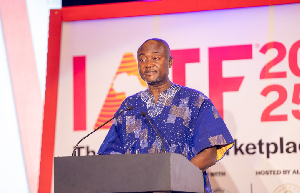
 Benjamin Kwaku Asiam, Acting National Coordinator of the National AfCFTA Coordination Office
Ghana is intensifying its efforts to move beyond commodity-based trade and pivot toward value-added industrialisation, positioning itself as a regional leader under the African Continental Free Trade Area (AfCFTA).
This bold shift was articulated by Benjamin Kwaku Asiam, Acting National Coordinator of the National AfCFTA Coordination Office (NCO), who spoke on behalf of Elizabeth Ofosu-Adjare, Minister of Trade, Agribusiness, and Industry, during the high-level Ghana Roadshow for the 2025 Intra-African Trade Fair (IATF2025) on June 10, 2025.
He emphasised that Ghana's strategic focus is no longer on whether Africa has potential, but on whether African nations have the will to realize it.
“Ghana is pursuing a bold shift from commodity-based trade to value-added industrialisation, supported by policies like the 24-hour economy and the Accelerated Export Development Programme.
"…Over 2,000 MSMEs have received direct support through the NCO, with more than 900 products now registered to trade under AfCFTA.”
The IATF2025, scheduled to be held in Algiers, Algeria this September under the theme "Harnessing Regional and Continental Value Chains; Accelerating Industrialization and Global Competitiveness under the AfCFTA", will bring together over 2,000 exhibitors and more than 35,000 visitors from 140+ countries.
For Ghana, this event is both a showcase and a strategic lever to expand its trade footprint, attract investment, and deepen regional value chains in critical sectors such as agribusiness, pharmaceuticals, and light manufacturing.
Asiam outlined Ghana’s evolving trade strategy, highlighting the country’s commitment to shifting from an economy traditionally dependent on raw commodity exports, such as cocoa, gold, and oil—towards one rooted in value addition, technology transfer, and industrial partnerships.
“AfCFTA is Africa’s blueprint for redemption and transformation… and IATF2025 is our platform to make it real,” he said.
“Our future lies in developing higher-value sectors. This includes agro-processing, industrial development, and digital innovation. These are central to Ghana’s transformation agenda.”
This shift is underpinned by flagship government initiatives like the 24-Hour Economy and the Accelerated Export Development Programme, which aim to enhance export competitiveness and build industrial resilience.
According to Asiam, over 2,000 micro, small, and medium enterprises (MSMEs) have received direct support through the NCO. More than 900 product lines have already been registered to trade under the AfCFTA, with over 1,000 Certificates of Origin issued.
Gabriel Edgal, Chairman and Group CEO of Oakwood Green Africa and IATF2025 Ambassador, described Ghana as a natural trade hub for West and Central Africa.
He called on financial institutions, insurers, creatives, and logistics firms to seize the moment and use IATF2025 as a springboard for African-led innovation and growth.
Also speaking at the event, AfCFTA Secretary-General Wamkele Mene reiterated the significance of IATF2025 as a “marketplace of ideas, opportunities, and partnerships”—key to scaling intra-African trade and reducing the continent’s over-reliance on external markets.
“For too long, Africa’s share of global trade has remained at a mere 3%. The AfCFTA and platforms like IATF are designed to change that by building integrated markets and regional value chains,” he stressed.
AM/KA

Copyright © 1994 - 2026 GhanaWeb. All rights reserved.










