



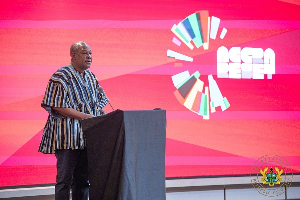
 President John Dramani Mahama
President John Mahama has announced sweeping reforms that will see Ghana purchase its cocoa using domestic currency and cease exporting raw mineral ores by 2030, marking a decisive shift toward economic sovereignty.
Speaking at the closing of his high-level side event, “Accra Reset’s Addis Reckoning,” held on the sidelines of the 39th African Union Assembly of Heads of State, President Mahama detailed immediate steps Ghana is taking to break free from exploitative financing arrangements that have long constrained the country’s cocoa sector.
“One of the key decisions we’ve made is to stop accepting foreign funding for the purchase of our cocoa. We are going to raise domestic bonds. We have enough Cedis in Ghana to pay for our cocoa,” President Mahama declared, outlining a radical departure from decades-old practices.
Ghana to end raw mineral ore exports by 2030 - President Mahama
The President revealed that Ghana’s cocoa crisis had brought the structural problems into sharp focus. After setting a producer price when international cocoa traded at $7,200 per ton and the Ghana Cedi stood at 11.5 to the dollar, market fluctuations created significant losses when prices fell to $4,200, and the Ghana Cedi appreciated to 10.7 per dollar.
More critically, President Mahama exposed how foreign financing arrangements have hamstrung Ghana’s capacity for value addition. “You know what the collateral for the funding is? Our own cocoa beans. You collateralise the beans with the financier, buy them, ship them, and they pay you the international market price,” he explained.
“You know the interesting part? We have the capacity to process 400,000 tons of those beans in Ghana, but because they are collateralised, we cannot even allocate them to local processors. We must ship all the beans outside.”
Under the new arrangement, Ghana will raise domestic bonds in Ghana Cedis to purchase cocoa directly from farmers, eliminating the need to pledge the beans as collateral. This will immediately unlock 400,000 tons of cocoa beans for local processors, creating thousands of jobs and retaining significantly more value within Ghana’s economy.
President Mahama went further, setting an ambitious yet firm deadline to end the export of unprocessed minerals from Ghana.
“I say by 2030, there won’t be any raw mineral ores leaving Ghana. You’re not going to ship raw manganese ore out of Ghana. You’re not going to ship raw bauxite ore out of Ghana. You’re not going to ship raw iron ore out of Ghana. You must process all that locally,” he stated emphatically.
The announcement represents what President Mahama says is a comprehensive application of the Accra Reset philosophy, his continental initiative aimed at scaling up development across Africa by asserting sovereignty over natural resources and building domestic processing capacity.
The President framed his bold moves in the context of mounting pressure from Africa’s youthful population, which is increasingly desperate for economic opportunities.
“That is the only way we can provide opportunities for our young people. Our young people are less patient than our generation. They want to see that progress and prosperity today,” he said.
He connected the urgency of implementation directly to the migration crisis: “That is why Accra Reset needs that urgency to stop our young people from braving the dangers of the Sahara and the Mediterranean as they try to reach Europe in search of opportunity.”
Acknowledging that continental transformation requires immediate action rather than endless planning, President Mahama endorsed a proposal for rapid implementation through willing partners.
“We come with the decisions. We agree. We do the frameworks. What is missing is urgency and implementation. We take time. And we behave like time is waiting for us,” he said, channelling concerns raised during the discussion.
“That is why Accra Reset is a good idea. But let’s implement urgently. If parts of the continent are not ready, let’s form a coalition of the willing to move this as quickly as possible. And let all the others follow and join.”
The Accra Reset initiative, launched by President Mahama, envisions a fundamental restructuring of Africa’s economic relationships with global powers, prioritising value addition, industrialisation, and resource sovereignty as the pathway to prosperity for the continent’s 1.4 billion people.
The announcements from Addis Ababa signal that Ghana intends to lead by example, implementing concrete measures that other African nations can replicate as part of a broader continental awakening.
“From Addis, we must stop talking and start implementing,” President Mahama concluded, crystallising the theme of the gathering he dubbed “the Addis reckoning.”
Understanding Ghana's stock market and how to invest | BizTech

Copyright © 1994 - 2026 GhanaWeb. All rights reserved.










