



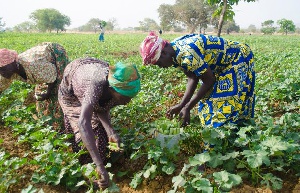
 File photo of women farming
Ghana has ranked highest among Kenya and Malawi in a research study assessing how African governments are mainstreaming gender in the agricultural sector.
The study, conducted by the Alliance for a Green Revolution in Africa (AGRA) as part of its Gender Mainstreaming in Agriculture Scorecard (GMAS), placed Ghana at the top for its gender-responsive strategies, with Kenya and Malawi following closely.
At AGRA Ghana’s national convening on using the Gender Mainstreaming in Agriculture Scorecard, held in Accra, participants concluded that while Ghana has made commendable progress, there is a need for a stronger commitment to gender-intentional agriculture and sustained capacity building within the sector.
AGRA’s research examined how governments are progressing in creating an enabling environment for gender-intentional agricultural policies, investing in inclusive decision-making to improve women’s livelihoods in agriculture, and establishing accountability mechanisms to ensure that women’s and youths’ development agendas are effectively planned and executed.
The Lead for Gender Integration at AGRA, Winnie Osulah, who presented the findings, noted that although Ghana topped the rankings, it did not attain the highest possible score of 72 across all thematic areas, indicating room for improvement.
“Ghana’s performance shows commendable progress, but more must be done to reach full gender integration. Governments, including Ghana, must demonstrate stronger commitment beyond policy formulation to investing rigorously in policy evaluation and implementation,” Ms Osulah emphasised.
According to Osulah, the study revealed that the continent has made progress on paper but still struggles to turn commitments into action. “We must move from policy formulation to policy implementation. It’s not enough to have documents sitting on shelves — they must translate into tangible benefits for women farmers,” she emphasised.
The Country Programme Lead for AGRA Ghana, Dr John Jagwe, reaffirmed AGRA’s commitment to supporting women in agriculture, highlighting their indispensable role in driving growth and sustainability.
“AGRA recognises the immense contributions of women to national development, and that is why we remain committed to promoting women’s empowerment and improving their livelihoods,” he stated.
Dr Jagwe outlined AGRA Ghana’s three main focus areas: improving the competitiveness of two key value chains — rice and soybean; creating employment opportunities for young people; and ensuring inclusive participation across all levels of agricultural transformation.
He revealed that AGRA has set an ambitious goal for 70 percent of all new agricultural jobs to go to women, with 2 percent reserved for persons with disabilities.
“These targets are bold but achievable,” he said, highlighting the importance of collaboration with key partners such as the Ministry of Gender, Children and Social Protection, the Ministry of Food and Agriculture, and the Ministry of Youth Development and Empowerment.
In a speech read on her behalf, the Director of Gender at the Ministry of Gender, Children and Social Protection, Faustina Acheampong, commended AGRA for the initiative. She called for collective action to dismantle the barriers limiting women’s participation in agriculture, especially by women in leadership.
“The barriers that hinder women can only be removed through a unified front. Every woman, especially those in leadership positions, must play an active role in championing change,” she said, pledging the Ministry’s continued support for AGRA’s efforts.
She disclosed that plans are underway to establish a Women’s Development Bank under the President’s “Resetting Agenda” to enhance financial inclusion and provide affordable credit facilities for women, especially those in small-scale enterprises and underserved communities.
She called on all stakeholders to remain united in advancing gender equality in agriculture, particularly in supporting rural women affected by climate change and limited access to modern farming tools.
“Let us continue to create spaces where women’s leadership in agriculture is nurtured, where their voices influence policy, and where their innovations thrive,” she urged.

Copyright © 1994 - 2026 GhanaWeb. All rights reserved.










