



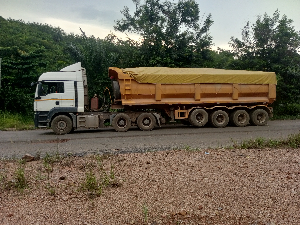
 A tipper truck hauling limestone from the Odugblase mines
(An investigative review of how limestone haulage revenues are calculated — and who really controls the numbers)
Revenue payments from limestone haulage operations in the Krobo area have remained largely consistent over the past five years, yet significant concerns persist over oversight, data verification, and the growing dependence of the local assemblies on the mining companies for critical revenue computations.
What appears on paper as a functional revenue arrangement increasingly masks deeper structural weaknesses — weak internal controls, dependence on private companies for data, and a worrying reluctance by duty bearers to reform systems.
GHACEM contracts independent transport companies to haul limestone from the Odugblase mines to its factory in Tema, with each transporter required to pay a GH₵50 conveyance fee per trip.
However, after repeated irregularities involving assembly agents who were originally responsible for collecting and recording these payments, the assemblies entered into an arrangement with GHACEM to streamline the process.
Under this system, GHACEM deducts the GH₵50 fee directly from the transporters’ service payments and then remits the total amount to the assemblies in a lump sum at the end of each month.
Interviews, official documents obtained through the Right to Information (RTI) Act, and testimonies from current and former officials all point to a worrying pattern: the assemblies do not know the true volume of limestone leaving their jurisdictions, nor can they independently confirm that the money they receive by way of conveyance reflects actual activity on the ground.

Assemblies Relinquish Control of Revenue Computation to Mining Companies
Rather than reforming the system or prosecuting wrongdoing, the assemblies opted for a different approach. Additional investigation reveals that the assemblies have, over time, ceded control of conveyance revenue computation to the mining companies after doubts emerged about the credibility of figures submitted by assembly agents stationed along haulage routes.
These agents were originally mandated to record truck movements and compute expected fees, but persistent irregularities and allegations of under declaration or inconsistent reporting forced the assemblies to abandon their own tracking system.
As a result, mining companies, on behalf of the assemblies, now solely generate the figures based on computations on the GH₵50 charged on each trip of limestone that passes through the haulage route and pay the lump sum at the end of the month — a practice that governance observers warn could compromise transparency and accountability.
Governance observers caution that this arrangement, while convenient, leaves the assemblies blind to the core data on which their revenue depends. It also shifts the power to define what is “owed” away from public institutions and into the hands of the very companies expected to pay.

Steady Payments, Weak Verification
Documents obtained from the Lower Manya Krobo Municipal Assembly confirm that GHACEM, for instance — through its subsidiary, West Africa Quarries Limited (WAQL), a major concession holder operating in the area since 2004 — pays GH₵50 per truckload of limestone transported from its quarry.
Annual figures obtained show consistent payments since 2021:
2021: GH₵316,860.50
2022: GH₵353,481.50
2023: GH₵235,331.56
2024: GH₵256,578.00
2025 (Jan–Oct): GH₵276,780.00
For Yilo Krobo, available figures show GH₵88,348 was collected in 2024 and GH₵60,624 between January and October 2025. Earlier years' data were not provided at the time of filing the report, raising questions about record-keeping and institutional memory.
While the numbers suggest a steady flow of revenue, the lack of a parallel monitoring system makes it impossible to determine whether revenues are increasing, decreasing, or being accurately reported.
Assemblies Admit They Do Not Track Truck Volumes
Former Yilo Krobo Municipal Chief Executive (MCE), Eric Tetteh, confirmed that the assembly does not track haulage activity. He admitted that although GHACEM granted the assembly permission to place officers at the quarry to track trucks independently, the assembly did not take up the opportunity.
“That was the practice before I came. We once had issues with them and they suggested we could handle the records ourselves if we wanted to… but I never had cause to request the data to determine if it tallies,” he said.
His statement raises a critical governance question: Why would an assembly not verify the data that determines one of its key revenue streams?

Why GHACEM, Not the Assemblies Collecting the Conveyance
Efforts to secure a formal response from GHACEM were unsuccessful, as an email sent through its official website did not deliver.
However, a source within GHACEM revealed that the shift did not originate with the company. Instead, in 2019, the assemblies themselves petitioned the former Eastern Regional Minister, Eric Kwakye Darfour, for GHACEM to take over revenue collection from them.
The assemblies cited internal leakages, unaccounted funds, and conflicts when assembly agents managed the checkpoints.
“The assemblies complained that when they send people to the roads to collect the conveyance, the money that comes into their coffers is not enough,” the source said.
Following the petition, the Regional Security Council (REGSEC), led by the former regional minister, instituted a revenue-sharing formula:
Lower Manya Krobo: 70%
Yilo Krobo: 30%
The rationale was that most active mining occurs in Lower Manya, while Yilo hosts more diversified mining operations.
But despite the arrangement, no documented contractual agreement outlining responsibilities, data-sharing requirements, audit procedures, or dispute resolution mechanisms could be verified by this investigation.
GHACEM Says Its System Is Transparent — If Assemblies Request the Data
GHACEM insists that assemblies can access all haulage data at any time.
“They can go to our unit at the quarries. Each month they’ll be able to know how many trucks went out because we have a weighbridge… We issue waybills to the trucks before they exit,” the source explained.
He added that the system is digitised and data has been shared before upon request, yet the assemblies do not make such requests regularly — if at all. This creates an accountability paradox.
Current MCE Confirms Lack of Written Agreement
The Municipal Chief Executive for Lower Manya Krobo, John Atter Matey, who assumed office in June 2025, disclosed that he is not aware of any formal agreement governing the arrangement.
“I’m not able to tell whether it’s a verbal agreement or a written agreement… That was the arrangement I came to meet,” he stated.
Asked whether he had seen the supporting data from GHACEM, he redirected the question to the Finance Office.
“They (GHACEM) pay whatever monies they have to pay into the assembly’s accounts… The finance officer brings the payment. I check and see how much we receive a month,” he stated.
His responses suggested a passive oversight role, with no system in place to independently verify whether payments are accurate.

Governance Expert Calls for Immediate Reforms
Local governance specialist, Daniel Alimo caution that the current arrangement exposes the assemblies to needless financial risk and undermines their autonomy.
“There should be a formal agreement… The GH₵50 being taken needs to be interrogated. If there’s no formal agreement or checks and balances, the assemblies must renegotiate. Otherwise, they should have people who collect data on the trucks and send weekly reports to the finance committee,” he added.
He further questioned why assemblies with paid revenue collectors would outsource such a critical revenue stream to a private company.
His prescription is urgent and blunt: By early 2026, a new, accountable system must be in place.
Growing Calls for Independent Oversight
Civil society groups in the Krobo area argue that while GHACEM’s system may be efficient, entrusting a private entity with the calculation of public revenue is fundamentally flawed. Without independent verification — through trained officers, GPS-linked monitoring, or weighbridge audits — errors or revenue leakages could remain undetected for years.
In communities that have borne the environmental and social costs of quarry operations, public trust in the assemblies hinges on transparency.
Residents expect local leaders to ensure that every cedi due from extractive operations is collected, recorded, and utilized for development.
The Road Ahead
As quarry operations intensify and the assemblies grow increasingly reliant on extractive revenues, the debate is shifting. It is no longer about whether GHACEM’s payments are consistent.
The real question is: Why do public institutions lack the capacity — or the will — to verify what they are owed?
Unless the assemblies rebuild internal tracking systems, establish formal agreements, train revenue collectors, and digitise monitoring, they risk permanently ceding financial oversight to private companies.
The future of extractive governance in the Krobo municipalities depends on whether local authorities can reclaim control of the revenue systems that directly fund their development agenda.
This story received support from Oxfam in Ghana through DANIDA. Any financial assistance or support provided to the journalist has no editorial influence.


Copyright © 1994 - 2026 GhanaWeb. All rights reserved.










