



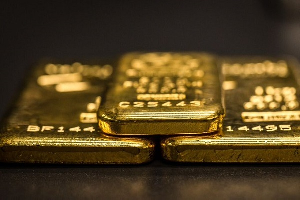
 File photo of gold bars
Ghana’s growing dependence on gold for export earnings has renewed concerns about the vulnerability of the economy to swings in international commodity prices, with the International Monetary Fund (IMF) warning that the country’s recent macroeconomic gains could be exposed if gold prices weaken significantly.
The IMF, in its latest assessment of Ghana, said gold accounted for more than 65 percent of the country’s merchandise exports in 2025 and was expected to represent an even larger share in 2026.
The Fund cautioned that a sharp decline in international gold prices could reduce export receipts, foreign-exchange inflows and fiscal resources, potentially putting pressure on the country’s external and fiscal positions.
Data from the Bank of Ghana indicate that the concentration has increased further this year. By July 2026, gold accounted for about 68.3 percent of Ghana’s total export earnings, compared with 12.5 percent for cocoa, 9.4 percent for crude oil and 9.8 percent for non-traditional exports.
The trend has been supported by strong gold prices and increased production and exports.
In the first half of 2026, Ghana’s total exports reached approximately US$18.2 billion, compared with US$13.7 billion during the corresponding period of 2025.
Gold alone generated about US$12.5 billion in export receipts, up from US$8.3 billion a year earlier. Cocoa contributed approximately US$2.2 billion, while the country recorded an overall trade surplus of about US$8.8 billion.
The strong export performance has helped strengthen Ghana’s external position and rebuild foreign-exchange buffers.
However, the figures also highlight the scale of the diversification challenge, with gold alone generating roughly two-thirds of export earnings during the first six months of the year.
The IMF’s concern is that Ghana’s reliance on commodities leaves the economy vulnerable to external shocks, particularly changes in global commodity prices and exchange-rate movements.
The warning comes even as gold continues to trade at historically elevated levels. Gold was trading at about US$4,313.95 per ounce, although this was approximately 23 percent below its record high of US$5,602.22 recorded on January 28, 2026.
The government has acknowledged the risks associated with excessive dependence on the precious metal but maintains that the immediate priority is to maximise the benefits of the current commodity boom while building alternative sources of foreign exchange.
The Bank of Ghana is also seeking to manage the risks associated with concentration in gold. Governor Dr Johnson Pandit Asiama has defended the decision to rebalance part of the country’s gold holdings into foreign-exchange assets, arguing that reserves must be managed with consideration for safety, liquidity, returns and diversification.
At the same time, the Governor has highlighted the positive contribution of gold and cocoa exports to Ghana’s trade position.
Gross international reserves stood at approximately US$12.9 billion at the end of June, equivalent to about five months of import cover.
The situation therefore presents a policy dilemma for Ghana: gold is currently strengthening the country’s external position while simultaneously increasing its exposure to a potential commodity-price correction.
Economists and policymakers have consequently stressed the need to use the current period of strong commodity earnings to build a more diversified export base.
The government’s broader strategy includes expanding agriculture, manufacturing, agro-processing and services, with the aim of increasing the contribution of non-traditional exports to the economy.
President John Mahama has set a target of increasing non-traditional export earnings from approximately US$3.5 billion annually to at least US$10 billion by 2030.
Achieving that target would provide Ghana with a stronger source of foreign exchange outside the minerals sector and reduce the economy’s vulnerability to a downturn in gold prices.
The challenge, however, is to ensure that diversification progresses fast enough to reduce the risks associated with Ghana’s current gold concentration without undermining the benefits the commodity is providing to the economy.
For now, gold remains Ghana’s dominant export earner, but the IMF’s warning has strengthened the case for turning current mineral revenues into investments capable of creating alternative and sustainable sources of foreign exchange.

Copyright © 1994 - 2026 GhanaWeb. All rights reserved.










