



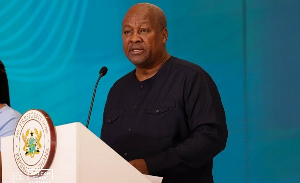
 President John Dramani Mahama
The government has launched a comprehensive recovery and reform campaign in the premix fuel sector following the release of an audit report exposing serious financial mismanagement and governance breaches in the 53 percent Community Development Fund (CDF), which supports coastal fishing communities.
The audit, commissioned by the Ministry of Fisheries and Aquaculture (MoFA) and conducted by its Internal Audit Unit, revealed that between 2017 and 2024, 132 Landing Beach Committees (LBCs) failed to account for funds received from premix fuel allocations, resulting in losses of GH¢13,753,300.
The total recovery target, including other identified irregularities, stands at GH¢27.7 million.
The report detailed widespread failures, including unauthorised withdrawals, non-compliance with approved fund distribution formulas, and poor documentation.
These lapses prevented resources from being used for essential community projects such as drainage systems to address flooding, toilets to combat open defecation, schools to improve educational access, and other infrastructure critical for coastal fishing communities.
The Ministry noted that these shortcomings represent a severe setback for development in underdeveloped coastal areas, which rely heavily on these resources to improve living conditions and support the Sustainable Development Goals (SDGs).
“This government will not look away from the institutional weaknesses we inherited. We are taking firm steps to recover public funds, restore confidence in the premix system, and ensure that resources meant for fishing communities are properly protected,” Minister for Fisheries and Aquaculture, Emelia Arthur said.
Ebow Mensah, Administrator of the National Premix Secretariat, confirmed that recovery processes have commenced.
“Recoveries have started, and structured repayment arrangements are being pursued where appropriate,” he said, adding that the audit provides both the moral and legal authority to act decisively and address long-standing governance gaps.
The Ministry and Secretariat have issued demand notices to affected LBCs and are engaging them to ensure restitution and compliance. Serious cases are being referred for further action, while governance structures at the landing-beach level are being restructured to tighten financial controls and oversight.
In response to the audit, MoFA and the National Premix Secretariat are implementing a suite of reforms designed to prevent future losses and ensure transparency.
Key measures include:
• Introduction of a nationwide Community Development Fund accountability and protection framework from February 2026.
• Clearer signatory rules and mandatory reporting for all LBCs.
• Alignment of CDF management with the Premix Fuel Automation System.
• Enhanced training for LBC executives and stricter compliance monitoring.
“These reforms mark a new chapter for the premix system. Our focus is on protecting fisherfolk, recovering public funds, and ensuring that the mistakes of the past are not repeated,” Mensah said.
The reforms aim to ensure that premix revenues are reinvested in community development projects, directly contributing to SDGs related to poverty alleviation, education, and clean water and sanitation.
The government has positioned this audit and recovery drive as a turning point for the premix programme, emphasising transparency, accountability, and long-term reform. By combining disclosure of findings with decisive recovery actions and strengthened safeguards, officials aim to rebuild public trust and ensure sustainable development outcomes for Ghana’s coastal communities.
“Transparency strengthens enforcement. By making these findings public, we have empowered ourselves to act decisively and fairly,” Ebow Mensah said.

Copyright © 1994 - 2026 GhanaWeb. All rights reserved.










