



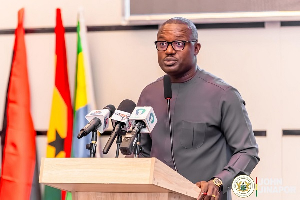
 Minister for Energy, Dr John Abdulai Jinapor
Government is targeting at least 1,400 megawatts (MW) of installed renewable energy capacity by the end of the decade as part of efforts to reduce energy costs, improve industrial competitiveness and accelerate the country’s transition to sustainable energy.
The Ministry of Energy and Green Transition said the country currently has about 280MW of installed renewable energy capacity, with pipeline projects expected to deliver nearly 600MW by 2028.
The sector minister, John Abdulai Jinapor, in a speech read on his behalf at the AGI Sustainable Energy B2B Expo in Accra, said affordable and reliable energy remains critical to business growth and export competitiveness.
According to the ministry, businesses currently pay between GH¢1.90 and GH¢2 per kilowatt-hour of electricity consumed, making energy costs a major production challenge for industry.
The ministry said government is therefore pursuing policies and interventions aimed at delivering cheaper, cleaner and more sustainable power to businesses.
Among the initiatives highlighted was the net metering programme, designed to reduce electricity costs for industries, businesses and households while improving environmental sustainability standards for exporters facing increasingly stringent international trade requirements.
He also cited ongoing investments in captive renewable energy projects, including a solar installation at the Tema enclave with a current capacity of about 16MW, supplying power to customers at competitive rates. Government has approved plans for the project to scale up to 200MW, with a long-term target of 1,000MW by 2030.
The ministry further disclosed that it is accelerating efforts to promote electric mobility through the Renewable Energy Fund, which is expected to support the establishment of electric vehicle charging infrastructure powered by renewable energy across the country.
Other interventions include the Public Facilities Sustainable Energy Action Plan and the National Energy Efficiency Action Plan being implemented with support from to improve energy efficiency in public institutions and free additional power for industrial use.
Government is also rolling out solar-powered irrigation initiatives to support year-round farming, improve agricultural productivity and create employment opportunities for young people.
The ministry stressed that strengthening the national grid remains essential to integrating renewable energy into the power mix and ensuring long-term energy security.
It also urged businesses to combine renewable energy systems with battery energy storage technologies to improve efficiency and ensure stable power supply beyond daylight hours.
The AGI Sustainable Energy B2B Expo was organised by the Association of Ghana Industries, in collaboration with in Accra GIZ.
AGI’s President, Kofi Nsiah-Poku, for his part, called for accelerated investment in renewable energy, warning that rising energy costs and unreliable power supply continue to undermine , he said sustainable energy had become central to Ghana’s industrial transformation agenda and could no longer be treated as a peripheral development issue.
Nsiah-Poku noted that industries across the country were under growing pressure to reduce operational costs while meeting international environmental standards, making the transition to cleaner energy both an economic and strategic necessity.
According to him, adopting smarter and more efficient energy solutions would help businesses improve productivity, lower long-term costs and strengthen their competitiveness in global markets.
He stated that renewable energy, particularly solar power, presents significant opportunities for Ghanaian industry by supporting administrative operations, cooling systems, lighting and light industrial processes, while the national grid continues to power heavy manufacturing activities. Such a diversified energy mix, he explained, would reduce pressure on the national grid, improve energy security and contribute to a more resilient industrial sector.
Nsiah-Poku further stressed that Ghana’s ambition of building a strong industrial economy and sustaining a 24-hour economy could not be achieved without stable and uninterrupted electricity supply.
He said recent energy disruptions had exposed the vulnerability of businesses that rely heavily on a single source of power, reinforcing the need for industries to embrace alternative and renewable energy solutions.
The AGI President also urged government to strengthen policy support for renewable energy adoption through tax incentives, affordable green financing and faster regulatory approvals. He described the national net metering programme as a potentially transformative intervention for industry, saying businesses were ready to invest in rooftop solar systems if implementation processes became more efficient and predictable.

Copyright © 1994 - 2026 GhanaWeb. All rights reserved.










