



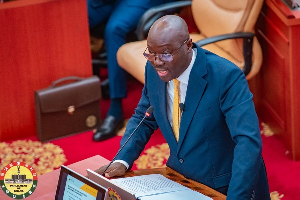
 Dr Cassiel Ato Forson is the Minister for Finance
The Minister for Finance, Dr Cassiel Ato Forson, has sought to quell mounting criticism over the government’s fiscal management by outlining extensive payments made to contractors, suppliers, and key sectors of the economy in the first half of 2025.
Addressing Parliament during the presentation of the 2025 Mid-Year Budget Review on Thursday, 24th July, Dr Forson rejected suggestions that the government was hoarding funds or failing to disburse critical payments.
He insisted that, contrary to the perception of financial inaction, the government was “spending and spending at the right places”.
“Rt Hon Speaker, contrary to the perception that we are not spending, we are indeed spending and spending at the right places. We are making the right investments,” the Minister declared.
His remarks came amid growing discontent from within both the opposition New Patriotic Party (NPP) and the ruling National Democratic Congress (NDC), including from some Ministers of State, government agencies, and departments, over what they described as delays in the release of funds and stagnation in project execution.
However, in a detailed account aimed at silencing his critics, Dr Forson outlined payments totaling GH¢114.5 billion made from the Consolidated Fund between January and June 2025.
These included: US$700 million in Eurobond obligations; GH¢10 billion to domestic bondholders; GH¢2.9 billion to the District Assemblies Common Fund; GH¢2.7 billion to SSNIT; GH¢9.1 billion to the energy sector to ensure a stable power supply and GH¢5 billion in arrears.
GH¢4.6 billion to the Ghana Education Trust Fund (GETFund); GH¢1 billion to support the Free Senior High School programme; GH¢4.6 billion to the National Health Insurance Scheme (NHIS); GH¢1.4 billion for NHIS claims; GH¢252 million for vaccines and essential medicines; GH¢72.8 million as Capitation Grants; GH¢477 million to beneficiaries of the Livelihood Empowerment Against Poverty (LEAP) Programme;
GH¢895 million to the School Feeding Programme; GH¢122.8 million for Basic Education Certificate Examination (BECE) registration; GH¢300 million to support the No Fee Stress Policy; GH¢191.7 million in Teacher Trainee Allowances; GH¢462.6 million in Nursing Trainee Allowances; GH¢25 million in allowances to Assembly Members;
GH¢21 million to the National Apprenticeship Programme; GH¢34.5 million to the Adwumawura Programme; GH¢2 billion for Goods and Services to keep Ministries, Departments, and Agencies running efficiently; GH¢2 billion to recapitalise and rescue the National Investment Bank (NIB).
Additionally, Dr Forson reported that non-interest government expenditures totalled GH¢84.2 billion.
He also reassured Parliament that government efforts were underway to improve fiscal discipline, reduce interest rates, and cut borrowing costs, all aimed at fostering macroeconomic stability.
The Minister’s clarification comes at a time when the circulation of money in the economy and delays in payment to government contractors have become points of concern in both political and business circles.
The mid-year budget update, therefore, served as both an account of government expenditure and a defence against allegations of fiscal inertia.
The Finance Minister announced some “priority projects”. Among them were a new Bridge Across the Volta River at Volivo, the Construction of the Tema-Aflao Road Project-Phase 1, the Tema Motorway Roundabout, through Ashaiman Roundabout to Atimpoku, the Construction of 14 Pedestrian Bridges, the Kumasi Roads and Drainage Extension, the Paa Grant Interchange and the Sekondi/Takoradi Township Roads- Phase 1.
Others included the Rehabilitation of Dome-Kitase Road, Obetsebi Lamptey Interchange Phase 2, Bolgatanga-Bawku-Pulimakom Road, the PTC Roundabout Interchange Project at Takoradi, and the Construction of Drinking Water Facilities in Wenchi.
Sekondi-Takoradi Water Supply; Modernization of Komfo-Anokye Teaching Hospital; Construction of Central Medical Stores in Tema; Effia Nkwanta Regional Hospital in Takoradi;
Bolgatanga Regional Hospital; Establishment of the University of Environment and Sustainable Development at Bunso and Establishment of 9 State of the Art Technical and Vocational Education Training Centres; Integrated E-Learning Laboratories in Senior High Schools; Expansion and Development of Existing Senior High Schools; Renewable Energy Programme: Pilot Photovoltaic System; Renewable Energy and Energy Efficiency Programme; Construction of the Takoradi Market; and Kumasi Central Market Phase 2.
The Finance Minister urged businesses to adjust their prices to reflect the current economic realities.
The Minister said that he recognises that businesses made sacrifices during the turbulent times, but they were not the only ones who made the sacrifices; Ghahains also did, hence his call for the price reductions.
“It is time for prices to come to reflect the realities on the ground.”
In other matters, the Finance Minister stated that Ghana’s progress in economic reforms and debt restructuring efforts has been recognised internationally.
On 16th June 2025, he said, Fitch Ratings upgraded Ghana’s Long-Term Foreign-Currency Issuer Default Rating to ‘B-‘with a stable outlook from ‘Restricted Default’, the first time since 2021.
Fitch cited significant exchange rate appreciation, declining debt levels, strong nominal GDP growth, increased reserve accumulation and normalised relations with external creditors as key drivers.
He said that “Speaker, to sustain these gains, we will, among other things: maintain fiscal discipline through continued implementation of prudent policies to promote fiscal and debt sustainability; continue the aggressive revenue mobilization by strengthening tax collection systems and broadening the tax base to increase domestic revenues without overburdening citizens; accelerate structural reforms in public financial management, including transparency and accountability measures, to improve efficiency and reduce corruption; strengthen monetary policy framework by BoG to complement the fiscal consolidation programme to control inflation and support economic stability; diversify the economy through investments in sectors beyond traditional exports to reduce vulnerability to commodity price shocks; and continue to maintain strong relationships with international financial institutions and development partners to support ongoing reforms and access technical assistance.”
He further stated that it is expected that the other rating agencies, namely S&P and Moody’s will follow suit given the remarkable progress we are making in ensuring economic stability and promoting inclusive growth.
“Speaker, this is just the beginning. We are determined to do better than the B- rating. Ghana deserves better,” he said.



Copyright © 1994 - 2026 GhanaWeb. All rights reserved.










