



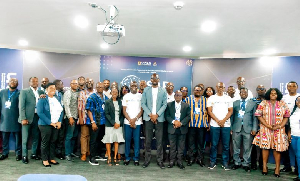
 Some of the stakeholders at the event
The National Identification Authority (NIA) says the increasing use of biometric verification through the Ghana Card will significantly strengthen efforts to curb fraud, eliminate ghost beneficiaries and prevent impersonation in public and private transactions.
The Deputy Executive Secretary of the NIA, Dr Fred Bedzrah, said the Ghana Card’s biometric features, including fingerprints, iris and live facial recognition, provided a robust mechanism for authenticating individuals and ensuring that people received services and payments intended for them.
He said unlike the mere visual inspection of identification cards, biometric verification enabled institutions to match an individual physically present with the biometric identity stored in the NIA database.
Dr Bedzrah was speaking in a media interaction on the sidelines of the Information Systems Academics and Practitioners Forum (ISAP Forum), organised by the Faculty of Information Technology and Communications Studies of the University of Professional Studies, Accra (UPSA).
The forum was held on the theme: “Public Sector Identification Systems for Socioeconomic Development: The Ghana Experience, the Emerging Identity Ecosystem and the Way Forward.”
According to him, impersonation was one of the major avenues through which fraud was perpetrated, explaining that biometric authentication could substantially close that loophole.
“The Ghana Card verification, and specifically biometric verification, means we don’t look at you and use our eyes to judge if you are truly who you are. We match your biometrics that we have in our system to you,” he said.
He added that the Ghana Card also made individuals more visible to the state and legitimate institutions, thereby helping to build trust in transactions.
Dr Bedzrah said the system could also help public institutions eliminate ghost names from payrolls and other government payment systems.
He cited the National Service Scheme as an example, saying persons enrolling onto the scheme were required to undergo NIA verification and would subsequently be verified before payments were made.
He explained that the system could establish whether the person being paid was the same individual whose biometric details were captured at registration.
“If you are not alive, you can’t verify yourself,” he said, explaining that the system also had a liveness-detection feature which prevented the use of photographs or other representations to impersonate a legitimate beneficiary.
He said similar biometric verification could be applied to salary payments and other government transactions to ensure that public funds were paid only to genuine beneficiaries.
Dr Bedzrah also disclosed that the NIA was expanding its identification system to cover children from birth, a move he said would help address future disputes and fraudulent alterations of personal information, particularly dates of birth.
He said the Authority was expected to commence registration of children aged between zero and five years from the following week, complementing the ongoing registration of children between six and 14 years.
He explained that early registration would make it more difficult for individuals to manipulate their dates of birth later in life for purposes such as securing employment or pension benefits.
According to him, the NIA’s objective was to build a foundational identity system that would follow an individual throughout their life—from birth to death.
“We started from 15. We moved to six. We are now going to zero. And then, when we are down to zero, go to death,” he said.
He said the system would also facilitate the deactivation of the identity of deceased persons once their deaths were properly registered and verified, thereby preventing their identities from being used for transactions after death.
On changes to personal information, Dr Bedzrah said Ghana needed to agree on a single authoritative institution responsible for foundational identity attributes such as dates of birth.
He said the maiden forum focused on national identification because identity was fundamental to socioeconomic development.
“It is not about giving out cards. It is about having a strong database that can even inform policy, inform development and other things,” he said.
Prof. Koi-Akrofi said the forum would become an annual platform through which academics, practitioners and other stakeholders would examine pertinent national issues and develop policy recommendations.
He said the current challenge was to ensure that the Ghana Card was effectively integrated into other sectors without creating an over-centralised system.
He endorsed the view that institutions should maintain their own databases while using the NIA as the trusted source for authenticating the identities of persons accessing their services.
The forum brought together stakeholders from the national identification, electoral, data protection, technology and other sectors to examine Ghana’s identification journey, the emerging identity ecosystem and the steps required to maximise its contribution to socioeconomic development.
He said several institutions currently had processes for correcting dates of birth, a situation that could create inconsistencies and opportunities for abuse.
He argued that the NIA, as the foundational identity institution, should be responsible for such corrections, with other institutions relying on the verified information.
He stressed that a person’s date of birth could not legitimately be changed because “you are born once,” although genuine administrative errors in the recording of the date could be corrected after a rigorous verification process.
He said the NIA used documentary evidence, corroborative information and, where necessary, background checks before approving amendments to personal details.
Trusted identity infrastructure
In the keynote address, the Dean of the Central Law School, Prof. Kenneth Agyemang Attafuah, said Ghana’s national identification system should no longer be viewed merely as a card-issuing project but as a critical piece of national digital infrastructure.
He said the real value of the Ghana Card lay in the trusted identity behind it and the ability of authorised institutions to establish with a high degree of certainty that an individual was who they claimed to be.
Prof. Attafuah, who previously served as Executive Secretary of the NIA from 2008 to 2009 and again from 2017 to 2024, said Ghana had travelled from fragmented identification systems towards a foundational national identity infrastructure.
He, however, cautioned against over-centralisation, saying the NIA should provide authoritative identity verification while sector institutions retained their respective statutory mandates and databases.
“The Ghana Card may establish who a person is; it does not decide whether that person qualifies for a pension, health-insurance benefit, driver’s licence, voter registration or passport,” he said.
He therefore called for an identity ecosystem that was interoperable but respected the independence and mandates of institutions.
Prof. Attafuah said reliable identification could reduce fraud and duplication, improve public service delivery, facilitate remote services, strengthen KYC and anti-fraud controls and improve the targeting of social protection programmes.
He said the success of the national identification system should consequently not be measured primarily by the number of cards issued, but by its impact on fraud reduction, inclusion, service delivery and administrative efficiency.
He also called for stronger privacy and cybersecurity safeguards, arguing that public confidence was essential to the successful deployment of digital identity systems.
The Dean of the Faculty of IT and Communications Studies at UPSA, Prof. Godfred Yaw Koi-Akrofi, said the ISAP Forum was established to bring academics and practitioners together to deliberate on critical information systems issues affecting national development and produce recommendations capable of shaping public policy.
AM

Copyright © 1994 - 2026 GhanaWeb. All rights reserved.










