



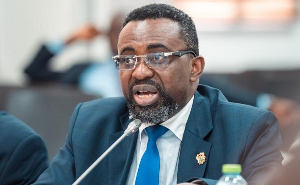
 Dr Johnson Asiama is the BoG Governor
The Bank of Ghana Governor, Dr Johnson Pandit Asiama, has called on the International Monetary Fund to urgently reform its sovereign debt resolution system and expand access to concessional financing,
He noted that current mechanisms are too slow and insufficient for countries facing overlapping shocks.
Speaking at the 2026 African Consultative Group meeting held during IMF/World Bank Group Spring Meetings, Dr Asiama said the Fund must deploy its convening power more decisively to ensure “time-bound restructurings under the Common Framework” with stronger creditor coordination and mandatory participation of private lenders.
The Governor’s statement reflects growing pressure from African policymakers for structural reforms to the global debt architecture, as countries continue to navigate tight financial conditions, elevated debt vulnerabilities and external shocks linked to geopolitical tensions and climate risks.
“African countries continue to face an exceptionally challenging macroeconomic environment,” Dr Asiama said, citing persistent inflationary pressures, weakened external balances and limited fiscal adjustment capacity. These pressures, he added, have been intensified by spillovers from the Middle East conflict.
The Governor argued that while the IMF’s Global Policy Agenda is broadly aligned with member needs, the scale and persistence of current shocks require what he described as a “step-change” in the Fund’s response.
EOCO ordered to withdraw ‘wanted’ notice, stop probe against businessman Kwamigah-Atokple
Central to his proposal is a redesign of the sovereign debt restructuring process under the G20 Common Framework.
Dr Asiama said delays linked to creditor coordination failures continue to undermine adjustment efforts in debtor countries and risk penalising governments implementing reforms.
“Programme design should better distinguish delays stemming from creditor coordination failures from those due to policy slippages, to ensure that strong adjustment efforts are not unduly penalised,” he said.
Ghana’s own experience under the Common Framework illustrates both the potential and limitations of the system. The country entered the framework in 2022 after debt levels approached 90 percent of gross domestic product, leading to a domestic debt exchange and a suspension of external debt servicing.
Compared with other cases, including Zambia, Ghana’s restructuring process moved relatively quickly. Authorities secured an agreement with official bilateral creditors in January 2024, which helped unlock IMF programme disbursements and additional multilateral financing.
The restructuring covered both external and domestic debt, spreading the adjustment burden across creditor groups and contributing to faster progress. However, the process also exposed structural weaknesses, including coordination challenges among creditors and concerns about the economic impact of domestic debt operations.
Dr Asiama’s call for reform reflects these constraints. He noted the need for credible comparability of treatment across creditors and stronger mechanisms to ensure private-sector participation, which have remained a key bottleneck in many restructuring cases.
“This includes scaling up concessional access, institutionalising SDR rechanneling and making the Resilience and Sustainability Trust faster and more flexible,” he said, pointing to the need to address both liquidity constraints and climate-related vulnerabilities.
The call comes as many African economies face tightening global liquidity conditions, limiting access to international capital markets and increasing reliance on multilateral financing. At the same time, rising climate risks and external shocks are placing additional strain on fiscal positions and balance-of-payments dynamics.
A joint statement issued at the meeting’s close by Seedy Keita, Chairman-African Caucus; and Kristalina Georgieva, Managing Director-IMF, emphasised the deteriorating macroeconomic backdrop facing the region.
The statement said global growth is projected as slowing to 3.1 percent in 2026 and 3.2 percent for 2027 under a baseline scenario, with risks tilted to the downside if the Middle East conflict persists. For Africa, growth is expected to reduce from 4.5 percent in 2025 to 4.2 percent in 2026 – reflecting tightening financial conditions, high debt service burdens and constrained access to affordable financing.
“Despite the recent benefits of hard-won stabilisation gains after a strong 2025, growth momentum in Africa is expected to slow down in 2026,” the statement said, adding that the outlook remains uncertain due to elevated debt vulnerabilities and rising development needs.
Policymakers agreed on the need to balance near-term stabilisation with medium-term resilience. Priorities include anchoring inflation expectations, maintaining credible but flexible fiscal policy and protecting vulnerable populations through targetted support.
The statement also emphasised a need to accelerate structural reforms, deepen financial markets and invest in energy and digital infrastructure.
The African Consultative Group further highlighted ongoing reforms to the Low-Income Country Debt Sustainability Framework, noting that enhancements to debt assessment tools are critical in an environment of rising macroeconomic risks and debt-service pressures.
Dr Asiama also highlighted the importance of strengthening IMF emergency financing instruments to ensure rapid support for countries facing acute external pressures.
He said recent global shocks demonstrate the need for “well-resourced and readily accessible emergency financing”.
In addition, he stressed the role of targetted capacity development in improving domestic revenue mobilisation, debt management, public financial management and financial sector oversight, including emerging risks related to crypto assets and cybersecurity.
The Governor’s proposals suggest that without reforms to both the debt resolution system and the Fund’s financing approach, countries may face prolonged adjustment periods and heightened risks to financial stability.

Copyright © 1994 - 2026 GhanaWeb. All rights reserved.










