



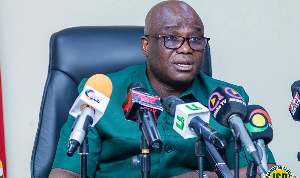
 Eric Opoku is the Minister of Food and Agriculture
Key players in Ghana’s rice value chain have abandoned plans to boycott this year’s National Farmers’ Day celebrations after a conciliatory meeting with the Minister of Food and Agriculture and the leadership of the National Buffer Stock Company.
The decision eases weeks of tension between the rice industry and government, following frustration over market bottlenecks, unsold paddy stock, and policy coordination failures.
The meeting in Accra brought together the Rice Millers Association of Ghana, the Competitive African Rice Platform, rice farmer groups from major producing regions, and allied organisations.
These groups had earlier threatened to withdraw from the celebrations in protest against what they described as persistent neglect of industry challenges.
After the talks, industry leaders expressed satisfaction with government’s immediate commitments and pledged full participation in the celebrations.
They described the engagement as constructive, opening the door to a more coordinated approach to stabilising the rice industry and recognising its role in national economic growth.
Central to the discussions was a situational assessment presented by the industry delegation, which highlighted congestion of unsold paddy in the northern belt, a problem they warned could spread south as harvesting peaks.
Concerns were also raised about weak policy implementation, poor coordination across agencies, unreliable data for planning, and slow adoption of research-driven farming methods.
Agric Minister, Eric Opoku, announced the formation of two committees to address both short-term market pressures and long-term structural weaknesses.
A Rice Purchase Committee will oversee the Buffer Stock Company’s buying programme, ensuring only Ghana-produced rice is procured to decongest warehouses and protect farmers from losses.
Inflation for November drops to 6.3%
A Policy and Strategy Committee will bring together government officials, millers, farmers, and researchers to design a coherent framework for the long-term goal of rice independence.
Mr. Opoku said the move aligns with the government’s Feed Ghana Programme, launched this year to modernise agriculture and reduce dependence on food imports. The programme focuses on expanding irrigation, supporting mechanisation, improving seed and fertiliser distribution, and strengthening market linkages for staple crops, especially rice.
Despite significant growth in paddy output between 2008 and 2020, Ghana still relies on imports for about half of its annual rice needs.
Analysts cite structural constraints including limited processing capacity, high post-harvest losses, and inconsistent policy direction, as barriers to self-sufficiency. Rising import bills, they warn, expose Ghana to global price volatility and erode foreign exchange reserves.
Sector advocates say the renewed government-industry partnership offers a chance to reverse this trend, provided the new committees deliver practical results quickly. Officials at the meeting described the dialogue as a turning point.
Industry leaders echoed that sentiment, expressing optimism that consistent engagement could help Ghana move closer to its long-standing goal of rice independence.
Stakeholders emphasised that credibility will depend on swift government action—particularly in purchasing local rice, clearing bottlenecks, and implementing a robust policy framework.
All you need to know about Ghana's new vehicle number plates | BizTech:



Copyright © 1994 - 2026 GhanaWeb. All rights reserved.










