



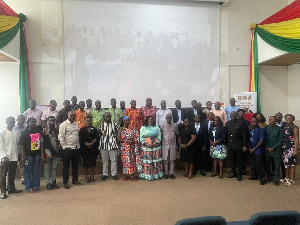
 Some of the policymakers, civil society actors and tax experts in a photograph at the event
The Minister of Gender, Children and Social Protection, Dr Agnes Naa Momo Lartey, has warned that Ghana’s current tax regime risks deepening inequality if it fails to account for the realities of women, particularly those in the informal sector.
Speaking at the 2024 National Tax Forum in Accra on September 10, 2025, she said taxation should not feel like a penalty for survival but rather a tool to support equity and nation-building.
Dr Lartey cited a recent study on Ghana’s personal income tax-free threshold, which revealed that women who represent seven out of ten workers in the informal sector are disproportionately disadvantaged.
Many earn just above the tax-free threshold yet remain far below what is needed to sustain their families, all while shouldering the unpaid care burden of raising children, supporting the elderly and caring for persons with special needs.
“When taxation does not recognize these realities, it risks deepening inequality rather than easing it. For many women, taxation feels less like a contribution to nation-building and more like a penalty for simply trying to survive,” she stressed.
Technical Advisor at the Ministry of Finance, Daniel Nuer, reaffirmed government’s commitment to building a tax system that is progressive, inclusive and responsive to socio-economic realities.
He outlined past reforms, including reliefs for persons with disabilities, VAT exemptions on foodstuffs and medicines and the zero-rating of locally produced sanitary towels in 2023.
He added that government continues to earmark tax revenues for social interventions such as the National Health Insurance Scheme, the Ghana School Feeding Programme and the expansion of the GETFund to cover free tertiary education for persons with disabilities beginning this year.
“Domestic revenue modernization is still the key. As much as we borrow or receive grants, it is what we generate internally that will make the difference in our lives as a country,” Nuer emphasised.
Elsie Appau-Klu, Technical Advisor at the Ghana Revenue Authority (GRA), opposed proposals to exempt sections of the informal sector from taxation.
“No matter how little you pay, it gives you the opportunity to hold leaders accountable,” she argued.
“If you are not contributing at all, how can you demand that your MP or minister fix your road? Even small contributions strengthen our social contract.”
The National Tax Forum, organized by Revenue Mobilization Africa (RMA) in partnership with the Ghana Integrity Initiative (GII), the Trade Union Congress (TUC) and the GRA, was held under the theme “Tax Policies for Social Protection.”
Most school feeding caterers had invalid contracts - Gender minister
As the headline event of the Promoting Tax Equity in Ghana project, the forum brought together policymakers, civil society actors and tax experts to push for policies that link revenue mobilization directly to social protection.
Will Ghana pass the Anti-Witchcraft Bill? Find out in the latest episode of The Lowdown on GhanaWeb TV in this conversation with Amnesty International:



Copyright © 1994 - 2026 GhanaWeb. All rights reserved.










