



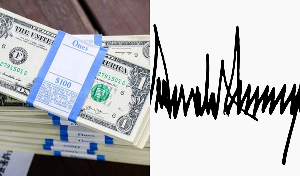
 The United States is set to introduce redesigned paper currency bearing Trump's signature
The United States is set to introduce redesigned paper currency bearing the signature of President Donald Trump from June this year.
This move will mark the first time a sitting president’s signature will appear on American banknotes.
The US Treasury Department announced on Thursday, March 26, 2026, that the move forms part of activities commemorating the country’s 250th anniversary of independence.
The redesigned notes will also, for the first time in 165 years, exclude the signature of the US treasurer, ending a practice that dates back to 1861, when federal currency was first issued.
Gold to drive Ghana's economic reset - Sammy Gyamfi
According to the Treasury, the first $100 bills featuring the signatures of President Trump and Treasury Secretary Scott Bessent will be printed in June this year, with other denominations to follow in subsequent months.
The new notes are expected to enter circulation weeks later as they pass through the banking system.
The US Treasury is, however, still producing notes bearing the signatures of former Treasury Secretary Janet Yellen and former US Treasurer Lynn Malerba, who will become the last in a long line of treasurers to have their signatures on US currency.
The move by the Trump administration is expected to project presidential identity across national symbols, including buildings, programmes, and commemorative assets.
Additionally, a federal arts panel recently approved a gold coin design featuring Trump’s image, although legal restrictions continue to block efforts to place living individuals on circulating coins.
US Treasury Secretary Bessent, for his part, defended the decision, tying it to national pride and economic performance.
"There is no more powerful way to recognise the historic achievements of our great country and President Donald J. Trump than U.S. dollar bills bearing his name, and it is only appropriate that this historic currency be issued at the Semiquincentennial," Bessent said.
What it means for Ghana's economy
While the redesign is largely symbolic within the United States, the move could carry broader signalling effects for global markets, including Ghana.
The US dollar remains the world’s dominant reserve currency and plays a central role in Ghana’s trade, debt servicing, and foreign exchange stability. As such, any policy direction, economic messaging, or perceived institutional shifts in the United States can influence investor confidence and currency flows in emerging economies.
For Ghana, where the cedi’s performance is closely tied to dollar inflows, strong economic signals from the US, such as those referenced by Treasury officials, could reinforce dollar strength.
This may also increase pressure on the Ghanaian cedi, making imports more expensive and potentially complicating inflation management.
MA

Copyright © 1994 - 2026 GhanaWeb. All rights reserved.










